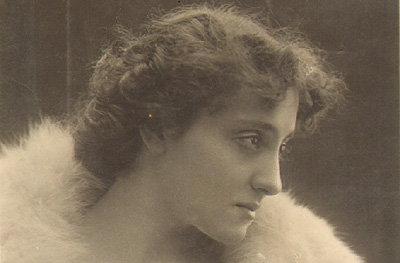
Lyda Borelli

Lyda Borelli
Lyda Borelli

C’era una volta una piccola educanda che voleva farsi monaca. La piccola educanda che aveva aperti gli occhi alla luce dinnanzi allo azzurro del golfo di Spezia nel fortunato giorno ventiquattro, del più fortunato mese di Marzo, del fortunatissimo anno milleottocentottantotto (forse nella sinuosa ed elegante linea del numero otto Paquin trasse l’ispirazione delle sue meraviglie) giorno, mese ed anno che l’Anadiomene aveva certamente protetti e favoriti da un poco della sua schiuma nativa; la piccola educanda aveva forse conservata nella retina impressionabile il grande mistero marino, mistero femminile e riflessivo, il che non è una antinomia, e nella breve anima platoniana racchiuso un mondo ideale, più ideale e più fittizio di quello che doveva calcare col coturno a diciotto bottoni, mondo senza confine come il nativo elemento aspirato nel primo sguardo confuso, mondo un po’ malato, ma tutto vivo di sogni e tutto folle di poesia.

(Secondo altre fonti, la data di nascita è il 22 marzo 1887. I genitori di Lyda, Napoleone Borelli e Cesira Banti erano arrivati alla Spezia poche settimane prima con la loro compagnia teatrale e con la loro figlia Alda, nata a Cava de’ Tirreni nel 1882.)

Forse la piccola educanda non sapeva di nascondere sotto la reticella i biondissimi capelli che un grande signore, il pubblico, avrebbe richiesti d’aiuto per salire sul verone della iperbole ammirativa come il cavaliere errante di Petrusinella; non sapeva di celare nell’uniforme a mostre violette chiare il corpo snello che doveva discendere ogni sera nel futuro da un quadro di Aristide Sartorio, e non sapeva che per completare il ciclo estetico doveva un po’ ammalarsi o far temere d’un male perché l’aureola della grazia si completasse.

Venere, che dell’arte oratoria doveva essere sazia per il contatto delle Muse, volle da un certo Anchise d’Ilio lasciarsi persuadere e ne nacque la gente latina: qual meraviglia se la piccola educanda che voleva farsi monaca si lasciò convincere da un prudente avviso materno?

E dal collegio alle quinte fu breve il passo, collegio allietato da un sogno, e quinte animate da Virginia Reiter, una realtà, quella appunto che poteva ad un’abitudine sognatrice dare l’indirizzo per la realizzazione. La piccola educanda non fece che una comparsa nel seguito della grande attrice e le venne proposto un brevetto di luogotenente nella grande armata da Virgilio Talli Napoleone, col consenso d’Irma Gramatica Recamier e di Oreste Calabresi Murat. Sono troppo note le sorti della grande compagnia del triunvirato che per un sessennio, una olimpiade e mezza di vittorie, percorse l’Italia da conquistatrice. La piccola educanda v’entrò nel secondo triennio, all’epoca del giro trionfale di quella Figlia di Jorio che resterà uno dei più grandi successi d’arte di poesia e di teatro di questo periodo pallidamente transitorio, e quando il triunvirato si disciolse restò con Virgilio Talli nella compagnia senza ruoli assurta a prima attrice interinale per rimaner sola oggi accanto a Ruggero Ruggeri che passerà sotto le spoglie di Parini e di Gringoire nella storia dell’arte drammatica contemporanea.
(Alessandro Varaldo, Fra viso e belletto – Riccardo Quintieri 1910)
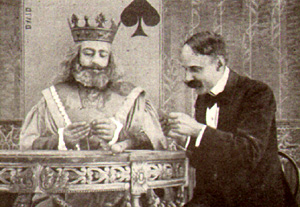
Joueur illusionniste 1903

Joueur illusionniste

Un illusionniste, après différents tours de cartes, fait grandir le roi de pique et joue avec lui.

Une discussion s’élève dans la partie, l’illusionniste le rétablit dans sa forme primitive et le remet dans le jeu.

Il jette ensuite ce jeu sur la table, d’où il en sort un château de cartes immédiatement construit.

Mot. De Code: Acina. Longueur 54 mètres.

Uno dei primi film diretti da Gaston Velle, a destra nell’immagine, alla Pathé. Secondo altre fonti (Georges Sadoul), il titolo è: Métamorphoses du Roi de Pique.

Copia del film alla George Eastman House, 85 ft, 1′ 25” (16 fps).

Oliver Twist Dickens’s Masterpiece on the Hepwix Film

Oliver Twist 1912

London, August 1912. Splendid success have the Hepworth Company made of Charles Dickens’s greatest story, and while everyone, from artistes to operators, is to be most heartily congratulated upon a real achievement in placing this world’s classic on the screen in such a masterly manner, yet we are inclined to give our highest meed of praise to the brain from which emanated the original idea of picturing the moving and human story of the workhouse foundling.

It was an ambitious scheme in the first place, for perhaps of all the great novelist’s works there is not one which needs such a wealth of setting, such a variety of scene and such a close attention to detail as “Oliver Twist.” Every scene, incident, and character in this greatest drama of real life is so intimately familiar to the public, that the least divergence from the story would be a serious drawback to the popularity of the film. That we, as perhaps exceptionally close students and lovers of Dickens, were quite unable to find a flaw in the truth of detail, of costume and of incident, is the best proof we can put forward that “Oliver Twist” on the latest “Hepwix” film is a worthy representation of the “Oliver Twist” that Dickens penned. Can we say more in its favour? We doubt it!

A three-reel film, and when we saw it, running in length to some 3,500 feet, this latest masterpiece of the Denman Street house deals with practically every prominent incident in the novel, from the famous entry of Oliver into the story on the occasion of his “asking for more,” to end effectively and suitably with the reunion of Oliver with the Brownlow family and the heartfelt toast they are shown drinking to future happiness. It would be impossible, and indeed unnecessary, in a review of this length, to attempt to record in detail each sharply outlined scene as the one merges into the other in the pleasing manner which is one of the many likable features of the films of this house. But we must find space to record our high appreciation of the effectiveness of the setting of the scenes en plein air, and more of particularly those showing the scenes on the road to the house at Chertsey where the burglary was committed — where Sikes threatens the shrinking boy beneath the arch of Chertsey Bridge, and ostentatiously loads and primes his pistol to strike fear into his poor little victim — one can almost imagine the actual scene before one. And, be it remembered, that we who write this have to see miles of film every week.

We have referred before to the excellent acting of the characters in this fine film, but we feel that we are not going too far in our eulogy when we say that it is a very long time since we have seen such forceful and yet restrained acting, and such expressiveness of gesture and movement, as are displayed by the actors and actresses in this piece.

This becomes the higher praise when we are forced to add that in our opinion there is a notable tendency to exaggeration in these points with many artistes, a weakness which was perhaps somewhat excusable in the early days of picture plays when the artistes had not become accustomed to the deprivation of the spoken word to aid in their efforts, but which should have become less pronounced, with the greater appreciation of the art of picture acting by the public, and with the immensely increased help given by perfect setting. Even if one could, it is unnecessary to select any special artist for sole mention in a cast which employs only four principal characters, and so we may justly say that Miss Ivy Sillais as Oliver, Miss A. Taylor as Nancy, and Messrs Harry Royston and McMahon as Bill Sikes and Fagin respectively, all employ their opportunities to the fullest possible extent. Miss Taylor, we would add, could not be surpassed in her rendering of the part of the tender-hearted and loyal Nancy.

We look with every confidence to a record success for this really wonderful film, and the exhibitor who secures this ” exclusive ” for his district should be free of the worry of empty seats for at least as long as he is showing it.