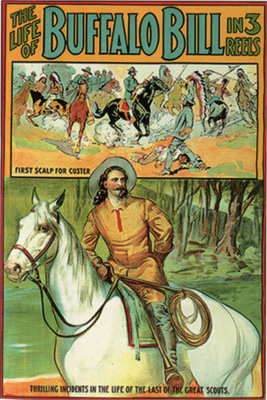
New York, August 1912. Attractive posters have long played the most important part in the proper presentation of feature films. Often companies putting a feature on the market or releasing a feature film, overlook this important part of the business. Instead of making posters of every size depicting many of the important scenes, they have a one and three-sheet posters made for their production, which results in dissatisfaction among the exhibitors. This compels them to buy left-over paper of “melodramatic” days.
To prevent this shortage of paper, the Buffalo Bill and Pawnee Bill Film Company, of 145 West 45th Street, New York City, have provided a full variety of posters for the proper presentation of their great Western three-reel subject “The Life of Buffalo Bill.”
Sunday, July 31, 1927. Chaney in “The Hypnotist” Playing the role of a Scotland Yard detective, Lon Chaney on Wednesday began work in “The Hypnotist,” which Tod Browning is directing. The cast includes Marceline Day, Conrad Nagel, Henry B. Walthall, Polly Moran and Jules Cowles.
Nagel in Chaney’s Support. Conrad Nagel has been added to the cast of Lon Chaney’s next, according to Irving G. Thalberg. It is a mystery story.
Thursday, October 20, 1927. Chaney Title Changed Lon Chaney’s new M-G-M picture will reach the screen as “London After Dark.” It formerly was “The Hypnotist.” Tod Browning directed with Marceline Day opposite.
Sunday, December 18, 1927. Lon Chaney in “London After Midnight” M-G-M Length 5687 ft.
THRILLS AND WEIRD DOINGS IN PROFUSION. FINE ENTERTAINMENT FOR THE MYSTERY LOVERS. PROBABLY A TRIFLE TOO SPOOKY FOR THE TIMID SOUL.
Cast… Lon Chaney is right at home in one of his unusual characterizations. Will please his following. He is ably supported by a competent cast including Marceline Day, Henry B. Walthall, Percy Williams, Conrad Nagel, Polly Moran, Edna Tichenor, Claude King.
Story and Production… Mystery-drama. Who killed Sir Roger Balfour? That’s the mystery propouned in Lon Chaney’s latest chill raiser, a story certain to disturb the nervous system of the more sensitive picture patrons. If they don’t get the creeps from flashes of grimy bats snooping around, cobwebbed bedecked mystery chambers and the grotesque inhabitants of the haunted house, then they’ve passed the third degree. But there’s a sensible and satisfying conclusion to the whole affair that compensates for the early mental tortures. And the ending is too good to disclose so urge the people to see the picture through from the beginning and not to divulge the climax to prospective patrons.
Direction Tod Browning; characteristically good. Author Tod Browning. Scenario Waldemar Young. Photography… Merritt B. Gerstad; first rate.
London After Midnight, titolo italiano Il fantasma del castello, è uno dei “film scomparsi” più ricercati della storia del cinema. Se riuscite a trovare una copia da qualsiasi parte… vogliamo vederlo in tanti.
L’argomento del film è questo:
Siamo a Londra, nel castello Balfour (nella versione italiana: Bradford).
Durante un notte di tempesta i servi sono richiamati da un colpo di rivoltella proveniente dalla stanza del castellano, Sir Roger (nella versione italiana Ruggero), che viene trovato ucciso. La polizia chiamata di urgenza e fatte le indagini del caso, attribuisce quella morte ad un suicidio, tanto più che Sir Roger ha lasciato ha lasciato un biglietto che conferma questa ipotesi. Ma di ciò non è convinta la figlia del morto, Lucille (nella versione italiana Lucilla), che spera un giorno sia posto in luce quanto per lei è un delitto.
Cinque anni sono trascorsi. Il castello è stato abbandonato, e Lucille si è recata a vivere poco discosto in casa di Sir James Hamlin (nella versione italiana James Hibbs), che fu intimo amico di suo padre, e del lui nipote Arthur (versione italiana Arturo) del quale è fidanzata.
Convinta che la morte del padre sia in realtà un assassinio, Lucille ha fatto chiamare un celebre criminalista, Edward Burke, noto anche per i suoi esperimenti ipnotici, e lo incarica di fare luce sul mistero. Burke si mette subito all’opera.
Intanto si è sparsa la voce che nel castello abbandonato sono comparsi gli spiriti. C’è chi ha veduto nottetempo la figura di un uomo aggirarsi intorno al castello, in compagnia di una donna. La coppia aveva uno strano aspetto… due mostri, due fantasmi!
Burke non bada più di tanto a questa storia di fantasmi. Dopo le prime indagini è convinto anche lui che la morte di Sir Roger è in realtà un assassinio. I suoi sospetti cadono in Arthur, il fidanzato di Lucille, ed una notte si reca nella sua camera per tentare di fargli ricostruire, sotto ipnosi, la scena del delitto. Ma è tutto inutile, Arturo è innocente.
Nella camera al buio, Burke riflette sul modo di proseguire le indagini sdraiato sul letto al posto di Arthur che dorme il suo sonno ipnotico poco discosto. Ad un tratto un’ombra si profila vicino a lui ed egli vede brillare la canna di una rivoltella. Rapido come un baleno, Burke trae la sua e spara, ferendo l’ignoto che riesce comunque a dileguarsi.
Qualcuno ha tentato di uccidere Arthur, pensa Burke, chi può mai avere interesse a sopprimerlo?
Il suo dubbio si rivolge ora a Sir James, zio di Arthur. Egli tenterà, servendosi di un esperimento di far sì che se l’assassino di Sir Roger è lui, debba rivelarsi.
Intanto, i fantasmi del castello hanno rapito Lucille, e di essi è diventato pure prigioniero il fidanzato che è accorso per liberarla. La notizia riempie di terrore Sir James che si sente attratto, come da una forza misteriosa, ad accorrere al castello.
E vi accorre, suo malgrado, vinto dalla forza magnetica di Burke che aveva montato tutta la storia dei fantasmi. Era lui il pauroso personaggio scorto di nottetempo, la sua compagna era Miss Luna, un’attrice di varietà, sua amica, e gli altri fantasmi non erano che poliziotti truccati.
Burke spiega a Lucille il suo piano. Uno dei poliziotti si truccherà in modo da rievocare le sembianze del defunto Sir Roger, e la stessa Lucille si vestirà con uno degli abiti di cinque anni prima per accogliere Sir James.
Quando Sir James arriva, nel sonno ipnotico, ripete quanto ha fatto anni prima, svelandosi finalmente come l’assassino.
Nella sera lontana del delitto, Sir Roger aveva chiamato presso di sè l’amico, comunicandogli che lo aveva nominato tutore di Lucille, nel caso della sua morte. Sir James si era detto felice di ciò, tanto più che era innamorato di Lucille e voleva sposarla. Ma questa confessione aveva fatto cambiare parere a Sir Roger che non desiderava affatto il matrimonio tra la figlia ed il vecchio James. Quest’ultimo allora, infuriato, aveva sparato su di lui.
Egli era anche l’autore della tentata uccisione del nipote, suo rivale.
Il mistero, dunque, è chiarito. Burke assicura James alla giustizia e rientra presso di sè. Dopo qualche tempo Lucille ed Arthur si sposano.
Mr. Gaston Melies, who is seeking the unusual and as yet unpictured local color of the South Pacific, has with Mrs. Melies and his company, reached his first stopping place al Papette on the Island of Tahiti, one of the Society Islands, known once as the Sandwich Islands. What a golden mine of romance is waiting for this adventurous picture maker! It was in this neighborhood that Robert Louis Stevenson lived for so long and where so main of his best romances were written. It has been said that here is romance’s last great stronghold and that it can be found nowhere else on earth as here.
There are stories like fairy tales of strange gods and of magic, and there are stories of beautiful Polynesian princesses (they usually have a hibiscus flower in their hair) who swim like mermaids. There are also stories, quite historical, of great warriors and heroic deeds of valor, of gun-runners, of diplomatic intrigues, of treasure hunters, and no one before this has been on the spot nor dared to make pictures of island life; because they lacked the local color. Mr. Melies has had the boldness and is likely to reap the rich harvest that is waiting for him.
Of course, to take a large party (there are sixteen players and operators) on so long a trip is a very expensive undertaking. They intend to take pictures in many parts of New Zealand after leaving the South Sea Islands, and before they return they will have crossed Australia and taken pictures in Java, where the life and customs are radically different, in India and elsewhere. The pictures that Mr. Melies intends to produce will include dramas and comedies as well as educational films. A taste of the life of these strange lands will be in the dramas and in them will probably be shown the life and experiences of white settlers with natives around them. The educational films will be of great value. The purely native life in many of these out-of-the-way corners of the world is fast changing into a hybrid life. To catch what may still be found of ceremonies and customs of the simple South Sea Islanders is as worthy a work as can be found for a motion picture camera. We have no doubt that it will repay Mr.Melies many times over, although he expects that the trip will cost something like $200,000.
These pictures that he will take, in all probability, rise above an unfortunate condition of the picture market that producers have found it hard to contend with. This difficulty is the purely local popularity that certain types of pictures have found. It is, perhaps, more noticeable in the type of picture called “Western,” the picture exploiting cowboy and Indian life. These are very popular in the South; but are not very acceptable to spectators in the Northwest nor on the coast. The picture of any kind that will be liked abroad is seldom the best kind of picture for American audiences. Hut pictures of life in the South Seas, of life in New Zealand, of life in the Dutch provinces, of Java, of India and Ceylon, etc., will have so great an interest that they will find no hindrance in local requirements, but will appeal as strongly to Americans as to Europeans; they will also appeal to the cultured and the unlearned, for both will find entertainment and the best instruction in them. Things that are new and strange, yet true, are greatly desired. If such are not to be found in the South Sea Islands and in Java, where on this earth, except in Thibet, will they be found? We are looking forward with the greatest eagerness to the releases that the travelers will send back, like letters home, to us. Perhaps the first, which will be sent from Tahiti, will be released late in September.
The purely educational films will be made by George Scott, who has managed the Melies factory for many years. He will travel much alone, taking with him only a carrier to help with the apparatus, and may make adventurous excursions “into the interior” for special films. We hope he will be adventurous not too adventurous. It would be too bad to lose one’s life for a picture. Then, also, some good films may be lost, if a headhunter chief should become very much irritated, for instance.
The dramatic stories will be prepared by Edmund Mitchell, about whom “Who’s who” has a long paragraph. Mr. Mitchell is a much-traveled man and has written a shelf full of novels, as well as guide books, etc., to parts of India. He is thoroughly familiar with the islands in the South Sea and with Australasia, and has written many able articles about them. Among his novels are “The Temple of Death” a story of Bombay and Central India, and “The Lone Star Rush” a story of western Australia. These, with many other works of fiction by this author, have, according to competent critics, strong plots and vivid local color. Mr. Mitchell’s presence with the company promises stories that will be very well worth while.
Besides these two men the full troupe consists of Bertram Bracken, the director; Hugh McClung, dramatic operator; Gustave Henschen, photographic operator: Samuel Wiel, stage manager; John Ortega, master of transportation: Henry Stanley, characters: Wm. Ehfe, juvenile lead; Ray Gallagher, heavy: Leo Pierson, juvenile; Miss Mildred Bracken, juvenile lead: Miss Fanny Midgley. character; and Miss Hetty Tracy, ingenue. The photograph printed herewith shows the party on the ship Manuka, just before sailing.
By Hartford C. Judson (Moving Picture World, August 24, 1912)