Notizie luglio 1927

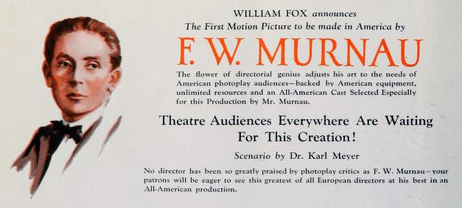
Pubblicità della Fox

Aurora di F. W. Murnau

Attualmente in Hollywood, il geniale regista tedesco F. W. Murnau ha finito di girare un film che costituisce una meraviglia anche per quella città abituata a tutte le meraviglie cinematografiche.

Questo film è tratto da una novella di Sudermann dal titolo Viaggio a Tilsit. Il produttore William Fox, affidando la regia a Murnau, ha dichiarato che non avrebbe imposto nessun limite al finanziamento del lavoro. Qualunque fosse stata la somma necessaria, tale somma egli l’avrebbe avuta senza discussione. Il lavoro avrebbe dovuto essere costruito in un’atmosfera di completa indipendenza e libertà d’azione.

Aurora (Sunrise) infatti è considerato a Hollywood come un film eccezionale. Sotto la direzione di Rochus Gliese, direttore tecnico del film, è stata costruita una intera città per l’esecuzione delle scene principali, e tale costruzione, cinta da un alto muro e nascosta agli occhi del pubblico, ha talmente incuriosito i tecnici delle case concorrenti che in ogni modo hanno tentato, anche facendosi passare per comparse, di varcare il confine oltre il muro, ma sempre invano, data la grande sorveglianza.

Questa città del film Aurora è chiamata a Hollywood col nome fantastico di Città di Nessun Paese. Nei giorni delle riprese, mentre il film era in lavorazione, era popolata da migliaia e migliaia di comparse. A lavoro ultimato, essa sorgeva come il fantasma maestoso di qualche città abbandonata da un popolo disperso, dopo chissà quale guerra o catastrofe.

Vicino alla città vi è un Luna Park completo con tutte le attrazioni e più moderni divertimenti, come quelli che possono visitarsi attualemente in molte città americane.

Murnau spiega che Aurora è “il film dell’armonia”, anzi “la sinfonia di due cuori”.

Cattive abitudini

Al Cinema Corso di Milano si è rappresentato con grande successo, molto significativo dopo una serie di passaggi di films senza gloria e senza eco di particolari trionfi, Vita da cani, film First National interpretato da Charlie Chaplin. Non è per rilevare quanto valente sia stata l’opera dell’artista nel realizzare il film che stendiamo questa nota; il suo valore, del resto, è sufficientemente messo in rilievo dal fatto che i sei anni di vita non si avvertono punto, mentre conosciamo altri lavori già vecchi prima ancora di nascere. Ma è per mettere in evidenza un’usanza poco lodevole di alcuni cinematografisti italiani.

Il film in parola è stato formato nell’edizione italiana con l’unione di due distinti lavori di Chaplin: Shoulder arms e A dog’s life. Possiamo anche dire che una certa discrezione è stata usata dal riduttore, per cui le due parti solo da un tenue filo sono collegate, evitando tale tenuità dannose interferenze nell’opera d’arte; ma questa attenuazione non è però sufficente a cancellare la cattiva impressione che si riporta nel constatare l’eccessiva libertà che nei confronti di opere straniere si prendono i concessionari o i riduttori italiani.

Il lancio del film, poi, è stato effettuato con grandi richiami alla: Grande Parata di Charlie Chaplin. Questa pubblicità, insistente sul successo di un altro eccezionale film, è, per lo meno, di dubbio buon gusto.

*Una donna di Parigi al Cinema Nazionale di Torino

A parte i tagli non sempre intelligenti, questo film di Charlie Chaplin è un capolavoro. La maestria del realizzatore e il suo acuto spirito d’osservazione, sempre vigile, anche nella sintesi, si revela appieno. Enumerare tutte le finezze del lavoro sarebbe troppo lungo e forse stancherebbe il lettore. Valga per tutto quello che si potrebbe dire, questa amara constatazione: il pubblico torinese non è ancora all’altezza dello spettacolo cinematografico d’arte e forse hanno ragione — commercialmente parlando — coloro che continuano a propinargli i soliti zibaldoni. Sino a quando?

Un’altra finezza del film è il procedimento tutto nuovo usato dal Chaplin per sottolineare e dare ad una determinata scena il significato voluto.

A lui non basta creare una situazione, ma vuole anche commentarla; e per commentarla si vale di uno specchio, la maschera facciale d’una figurazione, che nella scena è spettatrice, mostrando l’impressione che sull’animo suo la stessa scena produce. E quale maestria dimostra anche in questo espediente, il Chaplin! Anziché dettare alla figurazione — una masseuse svedese biondastra, angolosa, inespressiva — atteggiamenti artificiosi, ce la presenta impassibile. E il volto di quella proletaria, a contatto d’un mondo che le dà il pane e che forse odia, mentre guarda ora l’una ora l’altra delle due interlocutrici, è forse più espressivo, nella sua inespressività che quattro pagine di romanzo.

Charlie Chaplin, Adolphe Menjou e Edna Purviance sono tre nomi che dicono, per sè stessi, più di qualsiasi elogio; Carlo Miller, nella parte di Paolo Millet, ha saputo mantenersi all’altezza che la situazione gli imponeva. Non v’è, in tutto il film, un gesto inutile, una sola volgarità. Tutto è mirabilmente tenuto in bilico su quel filo di spada sul quale cammina l’Arte, per non cadere nell’istrionismo.

La messa in scena non è lussuosa: non è neppure elegante. È appena adeguata. Un direttore che sia veramente artista, non si lascia prendere la mano dall’achitetto.

La fotografia è nitida.

*In tutte le fonti d’epoca il titolo italiano del film di Chaplin è Una donna di Parigi.
 

Industria del cinema in Italia nel 1915

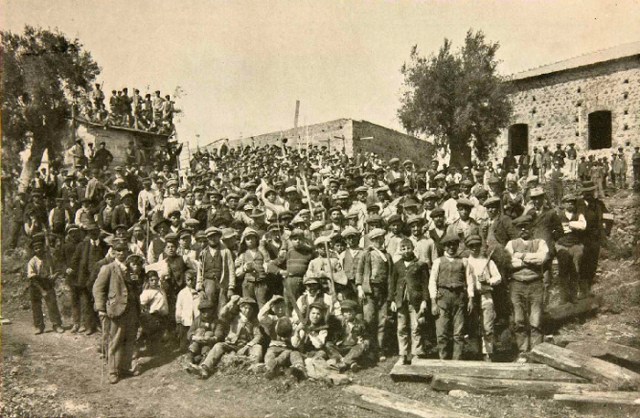
Maestranze dell'Etna Film di Catania (1915), prima della chiusura dello stabilimento.
Maestranze dell’Etna Film di Catania (1915), prima della chiusura dello stabilimento.

Si calcola che, in Italia, vi siano poco più di 1500 cinematografi. Il primato corrisponde a Torino che ne ha 68. Segue immediatamente Roma con 49, indi vengono: Milano con 40, Napoli con 31, Genova con 29, Bologna con 22, Firenze con 21, Venezia con 19, Palermo con 18, Catania con 17, Bari e Livorno con 12, Pisa con 10, Brescia e Sampierdarena con 9, Benevento, Padova, Perugia, Taranto e Treviso con 7, Alessandria, Bergamo, Mantova, Messina, Modena, Rivarolo Ligure, Savona, Spezia, Varese, Verona e Vicenza con 6, Ancona, Avellano, Ferrara, Lecce, Macerata, Parma, Pavia, Torre del Greco e Trapani con 5.
 Seguono centri minori, con una popolazione che non supera i 30 mila abitanti, in ciascuno dei quali si contano meno di cinque cinematografi.

I nomi più comuni sono: Edison, Moderno — comunissimi questi due — Massimo, Excelsior, Pathé, Lumière, Radium, Splendor, Iride e Ideale. Non mancano in alcuni paesi e piccole città di provincia, cinematografi privi di nome: si chiamano, semplicemente, “Il Cinematografo” e non è possibile confonderli con gli altri, chè, là, dove si trovano, di cinematografi c’è uno solo.

Le case di produzione sono 78. Soltanto Roma ne ha 24, Torino ne ha 22, Milano 11, Napoli 8 e Genova 7. Numericamente porta il primato la capitale, ciò non toglie che Torino debba sempre considerarsi come il principale centro cinematografico d’Italia, dato che le sue 22 case producono almeno per il doppio, in confronto a quelle di Roma.

I noleggiatori regionali sono ben 454 — quelli generali non superano la quarantina — 82 dei quali si trovano a Milano, 77 a Torino, 74 a Napoli, 65 a Roma e 37 a Genova.

Si contano infine, 19 pubblicazioni professionali, tra riviste e giornali, 10 associazioni diverse e 9 scuole cinematografiche.

Non ho trovato nessuna statistica sul numero dei lavoratori: artisti, tecnici, maestranze, ecc, ma non c’è dubbio, viste le altre cifre, che dovrebbe essere abbastanza consistente.

Tutto questo prima del fatidico 24 maggio 1915 che segnerà l’entrata dell’Italia nella Prima Guerra Mondiale.

Mr. Ambrosio comes to America

Arturo Ambrosio
Arturo Ambrosio

November 6, 1909. The trade-mark of “Ambrosio” having appeared on so many of the best films issued by the independents during the past year, great was our pleasure to be honored with the first private interview with Arturo Ambrosio, the head of the Ambrosio Company at Torino, Italy, on the first day of his arrival in this country. Whenever we have been fortunate enough to see any of the Ambrosio productions on the screen we have marvelled at the originality of conception, the thoroughness of execution and the daring flights of imagination, and have wondered what manner of man it was who directed these finished specimen’s of moving picture art.

Ambrosio — Arturo Ambrosio — the name which has been the opening gun, the slogan of the independent exchanges, is a man rather below the average stature, alert in action, pleasant in personality, and primed with enthusiasm as to the possibilities of the art of moving picture making. For Mr. Ambrosio considers it art and treats it as an art, and the early part of our interview was mainly on these lines and the effect it was having and would have on other arts. The interview had not progressed very far before we were fully convinced of the fact that Mr. Ambrosio’s ambitions were entirely different from those of many who have drifted into the moving picture game. Said he: “Our aim is to produce the most impressive, most realistic and technically perfect pictures within the bounds of human ingenuity and genius.” How different from the ambitions of those whose aim it is to make and sell the most film!

“Mr. Ambrosio, will you tell me how long you have been making moving pictures and something about your studio?”

“The firm of Ambrosio, of which I am — what you call it — chief stockholder, has now been doing business for five years. That we have prospered is largely due to my partner, friend and chief aide, Mr. Gondolfi. We have a glass studio 120 feet in length, but much of our work is done under the sunny skies of Italy. We have thirty trained artists in our steady employ, besides scores of supernumeraries. We are a little artistic colony, with entree into the most select circles in Italy, and Italy’s best dramatic talent at our disposal.”

“Mr. Ambrosio, we have seen and admired much of your work. May I ask why you have come to the United States? Are you not satisfied with the sales of your product in this country?”

The answer was an expressive shrug and “I come to see for myself and study the tastes of your people. I want to know why it is that the American selections from my output are not those which I consider my best, nor even those which I consider best adapted to the general public.”

“Mr. Ambrosio, why do you think our people should buy more of your pictures? We have our own manufacturers here who can supply the demand.”

“I believe our productions are the equal, if not the superior, of any in the whole world. I see the work of others. Your American pictures come to my country. We enjoy them. They are so delightfully fresh, and some of them are now even becoming artistic. No, I do not wish to criticise the work of your manufacturers or their art, or lack of art, but the superficial nature of much of the output is apparent. Is it from lack of effort and concentration, or lack of ambition, or is it because they do too much? At any rate, they seldom seem to rise above a certain level. Understand me, I am not making a comparison. I have not yet seen enough of your work to judge.”

“Mr. Ambrosio, the manufacturers of this country may be said to work to a schedule. They have to supply a regular output, released on stated days. It sometimes happens that circumstances will delay a certain subject and a manufacturer may have to rush out some simple production to fill his orders. Working to a schedule is not conducive to art, but our American system of standing orders is a sound business basis for the manufacturers to work upon and it has not interfered with the quality, which has materially advanced and is advancing. Do you have a regular output and regular release days?”

“No, we have no fixed output. In Europe this is governed by the demand, and the demand is governed by the quality. We may make one picture a week, or three a week, or we may spend weeks or months on a production, but we always have on hand an ample supply of finished negatives to meet any demand. Take, as an example, our ‘Nero,’ which you have seen. This was made months ago, and its date of issue in Europe is October 28. It is one of a series of spectacular subjects which we call the ‘Golden Series.’ Others of this series are ready, and some of them will far excel ‘Nero’ in my estimation. Yes, we adhere to a uniform release date in the various countries, as far as possible. Films are sold by sample in Europe, and up to now we have taken orders for 342 copies of ‘Nero.’

“Mr. Ambrosio, you have mentioned ‘Nero’; this picture must have cost you much money and much hard work.”

“Money! There you are! American — Money. Money — American. We do not take cost into consideration in making our pictures. We set out to attain a desired result — and we get it. We rehearse and rehearse and take and re-take scenes until I am satisfied we cannot do it better. And work? Yes, we work. I seldom ate or slept while this same ‘Nero’ was being produced, and if I did sleep 1 dreamed ‘Nero.’ Yes, we work until we perspire, and I can tell you that after directing the scene of the burning of Rome I almost collapsed.”

“Do your sales in Europe warrant the expense and effort you put in your work? In other words, if the American market was closed to you, could you afford to do things so elaborately?”

“No, not on the European trade alone. We would barely come out even. That is one reason why I am here. We need the support of the whole world to give the world the best that can be produced in motion pictures. My correspondence and not my vanity leads me to believe that more Ambrosio films can be sold in America. And we need the money to expend in making still better pictures.”

“Mr. Ambrosio, that leads up to the question, Who is your representative in this country?”

“Messrs. Raleigh & Robert, of Paris, are our exclusive agents for every country except Italy and Spain.”

“Did you ever have any direct dealings with the International Projecting and Producing Company of America or its president, Mr. Murdock?”

“No. I had a letter from Mr. Murdock during his recent visit to Paris, saying that illness prevented him from visiting our plant. Here it is. I have never met Mr. Murdock, but I hope to have that pleasure.”

“Are Raleigh & Robert still your agents, or have you come here to make other arrangements?”

“Raleigh & Robert are still our exclusive agents and will be until I announce to the contrary.”

This ended a very interesting chat. The following day we again saw Mr. Ambrosio in the presence of a representative of the “Billboard” and of the “Dramatic Mirror.” His attention was called to an advertisement published in a trade paper, dated October 9, stating that a certain company had exclusive control of his films in this country.

Mr. Ambrosio emphatically denied the right of anyone to make such a statement, and at the suggestion of the “Billboard” representative gave out a signed statement that Messrs. Raleigh & Robert, and through them the Film Import and Trading Company, of this city, were the only concerns authorized to handle his output in America.
(Moving Picture World)