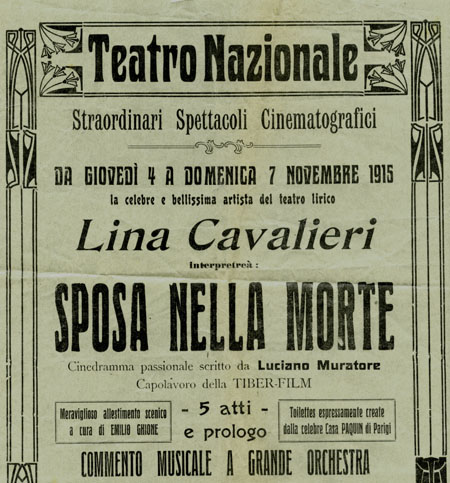
Cronaca Romana. Sposa nella morte della Tiber-Film al Teatro Nazionale.
Semplice è la trama del lavoro: Elyane e Pierre Marsant sono studenti all’Accademia di Francia, a Villa Medici, a Roma, dove cominciano a intendersi ed amarsi. La reputazione di geniale artista, dal fine sentimento, che gode Elyane, la introduce prima, e la rende habituée poi, in Casa Cenci di Vallalta. Qui, il Duca Alberto, con la facilità degli aristocratici amanti, e con il pervertimento delle nature calcolatrici, sottilmente ironiche e volontarie, s’induce a spingere Elyane a correre con lui l’avventura galante, con la lusinga di farla duchessa. Elyane troppo giovane e inesperta e forse non ancora dischiusa al vero sentimento dell’amore, sposta abbastanza facilmente il suo cuore, che da Pierre Marsant, affettuoso e passionale, passa al duca Alberto Cenci, di animo meno genuino, ma più conquistatore.
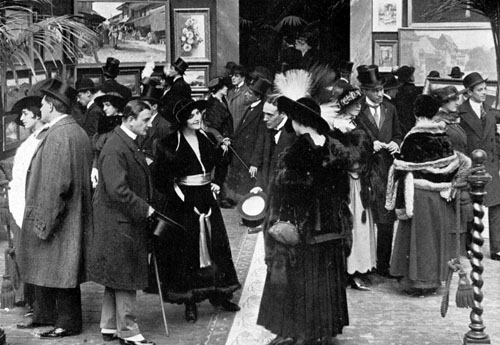
La fuga dei due a Parigi, una breve vita mondana, il trionfo ottenuto al Salon da Pierre Marsant, per un quadro da lui esposto: « Remember », il fortuito incontro dei due avversari, la partita d’onore che avviene fra loro con la conseguente ferita riportata da Pierre Marsant, l’attitudine di cinismo che, in tale circostanza, dolorosamente sentita da Elyane, assume il duca Cenci, tutto induce la donna a un ritorno verso un passato e un uomo, meno promettenti, ma più datori di pace e d’affetto.
Così, anche la pietà e il rimorso di Elyane, dopo essersi manifestati nella devozione al capezzale di Pierre, durante la malattia di lui, spingono la donna ad offrirsi all’amante genuino. Qui ha luogo la scena, non priva di effetto, sebbene più efficace sarebbe stata se più sostenuta, in cui Pierre, prima respinge, poi accoglie tra le braccia la bella indimenticabile Elyane. Ma l’ombra del passato si frappone tra i due, e il pittore Marsant fugge a Roma, lasciando a Parigi Elyane.
Però troppo sinceri erano la pietà e il rimorso di questa, troppo viva, anche, doveva essere in lei la nostalgia dei primi passi di vita del primo ambiente, il solo che fu veramente amico, conosciuto nella consuetudine di Pierre, buono e leale, perché la donna potesse consentire al gesto di Pierre allontanatosi da lei. Così ella lo raggiunge a Roma, determinata a divenire sua sposa.
Senonché, troppo repentine erano state le vicende perché il cuore della donna avesse potuto risollevarsi dal passato, e liberarsi dal suo male verso una visione di bene, sotto un impulso nuovo di passione purificatrice, per questo, Elyane, alla veglia del gran giorno di nozze, si libera dal dualismo del suo cuore agitato, mettendo fine ai suoi giorni. Indimenticabili le ultime scene, gli ultimi quadri, pieni di quella predestinazione che incombe su tutto; che si esprime nella magnificenza, nella ricchezza intorno profusa, nella serenità immobile, estatica della bella Elyane, già determinata per il suo gesto.
Questa la trama, semplice nella sua originalità, del lavoro che ha dato modo al pubblico di vedere Lina Cavalieri assumere tutti gli aspetti e tutte le sfumature dell’idillio, della gioia semplice e buona; della passione, della pietà, del rimorso e del doIore, come della rigenerazione, dopo il fallo.
La Cavalieri è stata ed è, fra le donne romane, quella la cui fama è mondiale. La sua bellezza è conosciuta ovunque. La sua immagine è fra le più note e diffuse. Al contrario, le legioni dei suoi ammiratori e delle sue ammiratrici rare volte l’hanno vista e conosciuta di persona. Quando la fortuna le arrise improvvisa e dalle piccole e modeste scene del famoso teatro trasteverino fu lanciata nel gran mondo, ella soggiornò per brevi periodi in Italia e a Roma, sicché mentre la fama della sua bellezza si rivelava attraverso le centinaia e migliaia di fotografie e di cartoline, che ne riproducevano l’immagine deliziosa, ella era lontana. Oggi il cinematografo dà a tutti la possibilità di veder vivere, in una illusione che si avvicina alla vita, questa artista che ai più era nota soltanto nella immobile grazia di una posa fotografica, ed ecco, che in ciò sta il successo assicurato della film novissima.
A renderlo completo la Tiber ha poi contribuito componendo una film mirabile per la parte fotografica e per la parte scenografica, e Lina Cavalieri, dal canto suo, ha voluto aggiungere al fascino della sua presenza, come protagonista nella favola ideata da Luciano Muratore, un atto di squisita e delicata bontà per i nostri soldati feriti, in favore dei quali è stata devoluta una parte degli introiti delle rappresentazioni datesi, per la prima volta in Italia al Teatro Nazionale.
Sicché questa Sposa nella morte, che ha vivamente incontrato le simpatie ed il plauso del nostro pubblico, ha dato anche modo di compiere una simpatica opera di amore per i nostri fratelli che, combattendo, sono stati colpiti sul campo.
Per la cronaca aggiungeremo che le proiezioni della bella film sono state riprese, non appena terminate al Teatro Nazionale, ai Cinema Moderno e Regina, contemporaneamente.
Ciò che avvalora il nostro giudizio, lusinghiero nella sua spassionata sincerità.
(La Cinematografia Italiana ed Estera, 15 e 30 novembre 1915)
The Shadow of Her Past.
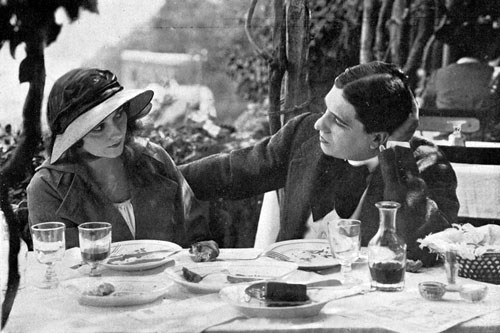
The combination of the name of Lina Cavalieri and the title, “The Shadow of Her Past,” should make this five-reel Pathe Gold Rooster Picture play a box office attraction of some strength. The picture without a name like that of the famous grand opera prima donna in the cast, and acted as badly as this is would have but little chance, but in this case it will be the combination of star and title that will draw. Lucien Muratore, the husband of the incomparable Lina, is featured in the picture and some of the advance announcements have stated that he supervised the making of the feature. If that is the case Mons. Muratore had best stick to grand opera, for there will be little or no chance for him as a movie director. The story deals with the love and adventures of two students abroad. The girl studying music is an American and the youth who has gone in for art is evidently a foreigner. They win the highest honors in their respective branches and fall in love. In Rome, where they have gone to continue their studies the girl becomes a social favorite, and although betrothed to her fellow worker, she is blinded by the social thing. When a young Duke proposes to her she immediately forgets poor Peter the artist and plans to elope to Paris. The Duke’s proposal did not, however, mean marriage, but once in Paris it was too late for the girl to back out. In Paris she is quite in the social swim, and even though she is the Duke’s mistress and is generally recognized as such, she is invited to all the big affairs of the season.
Peter in the meantime cannot forget and so he paints a picture of himself and the girl watching an Italian landscape. The picture is sent to Paris for the exhibition and wins the gold award. The girl sees it and as it is entitled “Don’t You Remember” she naturally has to remember. The Duke noting her interest in the picture but unable to recognize her, although everyone in the audience could, tries to buy the picture and the artist orders him out. The Duke is “insult” and a duel follows, with Peter as the victim. Hearing he is wounded, the girl rushes to his side and nurses him and eventually a reconciliation is effected, but at the last moment, when Peter is willing to marry her, in spite of her past, she commits suicide. Now it doesn’t follow that that would be the case in real life, for at least it is evident that some portions of the picture are founded on the fact of a romance in the life of one of the principals and as it is quite evident the girl did not commit suicide. The feature was evidently produced abroad. Its settings are exceedingly lavish and very well done and that can also be said of the photography, which in this particular picture has an exceedingly stereoscopic effect. But as to its direction and tho acting, the least said the better. Lina Cavalieri looks as handsome as ever and wears clothes very well indeed and at one point in the picture does a very graceful dance. Mons. Muratore was at his best in the dueling scene, where his actions after being shot resembled a man in swimming and it was one of the best laughs in the picture, although not Intended for comedy.
Fred
(Variety, July 21, 1916)
“The Shadow of Her Past”
Pathe Gold Rooster Play Features Lina Cavalieri.
Reviewed by Thomas C. Kennedy
The name of Lina Cavalieri, the star of the Pathé Gold Rooster play released this month, will doubtless attract large attendance at the picture houses where “The Shadow of Her Past” is on the program. Lina Cavalieri, operatic soprano, has been called the most beautiful woman in the world, though this is a distinction she shares with other present day beauties. However, the fact remains that she is a strikingly beautiful woman and her charm of feature and form can be appreciated by the spectators viewing “The Shadow of Her Past.”
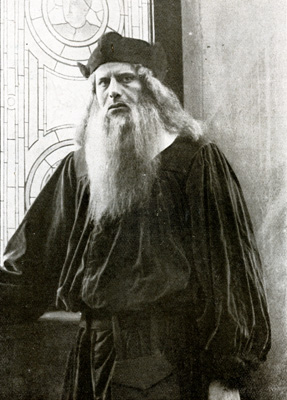
Lucien Muratore, also of some renown on the operatic stage, plays opposite the star. The production was made under his direction, and he must be praised for giving the story a handsome setting. In the role of the artist M. Muratore is not highly successful. In a cast whose every member over-acts most of the time, he is the chief offender against the golden rule of natural restraint. When he is wounded in the duel with the Duke the emotion, and the pain, he feels is expressed with much physical effort, and it will not be surprising to learn that a laugh or two were created by it at every showing of “The Shadow of Her Past.”
The story is a love romance which profits much generally by the tragic ending it has been given. The story is good. It bears up well under the strain put upon it by the players, who over-do their parts greatly. “The Shadow of Her Past” is the romance of an American girl who goes to Rome to carry on her study of music. Her meeting with a painter of great promise is the beginning of a deep, noble love which prospers until Elayne meets with success as a musician.
She is feted by society and her head is turned. A Duke is attracted by her beauty and she casts Peter aside for the nobleman. To her sorrow she discovers that the Duke has no intention of marrying her. Circumstances bring the Duke and Peter to hatred and a duel, in which the artist is seriously wounded. Elayne nurses him back to health and they are about to marry when she realizes that she cannot really belong to him in life, and she dies from the effect of a self-administered poison.
The story plays in Rome and Paris. There is a strong Latin flavor imparted to the picture both by the story, the settings and players. Both interior and exterior settings are exceptionally good. Many of the outdoor scenes are rarely beautiful.
(Motography, July 29, 1916)
Cavalieri Once Earned Twelve Cents Per Day
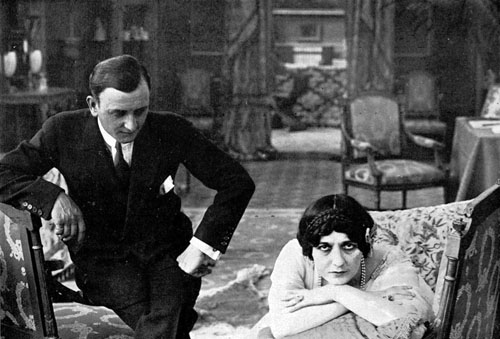
Lina Cavalieri, who is featured with Lucien Muratore in the Pathe Gold Rooster play, “The Shadow of Her Past,” released July 17, has had a very eventful life. When scarcely twelve years old she folded papers in the mailing room of a daily paper for a few cents a day. Her great beauty attracted the attention of Prince Sciarra, who thought so beautiful a girl should be given a chance and through the mailing room foreman, offered to pay for her education. It wasn’t long before her beauty aided by her voice and acting ability had all Paris at her feet.
(Motography, August 5, 1916)
Cavalieri Strong Box Office Attraction.
That the box office angle is sometimes lost sight of by the newspaper reviewers of a picture is shown by the success of Pathe’s “The Shadow of Her Past,” in which Lina Cavalieri and Lucien Muratore are starred. The fact that the picture was made abroad overshadowed in the reviewers’ minds the wonderful drawing value of Cavalieri “the most beautiful woman in the world.” For a number of years the famous opera singer has been one of the most talked of women in both Europe and America. Every American has read of her; to every American she is more than a name. That vast publicity has money value to the exhibitor, regardless of the locality in which the picture was filmed. The reviewers, being critics and not exhibitors, in many cases “damned it with too faint praise.” It was “foreign.” “the actors gesticulated too much,” “the story was hackneyed.” etc. etc.
Exhibitors, however, saw the opportunity for effective advertising. They clamored for “The Shadow of Her Past,” played it up strong and then reaped a harvest. The crowds came, liked the picture, and spoke about it to their friends. Bookings of three and four days were lengthened to a week. The result was that many a house record was broken and the exhibitors reaped and are reaping a harvest.
(Moving Picture World, October 21, 1916)
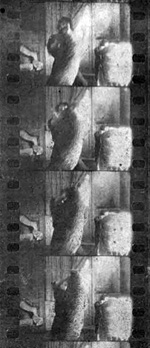
Il film è da considerare scomparso, eccetto per un breve frammento conservato nella Filmoteca de Valencia (IVAC).
The film is considered lost, except for a short fragment preserved at the Filmoteca de Valencia (IVAC).