Quo Vadis? 100th Anniversary

Quo Vadis?
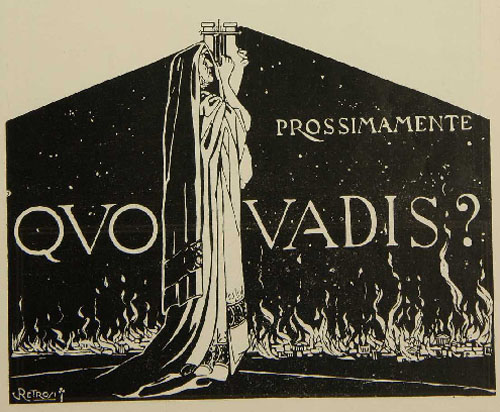
Coming soon “Quo Vadis?” (design by Retrosi, 1913)

1914. There are times when mere words appear totally inadequate to fittingly describe anything great and magnificent, and in attempting a pen picture of the colossal production of “Quo Vadis?” we find language almost fails us to  convey anything like the beauty, fascination, magnificence, and power to enthrall the production possesses. The work of Henryk Sienkiewicz is an acknowledged classic and has stood out amongst works of fiction as containing the most faithful representations of Roman History round the time of the voluptuous Nero. In this great reproduction, the Cines Co. have faithfully followed the lines laid down by the novelist, and we have such a series of pictures as have never previously been presented to the public. Every incident of the novel appears to have been preserved with remarkable fidelity, and while every scene has its point of interest, there is a tenseness and gripping power throughout that cannot fail to impress. There is not a weary moment during the whole of the six reels. Interest is sustained from beginning to end, and when the curtain falls on the last scene, there is a feeling of regret that we have not more to witness, and a wonder that the kinematographic art has reached such a state of perfection. There have been in the past many delightful and remarkable productions, but it will be long before the Cines Co.’s wonderful masterpiece “Quo Vadis?” is surpassed, and we look forward with confidence to the subject proving a real source of pleasure to the public, and one of the most powerful attractions yet seen in the world of pictures.

On all points the subject is a wonderful production. The beauty and magnificence of the various scenes and incidents are remarkable. Whether it be the fascinating scenes in the court of the profligate Nero, the burning of Rome, the striking incidents connected with the persecution of the Christians, the great thrilling depiction of the sports and pastimes in the amphi-theatre at Rome, or the more subdued incidents in the development of the remarkable story, we find the same completeness and mastery of detail. No expense or effort has been spared in the production, which we can well understand has been a work of considerable time and unlimited expenditure.

There is a sharpness and conciseness in the whole production that is at once remarkable and pleasing, and the effect upon the spectator when the whole of the 8,000 feet have been seen is a desire for more. Of the photography we cannot speak too highly; it is beautiful throughout, whilst the acting is of a very high order. There is no exaggeration, but a natural depiction of every character, and while it appears invidious to particularise, we may mention specially the characters of Nero, Chilo, Petronius, Ursus and Lygia, which leave nothing to be desired, for they are portrayed with all the fire and spirit of the ancient Roman regime.

1996. For decades “Quo Vadis?” has been circulating in black and white dupe prints, which are just a pale representation of the original’s tinted glory. Co-ordinated by the Nederlands Filmmuseum in Amsterdam, three European archives – the NFM (Nederlands Filmmuseum), the Cineteca Italiana (Milan), and the NFTVA in London – have now combined to produce a full restoration of “Quo Vadis?” in its original tinted 35mm Italian version. All three archives hold beatifully-tinted original nitrate material: Milan has a Swiss distribution print, with German/French intertitles; the NFTVA holds a later Aubert distribution print with French intertitles; the NFM has a shortened reissue version with Dutch intertitles. All of these were examined, compared, and restored by the NFM. A black and white dupe negative was made in Holland by Haghefilm, and a colour print was produced by Bologna’s Immagine Ritrovata labs using the Desmet “flashing” method, developed by Noël Desmet of the Cinémathèque Royale of Brussels.

Unfortunately, it has not been possible to reconstruct the original Italian intertitles, as they no longer exist in Italy, nor in the Kleine Collection at the Library of Congress in Washington, D. C. An English-language version has been produced for international screening purposes, using translations of the French, German, and Dutch intertitles, plus the original novel.

2013. If you owned “Quo Vadis?”(1913), what would you do with it for his 100th anniversary?

My answer is: Put it on Blu-Ray!

Tutto su Francesca Bertini

Francesca Bertini - La Regina del Cinematografo
Francesca Bertini – La Regina del Cinematografo

Tutto su Francesca Bertini, la Regina del Cinematografo… ed il suo tempo, finalmente in corso di stampa.

La biografia e filmografia di Francesca Bertini più completa mai pubblicata. Documenti originali d’epoca dal 1910 al 1985.

Prossimamente in libreria e sui vostri schermi in formato Kindle.

Stay tuned…

Mr. Ambrosio comes to America

Arturo Ambrosio
Arturo Ambrosio

November 6, 1909. The trade-mark of “Ambrosio” having appeared on so many of the best films issued by the independents during the past year, great was our pleasure to be honored with the first private interview with Arturo Ambrosio, the head of the Ambrosio Company at Torino, Italy, on the first day of his arrival in this country. Whenever we have been fortunate enough to see any of the Ambrosio productions on the screen we have marvelled at the originality of conception, the thoroughness of execution and the daring flights of imagination, and have wondered what manner of man it was who directed these finished specimen’s of moving picture art.

Ambrosio — Arturo Ambrosio — the name which has been the opening gun, the slogan of the independent exchanges, is a man rather below the average stature, alert in action, pleasant in personality, and primed with enthusiasm as to the possibilities of the art of moving picture making. For Mr. Ambrosio considers it art and treats it as an art, and the early part of our interview was mainly on these lines and the effect it was having and would have on other arts. The interview had not progressed very far before we were fully convinced of the fact that Mr. Ambrosio’s ambitions were entirely different from those of many who have drifted into the moving picture game. Said he: “Our aim is to produce the most impressive, most realistic and technically perfect pictures within the bounds of human ingenuity and genius.” How different from the ambitions of those whose aim it is to make and sell the most film!

“Mr. Ambrosio, will you tell me how long you have been making moving pictures and something about your studio?”

“The firm of Ambrosio, of which I am — what you call it — chief stockholder, has now been doing business for five years. That we have prospered is largely due to my partner, friend and chief aide, Mr. Gondolfi. We have a glass studio 120 feet in length, but much of our work is done under the sunny skies of Italy. We have thirty trained artists in our steady employ, besides scores of supernumeraries. We are a little artistic colony, with entree into the most select circles in Italy, and Italy’s best dramatic talent at our disposal.”

“Mr. Ambrosio, we have seen and admired much of your work. May I ask why you have come to the United States? Are you not satisfied with the sales of your product in this country?”

The answer was an expressive shrug and “I come to see for myself and study the tastes of your people. I want to know why it is that the American selections from my output are not those which I consider my best, nor even those which I consider best adapted to the general public.”

“Mr. Ambrosio, why do you think our people should buy more of your pictures? We have our own manufacturers here who can supply the demand.”

“I believe our productions are the equal, if not the superior, of any in the whole world. I see the work of others. Your American pictures come to my country. We enjoy them. They are so delightfully fresh, and some of them are now even becoming artistic. No, I do not wish to criticise the work of your manufacturers or their art, or lack of art, but the superficial nature of much of the output is apparent. Is it from lack of effort and concentration, or lack of ambition, or is it because they do too much? At any rate, they seldom seem to rise above a certain level. Understand me, I am not making a comparison. I have not yet seen enough of your work to judge.”

“Mr. Ambrosio, the manufacturers of this country may be said to work to a schedule. They have to supply a regular output, released on stated days. It sometimes happens that circumstances will delay a certain subject and a manufacturer may have to rush out some simple production to fill his orders. Working to a schedule is not conducive to art, but our American system of standing orders is a sound business basis for the manufacturers to work upon and it has not interfered with the quality, which has materially advanced and is advancing. Do you have a regular output and regular release days?”

“No, we have no fixed output. In Europe this is governed by the demand, and the demand is governed by the quality. We may make one picture a week, or three a week, or we may spend weeks or months on a production, but we always have on hand an ample supply of finished negatives to meet any demand. Take, as an example, our ‘Nero,’ which you have seen. This was made months ago, and its date of issue in Europe is October 28. It is one of a series of spectacular subjects which we call the ‘Golden Series.’ Others of this series are ready, and some of them will far excel ‘Nero’ in my estimation. Yes, we adhere to a uniform release date in the various countries, as far as possible. Films are sold by sample in Europe, and up to now we have taken orders for 342 copies of ‘Nero.’

“Mr. Ambrosio, you have mentioned ‘Nero’; this picture must have cost you much money and much hard work.”

“Money! There you are! American — Money. Money — American. We do not take cost into consideration in making our pictures. We set out to attain a desired result — and we get it. We rehearse and rehearse and take and re-take scenes until I am satisfied we cannot do it better. And work? Yes, we work. I seldom ate or slept while this same ‘Nero’ was being produced, and if I did sleep 1 dreamed ‘Nero.’ Yes, we work until we perspire, and I can tell you that after directing the scene of the burning of Rome I almost collapsed.”

“Do your sales in Europe warrant the expense and effort you put in your work? In other words, if the American market was closed to you, could you afford to do things so elaborately?”

“No, not on the European trade alone. We would barely come out even. That is one reason why I am here. We need the support of the whole world to give the world the best that can be produced in motion pictures. My correspondence and not my vanity leads me to believe that more Ambrosio films can be sold in America. And we need the money to expend in making still better pictures.”

“Mr. Ambrosio, that leads up to the question, Who is your representative in this country?”

“Messrs. Raleigh & Robert, of Paris, are our exclusive agents for every country except Italy and Spain.”

“Did you ever have any direct dealings with the International Projecting and Producing Company of America or its president, Mr. Murdock?”

“No. I had a letter from Mr. Murdock during his recent visit to Paris, saying that illness prevented him from visiting our plant. Here it is. I have never met Mr. Murdock, but I hope to have that pleasure.”

“Are Raleigh & Robert still your agents, or have you come here to make other arrangements?”

“Raleigh & Robert are still our exclusive agents and will be until I announce to the contrary.”

This ended a very interesting chat. The following day we again saw Mr. Ambrosio in the presence of a representative of the “Billboard” and of the “Dramatic Mirror.” His attention was called to an advertisement published in a trade paper, dated October 9, stating that a certain company had exclusive control of his films in this country.

Mr. Ambrosio emphatically denied the right of anyone to make such a statement, and at the suggestion of the “Billboard” representative gave out a signed statement that Messrs. Raleigh & Robert, and through them the Film Import and Trading Company, of this city, were the only concerns authorized to handle his output in America.
(Moving Picture World)