The story how Corinne Griffith managed to “get into pictures” is short but interesting. She happened to be attending a ball in New Orleans at the same time as a well-known producer of the Vitagraph Company.
She won a beauty prize in a competition, and the producer, who was impressed by her looks, offered her a chance to go on the screen, and she decided to accept it.
Corinne says that at first her family were “horrified,” but they are very proud of her now.
She was born in Texas, where her ancestors have lived for many years. Her grand father was mayor of the town four times. Her antecedents were Italian and Irish, and her lovely blue eyes certainly prove her Irish descent.
Corinne goes to the movies every night.
“ It’s the only way to advance in my work, ” she says.
“ I study all the stars, but I love Alice Joyce best. When I tell folks that, and also that I have the next dressing-room to Miss Joyce down at Vitagraph, everyone marvels. By all the rules we should be jealous and throwing things at each other, but we don’t ! She’s a dear ! ”
Besides being fond of Alice Joyce, Corinne likes “ beautiful clothes, chocolate cake, and melodramas, ” which, as she admits, is “ some mixture. ”
Corinne Griffith is a vision of feminine loveliness, so much so that she inspired this description, or rather, “ futurist impression, ” from an admirer : “ Tropic moonlight ; the Mediterranean at azure night ; perfumes of India ; a silken gemmed butterfly in a garden of orchids. ”
He couldn’t be very much more enthusiastic than this, could he ?
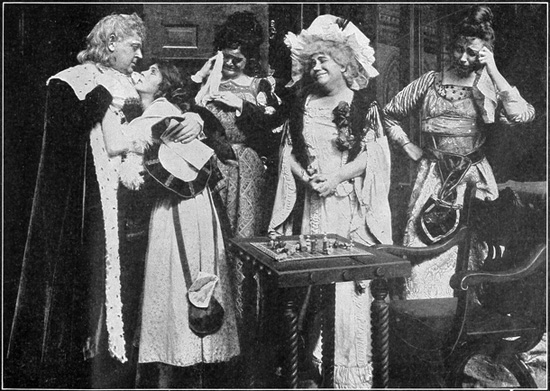
Winnifred Greenwood takes the part of Cinderella’s mother, while her father is played by Frank Weed. The wicked stepmother and the two step-sisters are played by Lillian Leighton, Josephine Miller and Olive Cox, respectively. T. J. Carrigan makes a most charming Prince Charming, and Charles Clary does splendidly as King Claudius. Adrienne Kroell as Princess Yetive, Jessie Steavens as the Dowager, George Cox as secretary to the king. Will Stowell as captain of the guard, Frank de Sharon as the milk vender, Frank Weed as the baker, all do excellent work, while Baby Griffin makes a most jolly and pleasing fairy godmother. Then, of course, there are courtiers, guards, heralds, court ladies, peasants, etc., galore.
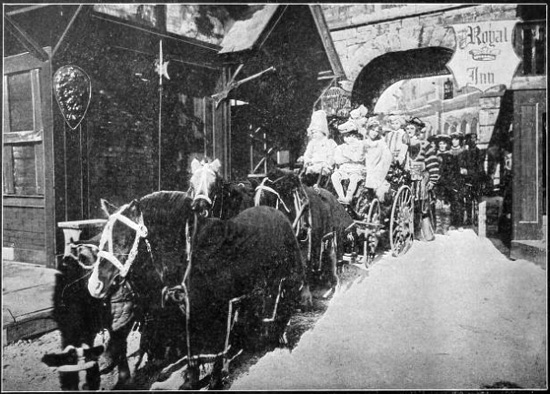
Cinderella Departs for the King’s Ball
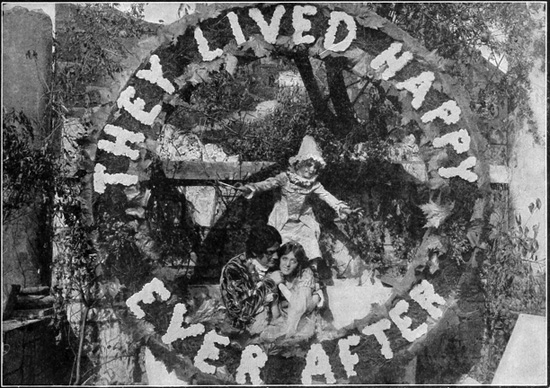
The simple old tale of Cinderella has been wonderfully elaborated. The Selig version exhibits many beautiful dramatic details that will come as a pleasant surprise to those whose memory still clings to the original. The story as arranged by Henry K. Webster is a big modern rapid-fire drama, with all the sweetness and simplicity of the old nursery tale. It was adapted and produced by Colin Campbell at the Selig Chicago studio, and fills three reels of film.
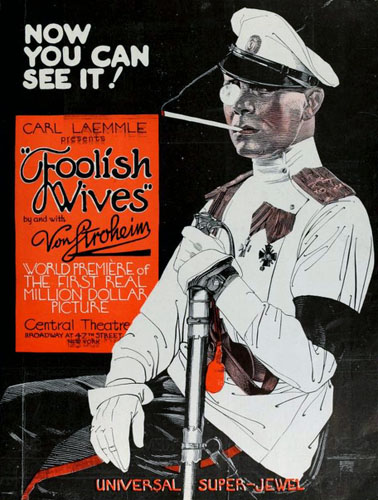
After taking nearly a year to produce, and another year to prepare for presentation, the much heralded “Foolish Wives” has arrived on Broadway (Wednesday, January 11, 1922) with the customary ovation accorded the more important film productions. Erich Von Stroheim‘s picture is one that is imbued throughout, from the first to the very last shot, with visual appeal and it is that element of gorgeousness that establishes the production as a million dollar affair. It would be impossible to go into detail here as to the elegance and superbness of the specially constructed sets that have cost small fortunes to build. But accuracy of detail was an essential, and Monte Carlo is offered in replica for the satisfaction of those who may have seen the original, and for the imagination of those who know it not. Casinos, palatial residences, and beach resorts too numerous to tabulate, offer the enchanting backgrounds against which Von Stroheim‘s story of an arch villain is portrayed.
As shown at its premiere, “Foolish Wives” ran three hours and forty minutes, with a five minute intermission, or approximately fourteen reels. Regardless of the magnificence and quality of either story or production, this is extreme for screen entertainment, or any other theatrical program for that matter.
The most important and immediate need of the picture is absolute and certain cutting. It cannot hold the attention of any audience for the length of time consumed by its present fourteen reels. Much of Von Stroheim‘s excellent, but none the less tedious, detail must necessarily come out to speed up the action and secure a better interest from the spectator. The ending, particularly, is especially dragged, with a flash of this and a flash of that, until it would seem that they never would reach the end. As originally shown the film ran over 14,500 feet, but after the opening night this was cut over 2,500 feet.
As a director, Von Stroheim asserts his mastery through his skilful handling of a not altogether nor universally appealing story. His development and characterization, notably in the way of detail, is convincing and rarely does he neglect minor bits except, maybe once, when he appears spick and span after wading for a considerable time through the marshes, while his fair companion looks much the worse for the experience. But this is not a frequent occurence and for the most part, everything else is distinctive. A melodramatic twist in which a fire plays an important part is followed by one of the picture’s weakest points, that of the birth of a child. The idea that the child will bring a reconciliation between the wife and the husband who has cause for doubt, is clear, but not a bit more convincing, since the husband’s character was intended to represent a fine, understanding type of American manhood. Some of the punches in the production are extremely unusual. Notable among these is the fire sequence, the marine with his forearms shot off, the storm, and many others.
“Foolish Wives” presents Erich Von Stroheim as the most convincing and thoroughly hateful villain of all time. His performance can best, and really only, be appreciated by actually witnessing it. He has selected a company of players which render individually fine performances. Mae Bush and Maude George, as two Countesses and cousins of the Count, are excellent, while Dale Fuller as a maid in the Count’s home, and also one of his victims, is effective in a difficult role. A great number of minor parts are also well handled and in many of the scenes thousands of extras appear.
Princesses Olga and Vera live in a luxurious home with their cousin. Count Sergius Karamzin. The spectator is aware that the trio are frauds who gamble at the casino at Monte Carlo, with counterfeit money. It is the Count’s business to make the acquaintance of notable visitors to further their schemes. So it is he effects an introduction to Mrs. Hughes, the beautiful young wife of an American Envoy. In the course of events, it transpires that the Count picks his women victims at variance. One is a maid in his home, another the half-wit daughter of Ventucci, a counterfeiter, and finally, after a carefully laid ruse, he traps the American woman. Honor is nothing to him. He asks her to aid him financially. She goes to him and the two are locked in a tower which is set on fire by the jealous and betrayed maid, who then commits suicide to hide her shame. The Count and Mrs. Hughes are rescued and the birth of her child secures her husband’s forgiveness. The same night Sergius attacks the half-wit girl and is killed by her father and thrown into the sewer. Finally the two “Countesses,” in reality international crooks, are exposed. (The Film Daily, January 15, 1922)

 sempre in penombra