Does the Photoplay Patron Prefer Comedy or Serious Subjects?

New York February 1912. There seems to be a considerable conflict of opinion among the potent figures of the film industry as to the preference the patrons of Photoplay theater have for comedy, the majority stating that there are not enough laughter-provoking pictures.

To discuss this all’important phase of the Moving Picture, one must naturally turn to the stage for data, in order that such a problem may be fairly solved, and there is nothing to indicate that the playgoers of modern times have been attracted to the playhouse thru comedy offerings as they are to see and hear plays and players, and songs and singers, of a more serious character. Moreover, all the great records achieved in the amusement field indicate a trend of public taste for the dramatic rather than for plays of a farcical order.

“Ben-Hur” has been before the public for twelve years; it has made a million for the producers, and there is almost a total lack of comedy in the portrayal of his epochal play. The most potent plays at the present time are nearly serious: “The Return of Baron de Grimm”; “Mme. X”; “The Littlest Rebel”; “The Music Master”; “The Garden of Allah” and “The Price” have attracted solely for tear-making qualities.

Closer to Moving Picture requirements, a study of vaudeville records shows that the most enduring playlets were such offerings as “The Littlest Girl”; “A Man of Honor”; “A Romance of the Underworld”; “Frederic Lemaître” (in which Henry Miller enthralled vaudeville audiences), and only a few days ago Blanche Walsh held an audience spellbound in a one-act play that had not even a smile in it.

“The Woman,” a Belasco success, draws large audiences without a star, because of the one compelling serious scene. “A Fool There Was” is considered the best “repeater” of modern plays, while Mrs. Leslie Carter has once more held her enormous clientele steadfast with “Two Women,” a play without a single comedy line.

Shakespeare’s tragedies always draw; his comedies are rarely given.

Comic opera has always spelled bankruptcy for the managers who would tempt fate with them, while grand opera al the Metropolitan Opera House draws an average of $70,000 a week, at $6 a chair.

No comic song ever had the vogue of such plaintive ballads as “Tha Last Rose of Summer,” “Home, Sweet Home” and “After the Ball,” all tear-compelling.

Even pantomime had its greatest vogue  with “Un Enfant Prodigue,” a veritable tragic poem without words.

No one will deny that the vogue of the silent drama is what it is, greatly, because such worthy film producers as the Vitagraph, Kalem, Biograph, Edison and others have realized that to  cater to the patronage most desired, they must emulate the methods of the highest grade  od producers of the stage, and they also are aware of the fact that the technique and philosophy of the silent drama is such that they are enabled to score even greater triumphs than the Frohmans and the Klaw and Erlangers, for the stage has its limitations, whereas the Motion Picture play is greatly enhanced by the verity and realism of nature’s own vast resources!

Robert Grau
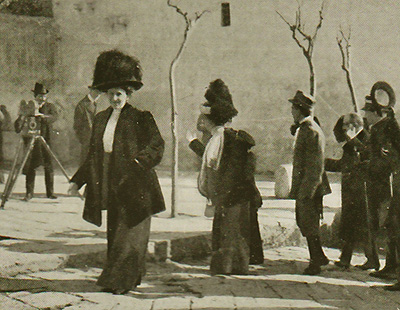
Un’avventura di Romolo Bacchini alla Vesuvio Films

Famiglie del 11° Bersaglieri davanti alla macchina da presa
Famiglie del 11° Bersaglieri davanti alla macchina da presa (1911)

Come avevo annunziato, ecco a voi un’avventura cinematografica di Romolo Bacchini, direttore artistico della Vesuvio Films di Napoli.

Correva l’anno 1912 e le vicende della guerra Italo-Turca occupavano molto spazio sui giornali e molti metri di pellicola. Tutte, o quasi tutte le case di produzione italiane e straniere avevano inviato i loro operatori in Libia. Gli spettatori delle sale italiane seguivano con molta attenzione i Cinegiornali della Gaumont, della Pathé e, naturalmente, i “dal vero” proposti dalle case italiane. Fu allora che alla Cines venne in mente l’idea di cinematografare le famiglie dei soldati sul fronte:

«Per mezzo della Cines di Roma, come avevamo preannunziato nel numero scorso, vennero cinematografate, qui a Torino, le famiglie dei militari che si trovano sul teatro di guerra in Tripolitania e Cirenaica.

A tale scopo, nella vasta caserma della Cernaia vennero raggruppate, il giorno 6 corr., circa 3000 persone, le quali, a gruppi ed isolate, si presentarono davanti agli obbiettivi della macchine da posa, perchè le loro sembianze ed i loro gesti di saluto e di incoraggiamento possano fra poco essere proiettati ai loro cari, nella nuova terra italiana conquistata col loro eroismo.

Brava la Cines: cogli elogi delle autorità si abbia anche i nostri per questa nobile iniziativa che ha incontrato il plauso di tutta Italia».

Altro che film a episodi: 3000 persone davanti alla macchina da presa! Un vero colossal. Ignoro che fine ha fatto questo “film”, sperduto nel buio come molti altri. Un vero peccato.

Come in ogni guerra, insieme alle “buone notizie”, dal fronte di guerra arrivavano periodicamente le notizie sulle vittime, ma in queste occasioni, le macchine da presa erano altrove… ordini… superiori?

Una di queste notizie fu la morte del napoletano Mario Fanelli, tenente del 11° bersaglieri. Qualche settimana dopo, la rivista Cinema, edita a Napoli, pubblicava una lettera:

Signor direttore,

Possediamo noi un film, fatto in occasione di una festa del glorioso 11° Bersaglieri, nel quale spicca la figura del compianto tenente Fanelli. Sicuri che alla sua Famiglia riuscirà gradito rivederlo ancora come se fosse vivente e in un giorno per lui di militare allegrezza, abbiamo, con paziente lavoro, distaccato e riprodotto in un film parziale tutti i fotogrammi nei quali l’eroico Tenente aveva azione, e questo abbiamo inviato in omaggio alla sua famiglia.

Le saremmo grati se ella, nel modo e nella forma che crederà opportuno, vorrà dire tale cosa nella sua diffusa Rivista, non già perchè desiderosi di pubblicità, ma perchè sia nota, che ancor noi vivamente partecipiamo – così come ci è possibile – all’unanime sentimento di fratellanza e di ammirazione, che ora unisce tutti gl’italiani con i prodi combattenti d’Africa.

Il Direttore
Romolo Bacchini

Una nobile iniziativa, niente da dire. Se volete vi racconto il seguito… ed il seguito fu: l’avesse mai fatto! I concessionari delle case di produzione, sopratutto la Pathé, furono sommersi dalle richieste di famiglie che affermavano aver riconosciuto un suo parente e chiedevano una copia “personalizzata” come ricordo. Non ho la minima idea se le richieste furono soddisfatte… avete provato a cercare fra i ricordi del bisnonno?

The Passion Plays of Italy


The Emigrant (L’emigrante), Itala Film 1915, with Ermete Zacconi “first intelligible moving picture without sub-titles” (music by Alessandro Sacco’s string quartet)

London, September 1916. The schools of Milano, Ambrosio, Itala, and the rest of them, have so far remained faithful to the dominant tradition of all South Latin drama – whether acted in dumb show or otherwise – in that the preponderating majority of “serious” films that have come from them have dealt almost exclusively with some aspect of the eternal duel of sex. We call it passion when we wish to convey that it possesses glitter and grip. But, indeed, the Italian renderings of our passion are quite often the raw, literal thing – what we should name in another connection, a “thundering bad temper”. Italian love-making can look extremely ludicrous to English eyes; just as English love-morals (as depicted on the screen) can be well-nigh incomprehensible to the citizens of Naples or Milan. Exactly how far either is to be taken as a sample of the actual thing it is not the purpose of this paper to inquire. Doubtless the cinema art of Italy has as much to do with the real lives and loves of the people as the equivalent representation in any other country has to do with them. The point is that, even if it wanted to, the film drama of Italy would scarcely be allowed by its intenser devotees to wander for long off the beaten track of “passion” and “intrigue,” with all the calamitous and tempestuous adventures that this guilty pair (especially in a land so rich in volcanoes) are apt to bring in their train.

When the Italian film does get off this track and strike out on a novel line of its own it certainly does not strike inward, either nationally or psychologically. You could not infer much of the Southern character and temperament, nor even many of the customs and observances current on the banks of the Tiber, from the tiny reflection of them which manages to get on the screen. But the Italian producer has a sort of instinctive wisdom in these matters after all. It was in his own original tongue that the famous recipe for restless crowds was first pronounced – panen et circences. The chiefs of Itala and Milano – not, of course, to mention Armando Vay – are “great” at circuses. The “science of the spectacle” has never been pushed to more daring lengths than in some of the gigantic “sets,” peopled with richly varied crowds and groups backing and flanking a trio or so of uncannily clever principals, which have been staged in the Italian studios. The “great act,” if sufficiently sensational, will always carry the weak story on its back in a film play – and in most Italian stories of this nature the “great act” is advisedly athletic in more senses than one. In the lesser novelties lately the love element has pursued its somewhat monotonous course, eked out with a panther, an escaped maniac, or a wonderful “double,” who deceives everybody in the picture up to the last moment, but nobody in the picture-house for a second. Dramatic invention of the plausible kind is not the most conspicuous gift of film writers either in Italy, but at the scène à faire (which may be translated as the “scene which does the trick”) they have ab unrivalled imagination. When the spectator’s imagination happens to be in accord with it the picture can speak with no uncertain voice. Those who prefer the amorous exotics may be recommended not to miss Inspiration, in which Signorina Menichelli comes out both bold and beautiful. The first version of this film, entitled Fire, was more Italian, but less to the taste of the Censor. Enough is left, however, to mark the Latin tradition in affairs of this kind. It is to be regretted that Hesperia has been seen but rarely in English picture theatres since the war broke out; while Bertini, so far as we are concerned, might be merely a stock illustration in La Vita Cinematografica for all we see her.

But the greatest landmark of Italian film history, when all is said, is Cabiria, and it is long likely to remain so. This is the production which was put back in the box almost as soon when first brought to England. At a second venture it leapt into fame, and received a “publicity” in keeping with its own giant proportions. It was the means of “discovering” a new actor Maciste; and it offered ad least one ineffaceable impression for these times in the scene of the great god Moloch. This wonderful, horrible episode, in a drama which lacked nothing in terrors and excitements, burned into the brain for months, and can never be quite forgotten. An alternative, and more realistic, rendering of this deity’s insatiability can now be seen in the pictures featuring the Battle of the Somme.

To Italy belong the honour of having turned out the first intelligible moving picture without sub-titles. It remains to be seen whether the Spanish producer and plot-man combined can found a school of pictures, even with all the literary impedimenta, which shall satisfy and gratify the Northern palate. Failing that, we shall pin our faith to the Tourist and Industry “short-lengths” for telling the British spectator alla he wants to know about Spain in film form.

D. Z. J. Gillingham (La Vita Cinematografica, 22/30 novembre 1916)