Playing for posterity

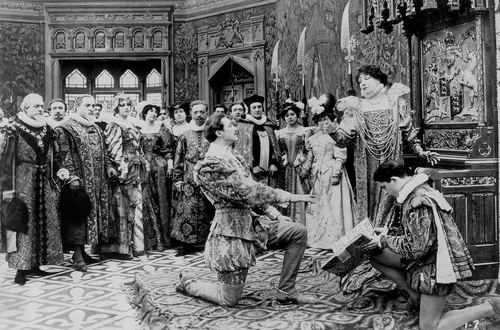
Les Amours de la reine Élisabeth (1912)
Sarah Bernhardt, Les Amours de la reine Élisabeth (1912)

Strange as it may seem, motion pictures have done much in cultivating the public. The year 1911 saw a number of natural developments in the growth of the “Silent Drama.” Perhaps one of the most important of these is the tendency towards longer subjects. Films of more than one reel are no longer a curiosity and have been received with much favor. Ancient and modern history is brought back to our memory in an interesting way, while, were these same subjects to be put in a stage, the companies would be received with empty benches.

Dickens’ “Becky Sharpe” and Julia Ward Howe’s ” Battle Hymn of the Republic” have been pictured in an instructive and impressive way. While it cost more than $100,000 to put on Dante’s Inferno, just twice as much as to produce the play of Ben Hur, The Fall of Troy, The Crusaders, Cinderella, and a Tale of Two Cities have cost many thousands. As illustrating the progress of the “Silent Drama.” the Milano Film Company, of Italy, which evolved Dante’s Inferno, now announce the completion of Homer’s Odyssey. This immense production evolved an expenditure of thousands of dollars and was two years in preparation. This will show that the picture play is being developed in a very high class scale as to authors, actors, and elaborateness of staging. The best plays are being chosen and the most eminent actors have succumbed to the inducements offered by picture companies. Among the celebrities who have become allies to the camera may be named McKee Rankin, Sydney Booth, Nat Goodwin. Charles Kent. Mary Fuller, and others. An English writer recently asked Bernhardt if she did not consider her posing for the camera a retrograde movement, to which she replied: “I am playing for posterity. Art is always Art. no matter where it is or what the environment. What would we all give if the art of our Rachel could have been preserved in this manner, and who does not regret that science and invention could not have been resorted to in the days of Keene and Garrick.”

Perhaps the most important achievement is that “Salvini,” whom Charlotte Cushman pronounced “the greatest actor the world ever saw,” now over 80 years of age, has consented to produce his sublime portrayal of “Othello” before the camera. Among the many admirers of motion picture; are “Tetrazzini,” the famous opera singer, and Professor Starr, of the Chicago University.

Professor Starr has pronounced “the moving picture” the highest type of entertainment in the world, and Mark Twain, shortly before his death, said: “The motion picture show makes me feel brighter, healthier and happier.”

The “motion picture” is fast becoming a great factor in educational work. Do you remember how you used to brood over the crude pictures in the little old geography? And how you promised yourself that some day you would see these places of interest? If any one would have told you then that, in comparatively a short time, scenes of pulsing life, with all the action and color of the original events, would be flashed on the class-room wall, you would have talked of fairy tales and scoffed at the notion. Yet this is the latest and perhaps the biggest step in education. Already in New York City a movement has taken form to provide for the schools, colleges, churches, social settlement, and every center where education is an object, exhibitions of motion pictures. They are presenting in a fascinating way the most direct and exclusive information on given subjects.

Instead of the “Declaration of Independence” being read in the old boresome fashion, the very men who gave life and force to the document by signing it, will seem to gather at an end of the class room. Already in our State at the Boulder School for the Deaf and Blind they have pictures which are being successfully used to teach the deaf and dumb the scenes of mining and agriculture. One of the most fascinating uses made of the motion pictures has been to entertain and suggest normal thought to the insane.

I sat by the fireside dreaming of days of long ago,
And pictures seemed to form in the midst of the ember’s
glow
But faded e’er I could catch them, the coals to ashes died,
E’en as my hopes had perished and the heart within me
sighed.

I left the dying firelight, and the lonely, cheerless room
And wandered down the avenue, seeking to lift the gloom
When I heard the sound of music, saw countless lights
agleam
And suiting an idle fancy, I entered as in a dream.

I entered into darkness, but sudden, before my eyes
On a curtain of white, came pictures and I stared in mute
surprise,
Pictures that world! In wonderment I quite forgot my pain.
Pictures that lived! And with them I lived my youth again.

The North, the South, the East, the West were all at my
command;

The whole world came before me. at touch of an unseen hand.
Ah! the pictures by the fireside may fade and die away,
But those on the magic canvas live anew for me every day.

From a Paper by Hattie M. Loble. Read at a Meeting of the Daughters of Confederacy, Helena, Mont., Tuesday, March 19, 1912.

Rodolfo Valentino interprete di Claudia Particella di Benito Mussolini

Non sono mai riuscita a chiarire del tutto i retroscena intorno al progetto di portare al cinema Claudia Particella, un romanzo di Benito Mussolini pubblicato a puntate dal quotidiano Il Popolo di Trento nel 1910. Se volete sapere di più a proposito del romanzo potete consultare il web dove i riferimenti non mancano.

Rodolfo Valentino, Arturo Ambrosio, Emil Jannings
Rodolfo Valentino, Arturo Ambrosio, Emil Jannings, Roma 1923

Come ricordano tutte le biografie di Rodolfo Valentino, il 1923 segna il suo ritorno in Italia dopo quasi dieci anni di assenza:

‟Presentiamo ai nostri lettori una fotografia rarissima dei rappresentanti di tre potenze cinematografiche (da destra a sinistra) Emilio Janning il grande attore tedesco che interpreta a Roma Nerone della UCI – Comm. Arturo Ambrosio direttore gen. Artistico della UCI recentemente insignito della Croce da cavaliere dei S.S. Maurizio e Lazzaro – Rodolfo Valentino, il noto attore italo-americano in viaggio in Italia, di cui sono note le interpretazioni cinematografiche e le avventure galanti, colti tutte e tre dall’obiettivo sullo sfondo delle costruzioni neroniane nei teatri di posa della Unione Cinematografica Italiana a Roma. Vuole forse questa fotografia essere auspice di un grande avvenire della cinematografia italiana? È quanto ci dirà il prossimo futuro.„ (al cinemà, 4 novembre 1923)

Di questa visita ai teatri dell’Unione Cinematografica Italiana le biografie di Valentino offrono quasi tutte la stessa versione, senza nominare né Arturo Ambrosio, uno dei pionieri della cinematografia italiana, né Emil Jannings. Il cinema italiano era in crisi, ma è sempre in quel periodo che Giuseppe Barattolo, a capo dell’Unione Cinematografica Italiana, offre un contratto a David W. Griffith per dirigere un film in Italia.

Valentino, Ambrosio, Jannings, altra foto dello stesso incontro a Roma
Valentino, Ambrosio, Jannings, altra foto dello stesso incontro a Roma nel 1923

Qualche anno dopo, nel 1938, la rivista Film pubblica un articolo dove si raccontano altri particolari su questo incontro premonitore dell’«avvenire della cinematografia italiana»:

‟Dopo aver ultimato il Quo Vadis?, Ambrosio si accinge ad organizzare un nuovo e grandioso film: aveva letto un romanzo storico di Mussolini Claudia Particella, se ne era entusiasmato e voleva fare un film. A tale scopo, fa venire Rodolfo Valentino dall’America e Emil Jannings dalla Germania, butta giù le basi organizzative e, poiché dovrà essere un film colossale, domanda aiuti in Banca: ma questa finge di non sentire. Ambrosio insiste, prega, si appella al suo passato così ricco di successi, tenta ogni via per poter fare aprire nuovamente gli sportelli, ma non ottiene nulla. Si dispera e ne soffre tanto che finisce per ammalarsi.„ (Film, 19 novembre 1938)

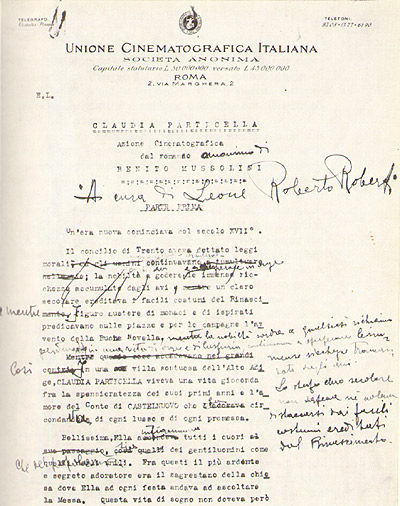
Molti anni dopo il progetto torna ancora alla ribalta nel volume di Pietro Bianchi Bertini e le dive del cinema muto (UTET 1969), dove a pagina 71 si può vedere la prima pagina della sceneggiatura di Claudia Particella “curata da Roberto Roberti con correzioni autografe di Benito Mussolini”.

Qualche anno ancora e nel 1985 nessuno ricordava più questi particolari visto che Aldo Bernardini e Vittorio Martinelli attribuiscono la scoperta a Gian Piero Brunetta, che aveva pubblicato la stessa prima pagina della sceneggiatura nella I edizione di Storia del cinema italiano 1895-1945 (Editori Riuniti 1979):

‟Secondo quanto ha potuto accertare Gian Pietro Brunetta, l’episodio risaliva all’inizio del 1923 e il film non venne mai realizzato perché in un secondo tempo il duce, divenuto capo del governo, ritirò la sua approvazione, trovò incompatibile con la sua nuova immagine e funzione un progetto del genere, che venne abbandonato. Lo stesso Brunetta pubblica una fotografia del frontespizio della sceneggiatura originale del film, dove si legge chiaramente, aggiunta a penna dallo stesso Mussolini, la scritta “a cura di Leone Roberto Roberti”. E’ dunque possibile che in un primo momento il regista avesse accettato la proposta e avesse scritto il copione, e che in un secondo tempo avesse declinato l’incarico.„ (Roberto Roberti direttore artistico, Le Giornate del Cinema Muto 1985)

La pagina della sceneggiatura è la stessa pubblicata 10 anni prima, ma quella del volume di Bianchi è una fotografia molto nitida dell’originale. Che fine ha fatto la sceneggiatura?

Secondo Sergio Leone, figlio di Vincenzo Leone (alias Roberto Roberti, Leone Roberto Roberti, Roberto Leone Roberti), intervistato da questa che scrive nel 1980, fu lo stesso Benito Mussolini a rifiutare l’offerta… fattagli degli americani.

Claudia Particella
Claudia Particella, prima pagina della sceneggiatura curata da Roberto Roberti con correzioni autografe di Benito Mussolini, intestazione dell’Unione Cinematografica Italiana Società Anonima (Pietro Bianchi, La Bertini e le dive del cinema muto, UTET 1969)

American producers need have no fear of an European invasion

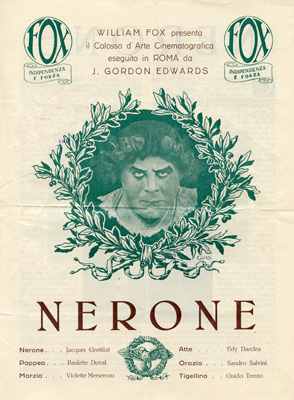
Nero (Nerone) Fox 1922
Jacques Gretillat as Nero, in the cover of the italian brochure

American producers need have no fear of an European invasion; especially after they witness the Fox production of “Nero,” which is scheduled for a Fall release. This remarkable picture was written by Charles Sarver and Violet Tracy, both Americans. It was directed by J. Gordon Edwards, an American, and produced by an American company. The picture was made in Rome, and promises to be the biggest production of the forthcoming screen season. It surpasses all foreign productions which have been shown in this country, and has more thrills than all of them combined, while the mob scenes, in which thousands appeared, prove beyond any reasonable doubt that American directors are the best. The objetionable feature of “Nero” is the over-acting of the italian actors whom Edward employed. The European actor doesn’t seem to be able to master the art of repression and restraint. William Fox must have spent a tremendous fortune on this spectacle, and Edwards was a year making it. But, both will be rewarded. Fox will get it all back, and a great deal more, while Edwards will take his place as one of the few great directors: an honor which he richly deserves. The photo dramatists will not overlook the names of Charles Sarver and Violet Tracy, for they have told a logical story with smooth continuity and they must not be overlooked when the credit for this great production is being apportioned out. European producers will never be able to send a greater picture to America during this generation, and everyone interested in photoplays and their construction should see this great work, even if they have to be inconvenienced on so doing.

H.H. Van Loan (Photodramatist, July 1922)