Ottobre 1923. La Fert, la grande casa cinematografica torinese, riapre i battenti e ritorna a fabbricare pellicole: questa è la grande notizia del giorno.
Il nome della Fert è noto e caro al pubblico come quello di una delle migliori ditte produttrici italiane. Costituita nel 1919 in Roma, con uffici e Stabilimenti a Torino (Madonna di Campagna), a Roma (via Nomentana), essa si distinse immediatamente per la ricchezza della messa in scena, per l’accuratezza dell’esecuzione, l’abbondanza e la bontà del corpo artistico a disposizione, fra cui la Maria Jacobini, Italia Almirante, Hesperia, Diana Karenne, Lucy Sangermano, Kally Sanbucini, Diomira Jacobini, Alberto Collo, Emilio Ghione, Oreste Bilancia, Franz Sala, André Habay, ed i direttori di scena Baldassarre Negroni, Gennaro Righelli e Mario Almirante.
Le prime pellicole fabbricate rispondevano ai nomi, che ancora il nostro pubblico ricorda, di Amore rosso, La preda, Cainà, L’incognita, Il viaggio, Zingari, Grande passione, Sogno d’amore, Madame Flirt, Demonietto, Zà la Mort, ed altri.
Dopo due anni circa, e precisamente il 3 febbraio 1921, la Fert si trasformò in società anonima, trasportando la sede a Torino; ma dovette poco più tardi, verso la fine del 1921, cessare la fabbricazione a causa della crisi imperante sui mercati cinematografici italiani e mondiali.
La nostra Società, che aveva cominciato ad interessarsi della Fert sin dalla sua costituzione in Società anonima, acquistò dopo la chiusura dello stabilimento, tutte le azioni della Casa.
Dopo di aver provveduto alla vendita all’estero di gran parte dei negativi già prodotti, la Società anonima Stefano Pittaluga sta ora procedendo alla completa riorganizzazione dello Stabilimento ed alla sua prossima riapertura.
Nuovi films verranno prodotti dalla Fert appena essa avrà ripreso la sua regolare attività, ed i nuovi dirigenti porranno la massima cura a che i futuri prodotti raggiungano la stessa elevatezza, conservino la stessa linea artistica a mantengano le identiche caratteristiche di distinzione che già diedero un nome alla Fert. A questo scopo la Direzione si è assicurata e sta assicurandosi la collaborazione di artisti di grande valore, un preciso elenco dei quali ci riserviamo di dare in seguito. E’ quindi sotto i migliori auspici che ci annuncia questa ripresa di attività di una delle maggiori Case italiane. La Fert ha attualmente un capitale versato di 3 milioni di lire.
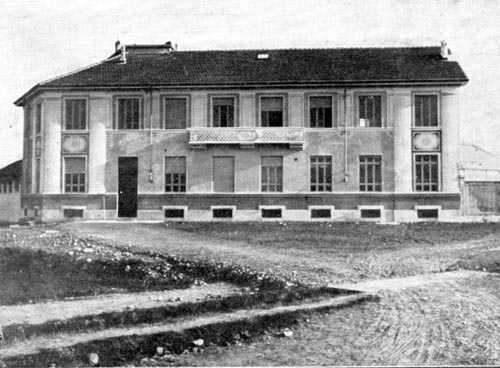
Palazzina degli uffici della Fert nel 1923
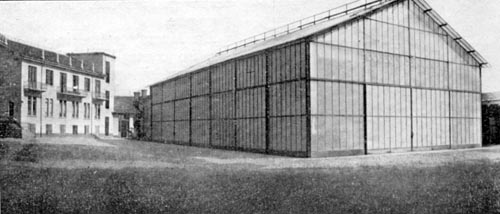
Di questi stabilimenti è rimasto in piedi soltanto il guscio murario esterno della palazzina degli uffici in Corso Lombardia 194, Torino.
July 30, 1912. Mutual Film Corporation have procured exclusive United States and Canadian rights on the original One hundred one Bison, also Bison Broncho and Keystone films, effective two weeks from date. You can commence to buy immediately.
August 3, 1912. Keystone Films. Ready for release week of August 12th. Two releases weekly, Wednesdays and Saturdays.
Wednesdays: A split-reel comedy and always a feature, supported and made by Mr. Mack Sennett, Mr. Fred Mace, and Miss Mabel Normand, the greatest comediennes, all well known and popular players in motion pictures throughout the world.
Saturdays: A feature dramatic in one and two reels played by a strictly “All Stab” Stock Company, consisting only of “Stabs”, and only of the most prominent and popular “Stars” in motion pictures playing all parts in the cast.
August 10, 1912. Mutual Gets Empire Film Exchanges
Will Also Handle’ Bison-101 Pictures — Acquisition of Great Importance to Film Supply and Mutual Interests.
Developments of the greatest importance to exchange men and exhibitors allied with the Film Supply Company and the Mutual Film Corporation occurred during the past week. It had been rumored for some time since the Baumann and Kessel interests deserted the Universal Film Manufacturing Company, that an alliance with the Film Supply Company was a possible alternative outlet for the product of the New York Motion Picture Company. Negotiations were opened which culminated in an agreement between the Mutual Film Corporation and the New York Motion Picture Company whereby the Mutual will market the product of the New York company under the trade marks ‘”Bison-101,” “‘Keystone” and “Broncho” pictures.
The Mutual Film Corporation has also purchased the Empire Film Exchange, which operated four distributing offices, and the stock and equipment of these exchanges will be merged into branches of the Mutual.
The negotiations in these transactions were finally concluded on Monday, July 29, and are the most recent in a long series of steps initiated by a group of Western investors, under the leadership of Mr. H. E. Aitken, for the purpose of improving the organization and increasing the efficiency of the Independent film service.
Mr. Aitken came to New York in the Spring of 1911 and took over the old Hudson Film Company, changed it into the Western Film Exchange of New York, and improved the quantity and quality of its business. He then organized the Majestic Motion Picture Company, and that Company’s energetic assertion of its right to do business has been a great factor in the re-organization of the Independent film manufacturers. Having, in the meanwhile, acquired valuable patent rights through Precision Camera Company, these interests then purchased control of the Carlton Motion Picture Laboratories, making the “Reliance” pictures, from Baumann and Kessel.
The next step was the organization of Mutual Film Corporation, which took over, upon its organization, the Western exchanges in New York, Milwaukee and Kansas City, Majestic exchange in Chicago, the H. & H. Exchanges in Chicago and Des Moines, Lake Shore Exchange in Cleveland, and Cadillac Exchange in Detroit. Shortly thereafter the Mutual Film Corporation acquired the Michigan Film & Supply Company of Detroit, the Buckeye Lake Shore Exchange of Columbus, Ohio, and Progressive Exchange in Omaha.
Since its organization in February, the Mutual Film Corporation has opened exchanges in Boston, Indianapoli.-. Philadelphia, Toledo. Washington, D. C, Atlanta, New Orleans, Dallas and Cincinnati.
After the organization of the Mutual was well under way. Mr. Aitken, in co-operation with Mr. Charles J. Hite and others, negotiated Mr. Hite’s purchase of the Thanhouser Company.
In the meanwhile the suits brought by the Majestic Motion Picture Company against the Sales Company and its officers and constituents caused the disruption of the Sales Company, with the result that the Film Supply Company of America with its extensive programme was organized.
Most recently the Mutual Film Corporation, as before mentioned, made arrangements for the acquisition of the four Baumann and Kessel film exchanges in New York, and for the control of the Bison No. 101 film, and it is said that negotiations are on for other valuable film enterprises.
The results outlined above, have been achieved only after years of unremitting effort, and the present strong financial backing of Mutual Company gives great promise of achievements in the future.
The consistent purpose of this group of men has been to improve the character of the Independent film and to afford exhibitors an opportunity to purchase film of the highest quality manufactured.
It should be noted in this connection that the Mutual has moved its executive offices from 145 West 45th Street to 60 Wall Street, where a handsome suite has been engaged.
Baumann & Kessel Eliminate Politics
For many years aggressive leaders in the film business. C. O. Baumann and his partner, Addie Kessel, are divorcing themselves from the politics of the trade and henceforth will devote all their energy and attention to the production of film. This is made possible by the contract entered into with the Mutual Film Corporation, whereby the latter company has purchased outright the Baumann-Kessel exchanges in New York City, and has taken the agencies for the United States and Canada of “101-Bison,” “Broncho” and “Keystone” films.
Mr. Baumann stated to a representative of The World that he was much pleased with the arrangement made with the Mutual Film Corporation, which is composed of men of high standing in the business world and of undisputed integrity as well as possessed of tremendous financial support.
“‘We will deliver to the Mutual every week a minimum of six reels per week, consisting of 101 Bison one, two and three-reel subjects; Broncho films, which are similar subjects produced by different stock companies, and Keystone films, split-reel comedies and dramatic subjects in which appear many popular players. Mr. Max Sennett is the director of Keystone films, in which he will take part, supported by Miss Mabel Normand. Fred Mace and others.
“I am gratified at the reception the exhibitors of the world have given 101 Bisons, and with my mind now free from the perplexing worries which have hitherto prevented my giving my entire time and attention to the manufacture of films, I can promise even better subjects than have been previously released.”
The amount of cash involved in the deal between Messrs. Baumann & Kessel and the Mutual Film Corporation runs into high figures, making it one of the most important transactions that have taken place in the trade for years.
August 24, 1912. Keystone Films are new in name only. They are produced by the company heretofore with the Biograph Co., and directed by the same man Mr. Mack Sennett. The quality of these films is well known to exhibitors.
Mack Sennett 1912
August 28, 1912. Mack Sennet, director, and Mabel Normand, leading woman, of the Keystone company of the New York Motion Picture Company, arrived in Los Angeles August 28 as the advance guard of a new company which is to be located in the old Bison plant at Edendale. Both were formerly with the Biograph Company, and others from the same company are said to be coming later. The Keystone brand of films, according to report, are to be produced from Los Angeles hereafter.
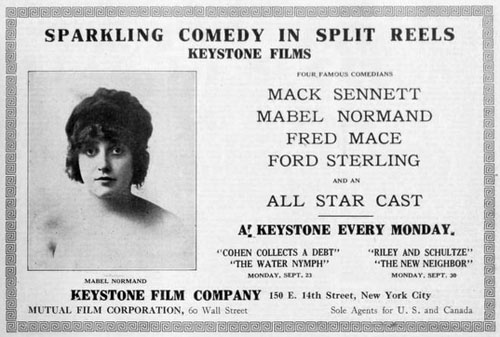
September 14, 1912. The Mutual Film Corporation will make the first release of Keystone films, for which it holdes the exclusive agency for the United States and Canada, on Monday, Sept. 25, with a split-reel comedy, “Cohen Collects a Debt” and “The Water Nymph.”
The leading parts in Keystone films are played by Mack Sennett, Mabel Normand, Ford Sterling and Fred Mace, supported by a strong cast. This quartet comes to the Keystone Co. from the Biograph, and their work is well known throughout the world. Mr. Sennett continues as director.
Shortly after Sept. 25 two reels of Keystone will be released, the reel made by Mr. Sennett and a dramatic production by another stock company, of which full particulars will be given when release dates are fixed. The Keystone comedy on Monday will always consist of two snappy subjects.
September 21, 1912. Doings at Los Angeles
Many Extensive Improvements Being Made in Picture Studios
Extensive improvements are in progress at three of the motion picture studios in this city. A large force of workmen is now engaged in erecting the new buildings at the plant of the Brand Advanced Motion Picture Co., located on a 40-acre tract in the San Fernando valley near the town of Burbank. The Universal people are spending a great deal of money on their new outdoor studio at Oak Crest near Los Angeles, where they have bought and leased a tract consisting in all of about 20,000 acres and are planning to build the largest motion picture plant in the world. James Young Deer, director of the Pathe Western company, has practically concluded the negotiations for the purchase of 35 acres of land at Edendale and architects are now at work on the plants for his studio, which if it will not be the largest in the world will be one of the most modern and one of the best equipped.
Preparations are also being made at Edendale for radical changes and extensions of the old Bison plant of the New York Motion Picture Co. Charles O. Baumann and A. Kessel are here from New York for a personal inspection of the plant and Mack Sennet, the director of the new Keystone company, preceded them by a couple of days. Sennet, with the assistance of Mabel Normand, Henry Lehrmann and Ford Sterling, who came from New York with him, and Fred Mace, former director of Imp comedies, is already at work at the Edendale plant making comedies for future release. The balance of the company was employed here, being recruited from the ranks of other companies on the ground. Fred Balshofer has announced that there are to be two Western releases a week by Ince and Ford, two split reel comedies, one by Sennet and the other by Mace, and one dramatic by a director who is coming on in a few days, but whose identity is not to be revealed at this time. It is reported that Baumann and Kessel, before they return to New York, may have other important revelations to make.
Mabel Normand, Keystone Films 1912
(news & images from The Moving Picture World July-September 1912)
Planning the defense of America. The war college in session
September 9, 1916. Producing Concern Alleges Manufacturer’s Strictures Against “Battle Cry of Peace” Have Damaged It Materially
The Vitagraph Company of America, through J. Stuart Blackton, vice-president, has brought suit in the Supreme Court of New York against Henry Ford, asking judgment in the sum of $1,000,000. The complaint is dated June 26 and alleges that on or about May 5, 1916, Mr. Ford caused to be published in not less than 250 newspapers published in the United States an article entitled “Humanity and Sanity,” in which the Detroit manufacturer charged in substance that the general agitation then prevailing in the country for preparedness and defense of this country against foreign invasion was due to the efforts of munitions manufacturers to promote their selfish interests and that “The Battle Cry of Peace,” a film manufactured and produced by the plaintiffs at great expense, was inspired by Hudson Maxim, “a manufacturer of munitions of war, in the interest of munitions manufacturers for the personal and selfish gain and interest of said Maxim and others interested with him in the manufacture and sale of munitions.”
Among the items complained of in the Ford article are such sentences as:
“Have you seen that awful moving picture, ‘The Battle Cry of Peace’?
“Did you shake with fear and tremble for your country’s safety?
“Did you know that others were shaking at the same time, but with laughter at your fear, and with joy over the fat contracts your fear might bring them?
“On the screen you were told that the play was founded on the story of Hudson Maxim, ‘Defenseless America.’ You saw Mr. Maxim in the picture. He was holding something aloft. It was an instrument of warfare.
“Now, Mr. Maxim was merely advertising his wares and playing on your fears to make a market for his goods.
“Mr. Maxim has something to sell — war munitions.”
At another point in the article occurred the sentences:
“The book was a fine advance notice. The picture was a fine follow-up.”
The complaint further sets forth that “the charge made in said article by the defendant was made and intended to convey to the public the impression that the said moving picture ‘The Battle Cry of Peace’ was produced by this plaintiff at the instance of and in the interest of the said Hudson Maxim or in the interest of manufacturers of steel, powder, arms, ordnance and munitions of war and for the purpose of furthering the personal and selfish interests of said manufacturers; and that the charge made in said articles was meant to and tended to convey the impression to the public that the plaintiff was willfully, wickedly and maliciously attempting to inspire in the public mind the belief that this country stood in great danger in the event of invasion” and that “this plaintiff did this from ignoble, dishonest, dishonorable and treasonable motives.”
The complaint declares the Vitagraph company produced “The Battle Cry of Peace” not only for commercial purposes and to furnish the public with a clean and interesting film drama,but for the purpose of furthering a national propaganda to enlighten the public upon the condition of the country as it was then known and for the purpose of communicating a great and important message to the American people: that the publication of the articles has to a great extent injured the reputation and business of the Vitagraph Company; that it has been and still is obliged to spend large amounts of money in publishing denials of said accusations in order to restore its reputation; and that as the result of the publication by the defendant the receipts and gains from “The Battle Cry of Peace” have materially decreased.
In commenting on the suit Mr. Blackton said:
“Mr. Ford has a right to his own opinions. If he thinks the great industry he has built up and the millions he has made should be left unprotected for a lot of barbarians to come and acquire almost without a struggle, he is welcome to such opinions. He may even spend time and money in spreading his propaganda, but he has no right to attack others who differ with his views.
“I wrote and produced ‘The Battle Cry of Peace’ to further the interests of practical preparedness, to arouse in the hearts of American citizens the sense of their strict accountability to their government, and through the tremendously powerful medium of the motion picture to counterbalance the pernicious influence of the apostles of peace at any price.’
“The accusation that munition interests are responsible for the picture is absolutely without foundation. In the latter part of April, 1915, Hudson Maxim sent me a copy of his book ‘Defenseless America.’ It contained many valuable and remarkable Statistics about the deplorable condition of this country’s defenses and 1 realized that a motion picture illustrating the facts set forth in the book would reach millions of people in a short period of time.
“Mr. Maxim was paid a stated sum for the use of the material in his book and around these facts I wrote the drama of ‘The Battle Cry of Peace.’ That was the only connection Mr. Maxim had with the affair. This was in April, 1915, and the Maxim Munition Company, of which I had never heard until Mr. Ford’s advertisements appeared, was not in existence until about December, 1915.
“Mr. Ford’s printed statement that munition manufacturers were back of the picture prejudiced many people against ‘The Battle Cry of Peace’ and damaged the business of theaters in many cities.”
Although the complaint is dated June 26, the papers were not served until recently, on the occasion of a visit to New York by Mr. Ford. The automobile manufacturer has applied to the New York courts for an order to remove the case to the District Court of the United States for the Southern District of New York. As a reason for the change Mr. Ford sets forth that he is a resident of Michigan. The order for the transfer was entered August 31.
September 23, 1916. VITAGRAPH VS. FORD TO U. S. COURT. Henry Ford, millionaire automobile manufacturer and prominent exponent of peace, who is named as defendant in a suit filed in the Supreme Court by the Vitagraph Company of America to recover $1,000,000 damages, has succeeded in having the action removed from the State Court to the United States District Court which tribunal wilt have future disposition of the case.
In his application for the removal of the suit to the Federal Court Mr. Ford set forth through his attorneys, Crisp, Handall & Crisp, that the plaintiff corporation has its principal place of business in New York, while his domicile as well as his business enterprises is at Detroit. Consequently he averred that owing to the diversity of citizenship of the parties to the litigation the Federal Court was the proper tribunal to adjudicate the issues.


 sempre in penombra