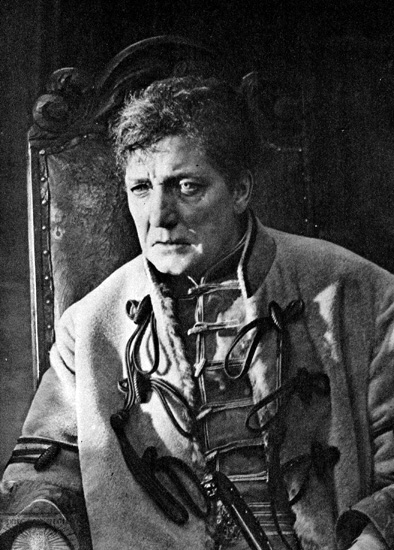
« Il Monastero di Sandomir, capolavoro cinematografico della Svenka di Stoccolma, messo in scena da Victor Sjostrom, interpretato dalla celebre attrice svedese Tora Teje. Altri interpreti Tore Svennberg e Richard Lund.
È la storia fosca di una nobile famiglia polacca distrutta dalla colpa d’una donna bellissima e simulatrice. Amore, tradimento, finzione, vendetta, si succedono attraverso il gioco serrato degli attori, che rappresentano i personaggi del dramma con verità umana e con tragica cupezza. L’espiazione mistica del marito, che atrocemente offeso nell’onore e negli affetti, s’era vendicato senza pietà, costituisce un episodio commoventissimo, pieno di significato spirituale e di bellezza scenografica. Il Monastero di Sandomir, sorto sulle rovine fumanti del Castello in cui fu consumato il terribile dramma, chiude nelle sue mura austere l’uomo che à offerta a Dio la sua triste vita spezzata, in olocausto del suo peccato di sangue. »
(dalla pubblicità del Sindacato per il Libero Commercio Cinematografico, Roma 1922)
« A dispetto dei costumi benelliani, Klostret i Sendomir (1919) è, in certo modo, l’opera più sperimentale di Sjöström. Quasi tutto girato in interni, il film, ambientato nel secolo decimottavo, si avvale di un’illuminazione fortemente effettata. Le linee sinuose della tragedia, cupamente evocata dal monaco (l’ex-castellano Starensky, uccisore della moglie Elga, bella e infedele), si intrecciano con quelle, ancor meno rettilinee, dello stile. È evidente che Sjöström, influenzato dalla messinscena espressionista, tenta una difficile meditazione tra il chiaroscuro di ascendenza fiamminga e la lezione di Munch. In pratica si va — come gusto — dalle illustrazioni per romanzi storici all’eclettismo del secondo Reinhardt. »
Francesco Savio (La parola e il silenzio, il film scandinavo dalle origini al 1954, Mostra di Venezia 1964)
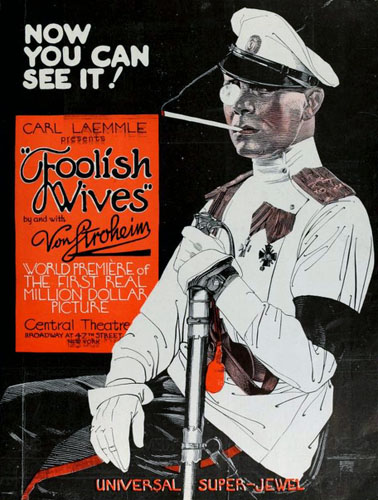
After taking nearly a year to produce, and another year to prepare for presentation, the much heralded “Foolish Wives” has arrived on Broadway (Wednesday, January 11, 1922) with the customary ovation accorded the more important film productions. Erich Von Stroheim‘s picture is one that is imbued throughout, from the first to the very last shot, with visual appeal and it is that element of gorgeousness that establishes the production as a million dollar affair. It would be impossible to go into detail here as to the elegance and superbness of the specially constructed sets that have cost small fortunes to build. But accuracy of detail was an essential, and Monte Carlo is offered in replica for the satisfaction of those who may have seen the original, and for the imagination of those who know it not. Casinos, palatial residences, and beach resorts too numerous to tabulate, offer the enchanting backgrounds against which Von Stroheim‘s story of an arch villain is portrayed.
As shown at its premiere, “Foolish Wives” ran three hours and forty minutes, with a five minute intermission, or approximately fourteen reels. Regardless of the magnificence and quality of either story or production, this is extreme for screen entertainment, or any other theatrical program for that matter.
The most important and immediate need of the picture is absolute and certain cutting. It cannot hold the attention of any audience for the length of time consumed by its present fourteen reels. Much of Von Stroheim‘s excellent, but none the less tedious, detail must necessarily come out to speed up the action and secure a better interest from the spectator. The ending, particularly, is especially dragged, with a flash of this and a flash of that, until it would seem that they never would reach the end. As originally shown the film ran over 14,500 feet, but after the opening night this was cut over 2,500 feet.
As a director, Von Stroheim asserts his mastery through his skilful handling of a not altogether nor universally appealing story. His development and characterization, notably in the way of detail, is convincing and rarely does he neglect minor bits except, maybe once, when he appears spick and span after wading for a considerable time through the marshes, while his fair companion looks much the worse for the experience. But this is not a frequent occurence and for the most part, everything else is distinctive. A melodramatic twist in which a fire plays an important part is followed by one of the picture’s weakest points, that of the birth of a child. The idea that the child will bring a reconciliation between the wife and the husband who has cause for doubt, is clear, but not a bit more convincing, since the husband’s character was intended to represent a fine, understanding type of American manhood. Some of the punches in the production are extremely unusual. Notable among these is the fire sequence, the marine with his forearms shot off, the storm, and many others.
“Foolish Wives” presents Erich Von Stroheim as the most convincing and thoroughly hateful villain of all time. His performance can best, and really only, be appreciated by actually witnessing it. He has selected a company of players which render individually fine performances. Mae Bush and Maude George, as two Countesses and cousins of the Count, are excellent, while Dale Fuller as a maid in the Count’s home, and also one of his victims, is effective in a difficult role. A great number of minor parts are also well handled and in many of the scenes thousands of extras appear.
Princesses Olga and Vera live in a luxurious home with their cousin. Count Sergius Karamzin. The spectator is aware that the trio are frauds who gamble at the casino at Monte Carlo, with counterfeit money. It is the Count’s business to make the acquaintance of notable visitors to further their schemes. So it is he effects an introduction to Mrs. Hughes, the beautiful young wife of an American Envoy. In the course of events, it transpires that the Count picks his women victims at variance. One is a maid in his home, another the half-wit daughter of Ventucci, a counterfeiter, and finally, after a carefully laid ruse, he traps the American woman. Honor is nothing to him. He asks her to aid him financially. She goes to him and the two are locked in a tower which is set on fire by the jealous and betrayed maid, who then commits suicide to hide her shame. The Count and Mrs. Hughes are rescued and the birth of her child secures her husband’s forgiveness. The same night Sergius attacks the half-wit girl and is killed by her father and thrown into the sewer. Finally the two “Countesses,” in reality international crooks, are exposed. (The Film Daily, January 15, 1922)
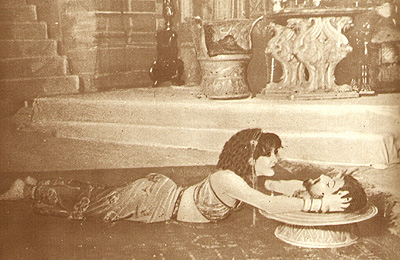
Lyda Borelli interprete di Salomè al Teatro Valle 1909
Per tutta la famiglia del teatro Ruggero Ruggeri diventò matto sul finire del 1908 quando, unitesi, per il capocomicato, in società con Paradossi, udendo recitare una giovane attrice che egli aveva conosciuto bambina pensò improvvisamente di farne la sua «prima donna».
Quell’attrice era allora «amorosa» con Talli.
— Matto! Matto! Matto! — dissero allora i suoi colleghi e i suoi amici.
Quell’attrice era Lyda Borelli.
La Quaresima che iniziò il nuovo triennio se fu proficua di soddisfazioni, fu eccessivamente laboriosa, snervante.
Ad eccezione del Ferrero che era già stato brillante con lui, il triennio precedente. Ruggeri si trovò ad avvere a che fare con elementi completamente nuovi : Bonafini, Calò, Campa, la Cartoni-Talli, e, più specialmente la Borelli.
Il repertorio, nuovo per tutti, era in parte nuovo anche per lui, cosi che ogni mattina la prova cominciava alle otto e mezzo per finire senza interruzione, fra le cinque e le sei; poi la; recita e poi… non raramente qualche prova generale dopo lo spettacolo.
Quegli attori secondari a otto o nove lire al giorno, quei generici a sei e sette, quelle attrici con dodici o quindici al massimo — credo che la Borelli stessa guadagnasse poco più di trenta lire al giorno — erano meravigliosi per disciplina, per buona volontà e per senso d’arte.
E la Compagnia Ruggeri era quella che in rapporto alle altre offriva più lauti stipendi.
Anche il capocomico s’alzava presto la mattina. E non era lieve sacrificio. Arrivava sul palcoscenico un po’ nervoso, un po’ accigliato. Si metteva presso la buca del suggeritore dietro un paravento e, giù, al lavoro.
La Borelli, fasciata da un lungo golf di lana bianca, con il volto esile affondato nell’oro abbondante della sua capellatura e illuminato dalla luce intelligente degli occhioni, pareva ancora più giovane di quello che era; non aveva dormito. Aveva studiato tutta la notte ed era lì gaia, fresca, piena di ardore e di sicurezza: memoria prodigiosa al servizio di una volontà di ferro.
Ruggeri era direttore assai severo e molto esigente: mentre si dedicava con una pazienza di cui sembrava incapace a coloro che mostravano buona volontà e facilità di comprendonio, era addirittura un medico crudelmente sincero per quelli che giudicava privi di ingegno o comunque fannulloni: e li scartava od aveva per essi così taglienti ironie ch’erano più amare d’una sfuriata.
In quella Quaresima lo si vide alle prove fare le parti di tutti. uomini e donne, dando un colore ad ogni personaggio, una: personalità un carattere ad ogni interpretazione. È il suo metodo di direzione. Generalmente i suoi insegnamenti stringono l’attore nei confini di sue regole personali, informate però sempre a estetica e a buon gusto. Egli non soffoca l’altrui genialità, ma conferisce all’esecuzione generate un’armonia nella quale è impossibile non udire e non vedere lui.
Allora, oggi e sempre, la Compagnia di Ruggeri ha avuto ed avrà una caratteristica propria: l’eleganza nel tono e nello stile. Il pubblico decretò che Ruggeri era rinsavito quando, in quella stessa laboriosa Quaresima del 1909, al Teatro Valle di Roma, la sera di un suo compleanno, Lyda Borelli si avventurò trionfalmente nel grande cimento di Salomè.
Quella rivelazione fu anche il doppio trionfo di Ruggeri: triondo profeta e di direttore.
Egli era stato un profeta che aveva voluto ad ogni costo avverare la sua profezia e nelle lunghe e numerose prove del singolare lavoro di Oscar Wilde, l’ultima delle quali durò fino alle sei del mattino, Ruggeri fu, quale direttore di Lyda Borelli, artefice di un’arte irraggiungibile. Plasmò, scolpì, creò. La creta era ancora informe e da quella egli trasse tutte le virtù che fecero poi della bellissima attrice la più acclamata delle nostre artiste.
Ognuno di noi sa quale carriera luminosa ella abbia poi fatto, troncata soltanto per sua volontà.
 sempre in penombra