Violet Hopson: It is character that counts

Is the Villainess Popular?

This is the question which we asked Miss Violet Hopson recently, knowing that in a great many of her films she portrays the wicked woman of the piece.

“Yes,” she said. “I think to a great extent men like just a little bit of villainess in every woman. And I am sure the reasons for this are, that one seldom finds a woman, who is a villainess either in fiction or real life, who has not a very strong personality and a great command of self. And men admire a woman with plenty of character, don’t they?

“Besides, women’s  responsabilities have increased to such an enormous extent during the last four years, that the majority of us have become rather independent. This terrible war has in a great many ways improved woman’s position in this country; and I am certain that men who have been overseas for so long will consult their women-folk, and consider their advice far more than they have done in the past.

A Villainess is Often Sympathetic

“But I certainly do not think that the siren-villainess is at all popular. She is the type of woman who is out to cause trouble everywhere. On the other hand, the mild type of  villainess has such a complete comprehension of human nature and its myriad frailties that she also possesses a wonderful sympathetic nature. And sympathy is one of the finest traits in any woman’s character.

“Many of the letters which I receive (and they number on an average 700 a week) are from the opposite sex, and a great proportion of them convey appreciations of my film work. I find my screen characters are popular because I usually portray women who are strong-willed, and yet not real sirens.

“The fluffy, irresponsible type of woman may be popular, and in many cases she may have offers of marriage; but I think our returned warriors are looking for the reliable, capable girls as mothers of the coming generation.

He Liked a Woman With a Temper

“One correspondent in a recent letter writes: ‘I’ve always liked villainesses, but I have really fallen in love with one – you can guess who it is. The only thing that worries me is that is that if I marry a villainess I’m  afraid I shall not have enough money to buy all the wonderful clothes they always seem to require.’

“Another one writes:  ‘I love to see you on the screen. I prefer girls with a bit of a temper and who can stick up for themselves, and your characters are just right – especially when you played Mady Launcelot in the Nat Gould racing story – she was my ideal woman. A thorough sportswoman yet so sympathetic.’

“As a rule tha villainess usually turns out to be a really good sort in the end; and I think this is so in real life too, for no matter how villainous a person may be, there is always some fine, dominant feature in their character that will make them well worth while. For, as Carlyle says, ‘Evil, in the widest sense we can give it, is precisely the dark, disordered material out of which man’s free will has to create an edifice of order and good.’ ”

Her Own Brand of Pictures

When not acting for the Broadwest Film Company Miss Violet Hopson intends offering to the world her own particular brand of pictures. She believes she knows what the public wants and likes. Her first production is to be a racing story, “For,” she says, “Our national sport is undoubtedly horse-racing. The fascination of the turf is inborn in us.”

(The Picture Show, May 17, 1919)

Links: Violet Hopson on Women and Silent British Cinema; Video From the Scottish Screen Archive:  Miss Violte Hopson visits Dundee Fire  Station (1920) 5′
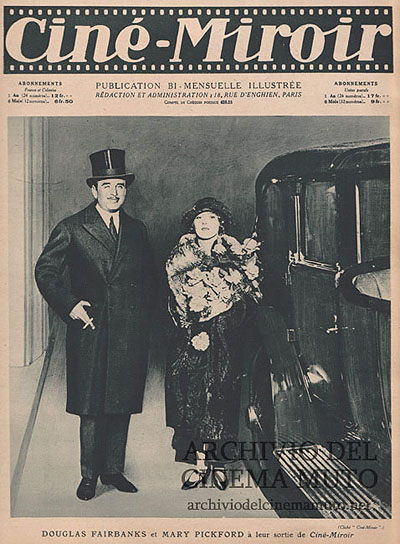
Douglas Fairbanks et Mary Pickford à Paris, mai 1924

Douglas Fairbanks et Mary Pickford à leur sortie de Ciné-Miroir

L’inimitable “Doug” et Mary Pickford, “La Bien-Aimée du monde” pendant leur séjour à Paris ont rendu visite a “Ciné-Miroir”

Nous avons eu le grand honneur de recevoir Douglas Fairbanks et Mary Pickford. Ce fut une réunion sans tapage, sans réclame, comme c’est l’habitude dans notre maison; une fête tout a fait intime, mais que nous devons raconter à nos lecteurs, puisque ce sont eux qui font le succès de Ciné-Miroir et accroissent, chaque jour, son influence : les amis de nos amis sont nos amis. Déjà, à l’arrivée à Cherbourg de Doug et de la délicieuse Mary, la bien-aimée du monde, nous avions envoyé l’un de nos collaborateurs, M. Bourdet, pour les saluer en notre nom. Un collaborateur… un ambassadeur devrait-on dire, puisqu’il s’agissait d’une majesté : Sa Majesté Douglas… Et, après avoir vu bien des rois dans nos randonnées à travers l’Europe, nous pouvons assurer qu’il en est peu qui méritent a ce point l’admiration populaire. Ce qui retient, captive, conquiert, en effet, dans un couple humain, c’est moins l’éclat de sa renommée ou l’éblouissement de sa fortune que la bonté, la simplicité qu’il dégage. A ce point de vue, le couple Douglas Fairbanks-Mary Pìckford donne un spectacle absolument exquis.

Lorsque, dans le cabinet de notre directeur, en ce soir du 9 mai, ils parurent, accompagnés de M. Smith, le très remarquable représentant a Paris de la firme United Artists, il y eut non pas des applaudissements, mais un silence que chacun laissa couler, car chacun était déjà sous le charme. Ces deux grands acteurs ne faisaient point une entrée de théâtre, ils venaient vers nous camme s’ils étaient seuls dans l’allée d’un jardin. Mary, plus petile, délicieuse de féminité, légèrement appuyée sur son mari, confiante, enchaînée au même destin… Mais c’est à l’intérieur d’une pièce qu’il faut voir Douglas Fairbanks : sous l’impeccable jaquette et malgré l’embarras de son haut de forme, il reste l’athlète toujours prêt à mesurer sa force, à manœuvrer ses muscles. Dans un appartement, il se sent visiblement enfermé : sauvage et résigné tout ensemble, il fixe de ses yeux gris foncés les murs, les fenêtres, comme s’il cherchait une ouverture par où s’échapper. Ce qui frappe en lui, c’est un corps et un esprit s’entraînant sans arrêt, perpétuellement tendus vers l’effort, vers l’œuvre à réaliser. Nos hôtes, nous l’avons dit, furent reçus dans l’intimité. Douglas, qui comprend le français, laisse à Mary Pìckford le soin de s’exprimer dans notre langue, ce dont elle s’acquitte avec une ìnfinie bonne grâce.

Jean Vignaud (Ciné-Miroir n. 51, 1 juin 1924)

L’arte di Buster Keaton secondo Luis Buñuel

In Keaton l’espressione è semplice come quella di una bottiglia, ad esempio; sebbene sulla pista rotonda e chiara delle sue pupille la sua anima asettica. Ma la bottiglia e il viso di Keaton possiedono punti di vista infiniti.

Sono elementi rari cui è affidato il compimento della missione dell’ingranaggio ritmico e architettonico del film. Il montaggio, chiave di volta del film, combina commenta e unifica tutti questi elementi. Ci si può attendere una maggior capacità cinematografica? Si è voluto credere all’inferiorità di Buster, “l’antivirtuoso”, rispetto a Chaplin; farne una specie di limite a tutto svantaggio del primo, una specie di stigmate. Riteniamo un pregio la capacità di Keaton di giungere al comico mediante l’armonizzazione delle situazioni, degli oggetti e degli altri mezzi di realizzazione. Keaton è carico d’umanità; di più: d’una recente e increata umanità, di una umanità alla moda se vogliamo.

Luis Buñuel (Cahiers d’Art, n. 10, 1927)