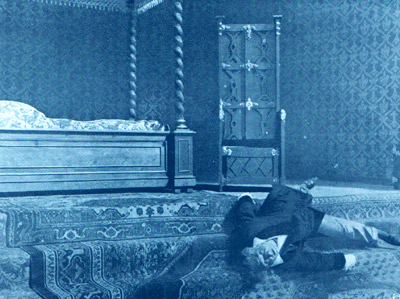
La vita intima di Sua Santità Pio X 1912

Un fotogramma del film

Correva l’anno 1910 quando l’operatore cinematografico Aldo Molinari, giornalista e scenografo nato a Roma il 13 dicembre 1885, ottenne il permesso della Prefettura SS. PP. AA. di eseguire alcune fotografie nei giardini del Vaticano. Il permesso fu rinnovato ben cinque volte.

Nel 1912, il film La vita intima di Sua Santità Pio X era pronto per la distribuzione. Questo film “dal vero”, rappresentante per l’Italia Giuseppe Barattolo, concessionario Mario Falace per Roma e Lazio, Italia Meridionale e Isole, Marche, Umbria, Abruzzi, Tripolitania e Cirenaica, fu distribuito in altri paesi di Europa e America.

Sembra che il risultato economico fu abbastanza buono. Parte dei ricavi furono impiegati nella fondazione della casa di produzione Vera Film, che nel 1913 produsse, fra le altre pellicole, Mondo baldoria “primo soggetto futurista con visioni grottesche del dolore umoristico”.

La vita intima di Sua Santità Pio X non compare nel volume Cinema Muto Italiano – I film “dal vero” 1895-1914, Aldo Bernardini (La Cineteca del Friuli 2002), né con questo, né con altro titolo alternativo. A pagina 134 di Cinema delle Origini in Italia – I film dal vero di produzione estera 1895-1907, sempre Aldo Bernardini (Cineteca del Friuli 2008), si trovano alcune informazioni sul documentario La ville eternelle, produzione Pathé 1907. Secondo le recensioni, anche in questo documentario (m. 170), fra le altre scene, si vede Pio X a passeggio nei giardini del Vaticano.

Duke and Duchess of Sutherland on the Films

Duchess Plays Part on The Film
The Duchess of Sutherland, Douglas Fairbanks and Mary Pickford

The lure of the movies has captured even the Duke of Sutherland, who motored out to Hollywood and paid a surprise visit to Douglas Fairbanks’ studio recently.

After watching Douglas Fairbanks filming one of his scenes for his new Big Four picture, the duke asked if it would be possible for him to meet Mary Pickford. Miss Pickford was on location, but was reached by special messenger and returned at once.

The duke mentioned the fact that he had devised a scenario, and would like to see it produced, and the drama was promptly staged by Douglas Fairbanks.

It was some cast! Mary Pickford agreed to take the part of a maid, and Fairbanks played the villain. So, for the first time in history, the film’s most famous woman star and most popular male star appeared together in a picture. General J. W. Stewart, Admiral R. J. N. Watson, and Mr. Dudley Ward, M. P., members of the duke’s Party, were assigned parts, and the action commenced.

The Plot.

The action revolved around the duchess’s pearls – real ones – which were pilfered by Doug, the heavy villain, during service of tea. But Mary Pickford, the maid, discovers the plot, and is kidnapped by Admiral Watson. The General Stewart, as a Scotland Yard man, of course, miraculously appears, and the villain explains that he only annexed the pearls so as to cause an uproar in the duke’s home, and thus prevent his appearance in Parliament, where he was all set to make a speech.

The duke and duchess put in the whole afternon at the thrilling sport, and the notable film was brought back to England to entertain their friends.

After he had finished filming his scenario the duke and duchess motored to Douglas Fairbanks’ beautiful new Beverly Hills home on the hills above Hollywood, for dinner. Those present, in addition to the ducal party, where Mary Pickford, Charlie Chaplin and Mildred Harris, who in private life is Mrs. Chaplin.
(from The Picture Show, January 24th, 1920)

I don’t know what happened to the film, but it was the beginning of a long friendship:  Letters from Hollywood: Duchess Millicent’s Letters from Mary Pickford (The Sutherland Collection)