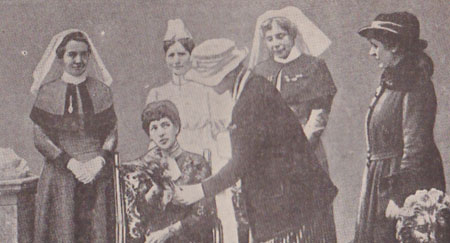
Royalty takes part in cinema play 1919

Women Who Win 1919
Queen Alexandra congratulates the leaders on the success of their work

The Cinema stage has scored a great triumph in being able to present to the millions of its patrons members of the English Royal family taking part in the photoplays, “Women Who Win,” and “The Power of Right.”

“Women Who Win” is a romantic drama, written by Miss S. Alma Stout. It tells of the Graham family, who have to face financial ruin. The girls turn out to work, but are inexperienced, and are quickly dismissed.

‘At their wits’ end how to get experience, Miss Wilson, a friend, suggests the Women’s Service Training Bureau.

They join, and we see them working in the positions they have attained.

This is the part of the story where the Queen and the Royal ladies come into the film.

Betty Graham, who is now a proficient and expert gardener, obtains a post at Clarence House, and very proud is she when Princess of Sweden, walking through the grounds, paused for a kind, appreciative chat with her; but even more gratified was the warm-hearted girl when her dear friend, Miss Wilson, was presented to Queen Alexandra.

Ella Graham, now a journalist, is commissioned to write up the work of women in an aircraft factory. H. M. Queen Mary is also a visitor to the works that afternoon, and chats with the workers.

We also see Queen Alexandra and Princess Victoria interesting themselves in the work of the bureau, and congratulating the leaders on the success of their work. The part of Miss Wilson is taken by Phyllis Villiers. Mr Davison, who holds the world’s rights of this photo-play, had the honour of being presented to Queen Alexandra.

“The Power of Right,” which, opening with a period depicting Britons as cave-dwellers. shows how, right through the ages, a constant struggle has been going on between Might and Right. In this story the Prince of Wales rewards Leslie, the hero, for capturing a spy. The part of Leslie is taken by Leslie Reardon.
Violet Hopson: It is character that counts

Is the Villainess Popular?

This is the question which we asked Miss Violet Hopson recently, knowing that in a great many of her films she portrays the wicked woman of the piece.

“Yes,” she said. “I think to a great extent men like just a little bit of villainess in every woman. And I am sure the reasons for this are, that one seldom finds a woman, who is a villainess either in fiction or real life, who has not a very strong personality and a great command of self. And men admire a woman with plenty of character, don’t they?

“Besides, women’s  responsabilities have increased to such an enormous extent during the last four years, that the majority of us have become rather independent. This terrible war has in a great many ways improved woman’s position in this country; and I am certain that men who have been overseas for so long will consult their women-folk, and consider their advice far more than they have done in the past.

A Villainess is Often Sympathetic

“But I certainly do not think that the siren-villainess is at all popular. She is the type of woman who is out to cause trouble everywhere. On the other hand, the mild type of  villainess has such a complete comprehension of human nature and its myriad frailties that she also possesses a wonderful sympathetic nature. And sympathy is one of the finest traits in any woman’s character.

“Many of the letters which I receive (and they number on an average 700 a week) are from the opposite sex, and a great proportion of them convey appreciations of my film work. I find my screen characters are popular because I usually portray women who are strong-willed, and yet not real sirens.

“The fluffy, irresponsible type of woman may be popular, and in many cases she may have offers of marriage; but I think our returned warriors are looking for the reliable, capable girls as mothers of the coming generation.

He Liked a Woman With a Temper

“One correspondent in a recent letter writes: ‘I’ve always liked villainesses, but I have really fallen in love with one – you can guess who it is. The only thing that worries me is that is that if I marry a villainess I’m  afraid I shall not have enough money to buy all the wonderful clothes they always seem to require.’

“Another one writes:  ‘I love to see you on the screen. I prefer girls with a bit of a temper and who can stick up for themselves, and your characters are just right – especially when you played Mady Launcelot in the Nat Gould racing story – she was my ideal woman. A thorough sportswoman yet so sympathetic.’

“As a rule tha villainess usually turns out to be a really good sort in the end; and I think this is so in real life too, for no matter how villainous a person may be, there is always some fine, dominant feature in their character that will make them well worth while. For, as Carlyle says, ‘Evil, in the widest sense we can give it, is precisely the dark, disordered material out of which man’s free will has to create an edifice of order and good.’ ”

Her Own Brand of Pictures

When not acting for the Broadwest Film Company Miss Violet Hopson intends offering to the world her own particular brand of pictures. She believes she knows what the public wants and likes. Her first production is to be a racing story, “For,” she says, “Our national sport is undoubtedly horse-racing. The fascination of the turf is inborn in us.”

(The Picture Show, May 17, 1919)

Links: Violet Hopson on Women and Silent British Cinema; Video From the Scottish Screen Archive:  Miss Violte Hopson visits Dundee Fire  Station (1920) 5′

El cine en el aire, julio 1919

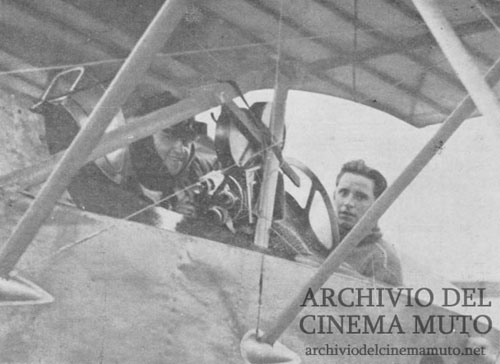
José Gaspar Serra, a la izquiera de la imagen cámara en mano

Es la hora, llena de encantos y poesía del atardecer.

Por el Paseo de Gracia, la aristocrática avenida, muy moderna y muy cuidada, donde los árboles ponen su rusticidad al lado de los escaparates llamativos y lujosos, pasean algunos desocupados: son en su mayoría personas pertenecientes a la clase media, a esa clase escarnecida por los de arriba y por los de abajo, que tienen ambiciones pero que no tienen voluntad.

(…)

El cielo, que poco antes era añil, se va blanqueando, palideciendo, como si entre él y la tierra hubiesen extendido un velo denso. Y de pronto, un espectáculo extraño se ofrece en las alturas.

Es al principio un ruido continuado, como de un motor a toda marcha. Luego en la bóveda blanquecina, aparecen dos aparatos con grandes alas y larga cola: son como dos pajarracos de una especie desconocida. Uno de ellos va delante, haciendo las piruetas en el espacio, girando vertiginosamente, dando saltos mortales, cual si estuviera poseídp de una locura infernal.

El otro, a poca distancia, lo va siguiendo, recto, sereno, como velando por la seguiridad del compañero.

En el paseo, la gente se arremolina, observando las raras maniobras de los dos aeroplanos. Y en el largo crepúsculo, el sol semeja detenerse, para gozar también del caprichoso espectáculo.

Algunos días después non enteramos: aquellos aeroplanos se dedicaban a la toma de vistas, haciendo una curiosa innovación. En el aparato de delante, iba haciendo de piloto, a la vez que de actor cinematográfico, el intrépido aviador Grassa, del ejército italiano, el cual obedecía las órdenes que se le transmitían desde el otro aeroplano. Este último iba tripulado por Stoppani, que hace poco realizó de un solo vuelo el viaje Turín-Barcelona, y llevaba como pasajero a nuestro amigo don Gaspar Serra, de la Regia Arts, el cual iba impresionando la película.

Así, esta cinta tendrá el atractivo de verse, por sobre el fondo que forman las casas y las calles de Barcelona, el efecto emocionante de los saltos y giros del otro aparato.

Don Gaspar Serra, espíritu cultivado, que sabe de la vida intensa y vertiginosa en la ciudad de los rascacielos, es el que ha introducido en España esta novedad en las vistas tomadas en aeroplano.

Agradezcámoselo. Así la monotonía de las calles rectas y de los edificios idénticos será rota por una emoción nueva.

Ezequiel Moldes (El Mundo Cinematográfico, 25 julio 1919)

Nota: el documental se llama Vistas aéreas de Barcelona (Regia Arts Films Corporation 1919), ignoro si ha sobrevivido alguna copia.