Does the Photoplay Patron Prefer Comedy or Serious Subjects?

New York February 1912. There seems to be a considerable conflict of opinion among the potent figures of the film industry as to the preference the patrons of Photoplay theater have for comedy, the majority stating that there are not enough laughter-provoking pictures.

To discuss this all’important phase of the Moving Picture, one must naturally turn to the stage for data, in order that such a problem may be fairly solved, and there is nothing to indicate that the playgoers of modern times have been attracted to the playhouse thru comedy offerings as they are to see and hear plays and players, and songs and singers, of a more serious character. Moreover, all the great records achieved in the amusement field indicate a trend of public taste for the dramatic rather than for plays of a farcical order.

“Ben-Hur” has been before the public for twelve years; it has made a million for the producers, and there is almost a total lack of comedy in the portrayal of his epochal play. The most potent plays at the present time are nearly serious: “The Return of Baron de Grimm”; “Mme. X”; “The Littlest Rebel”; “The Music Master”; “The Garden of Allah” and “The Price” have attracted solely for tear-making qualities.

Closer to Moving Picture requirements, a study of vaudeville records shows that the most enduring playlets were such offerings as “The Littlest Girl”; “A Man of Honor”; “A Romance of the Underworld”; “Frederic Lemaître” (in which Henry Miller enthralled vaudeville audiences), and only a few days ago Blanche Walsh held an audience spellbound in a one-act play that had not even a smile in it.

“The Woman,” a Belasco success, draws large audiences without a star, because of the one compelling serious scene. “A Fool There Was” is considered the best “repeater” of modern plays, while Mrs. Leslie Carter has once more held her enormous clientele steadfast with “Two Women,” a play without a single comedy line.

Shakespeare’s tragedies always draw; his comedies are rarely given.

Comic opera has always spelled bankruptcy for the managers who would tempt fate with them, while grand opera al the Metropolitan Opera House draws an average of $70,000 a week, at $6 a chair.

No comic song ever had the vogue of such plaintive ballads as “Tha Last Rose of Summer,” “Home, Sweet Home” and “After the Ball,” all tear-compelling.

Even pantomime had its greatest vogue  with “Un Enfant Prodigue,” a veritable tragic poem without words.

No one will deny that the vogue of the silent drama is what it is, greatly, because such worthy film producers as the Vitagraph, Kalem, Biograph, Edison and others have realized that to  cater to the patronage most desired, they must emulate the methods of the highest grade  od producers of the stage, and they also are aware of the fact that the technique and philosophy of the silent drama is such that they are enabled to score even greater triumphs than the Frohmans and the Klaw and Erlangers, for the stage has its limitations, whereas the Motion Picture play is greatly enhanced by the verity and realism of nature’s own vast resources!

Robert Grau

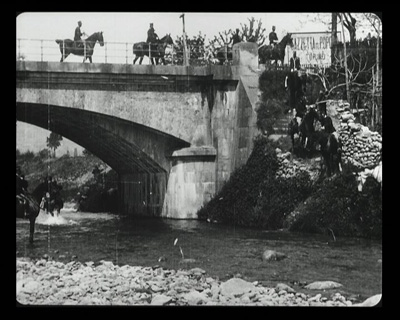
I Centauri di Tor di Quinto, località vicino a Pinerolo

Tor di Quinto, fotogramma del film (dal DVD della Española)
Tor di Quinto, fotogramma del film (dal DVD della Filmoteca Española)

Qualche giorno fa raccontavo del libro-dvd della collezione Sagarmínaga, una collezione di film dal 1897 al 1906, ritrovata in Spagna del 1997.

Uno dei film contenuti nel DVD 2, è Tor di Quinto, descritto così nel volume della Filmoteca Española, pagina 171:

Tor di Quinto, casa di produzione Warwick, Regno Unito, anno 1905, genere: scena all’aria aperta. Il marchio Warwick Continental Trading Parigi, compare nei primi fotogrammi. Tor di Quinto è una famosa scuola di cavalleria italiana, vicino a Roma. Insieme al titolo, la sequenza finale è virata in giallo. Metraggio 213,7 metri = 10′ 23 “ 18 f/s.

Secondo il catalogo Cinema Muto Italiano – I film dal vero 1895-1915, di Aldo Bernardini, Cineteca del Friuli 2002, Tor di Quinto (La scuola di cavalleria), operatore Giovanni Vitrotti, produzione Ambrosio e C. 1906, 98 metri, la descrizione dei quadri ed il metraggio (sopratutto il metraggio) corrisponderebbero soltanto ad una parte del Tor di Quinto ritrovato nella collezione Sagarmínaga. Una delle fonti d’epoca è una locandina del Politeama Piacentino del 2 giugno 1906:

1. Gli ufficiali della Scuola si recano alle esercitazioni. 2. Sfilata degli Ufficiali. 3. Discesa al galoppo di un’alta collina. 4. Salto d’ostacoli per gruppi – Galoppate – 5. Difficoltose scivolate a picco (viste di fianco e di fronte): esercizio riprodotto da molti giornali illustrati per la sua eccezionalità. 6. Salti di staccionate – Emozionanti cadute.

Il primo problema con il film omonimo incluso nel DVD della collezione Sagarmínaga, anno di produzione Warwick, Regno Unito 1905, titolo virato in blu, sottotitolo in tedesco: Die Centauren der Gegenwart!, è che ci troviamo davanti ad un metraggio molto più lungo dei 98 metri. Il secondo è la casa di produzione (Warwick Regno Unito? Warwick Continental Trading Parigi?). Il terzo…. guardate con attenzione l’immagine sotto (il cartellone pubblicitario della Gazzetta del Popolo – Torino). Secondo voi: le immagini corrisponderebbero a Tor di Quinto, località vicino a Roma?

Tor di Quinto, fotogramma del film (dal DVD della Española)
Tor di Quinto, fotogramma del film (dal DVD della Filmoteca Española)

Il film contenuto del DVD 2 della collezione Sagarmínaga è, sicuramente, un montaggio arbitrario del proprietario della collezione, ma non è un film del 1905, quasi tutte le scene, secondo le fonti d’epoca, corrispondono a I Centauri: esercitazioni dei cavalleggieri del Pinerolo, operatore Roberto Omegna, produzione Società Ambrosio 1908, metri 234, distribuzione Raleigh et Robert (Warwick Continental Trading) in Francia (e Germania) 1908-1909. Un vero successo al botteghino… Per sapere di più… sono qui, alla vostra disposizione, come al solito.

Ritorna online il Cinestore della Cineteca di Bologna

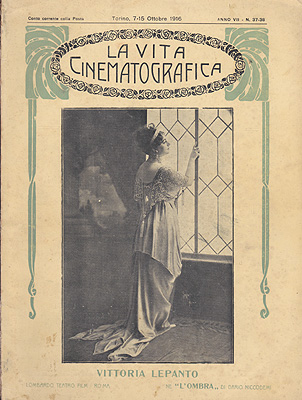
La Vita Cinematografica 1916
Vittoria Lepanto, La Vita Cinematografica 1916 (archivio inpenombra)

Cinestore che tempi… e che prezzi, vi ricordate? Era un post in questo blog del 1° febbraio 2011.

Il Cinestore, il negozio online della Cineteca di Bologna è ritornato: le fotocopie del Museo del Cinema di Torino, Fondo Vittorio Martinelli “disponibili” a prezzi sbalorditivi.

Una fotocopia ilford 50X70 a 140 Euro? Acquisto diritti per uso professionale in tutto il mondo?

La copertina di La Vita Cinematografica con Vittoria Lepanto non è l’unica pagina di rivista in vendita… Non ho parole. Ragazzi, avete sentito parlare della Media History Digital Library? Lo stesso Museo del Cinema di Torino, collezione online, riviste e monografie del cinema muto italiano mette a disposizione, gratis, parecchie riviste che da voi costano 140 Euro a pagina. Tutto gratis… che follia, che siamo matti!