La Tribuna, Roma 27 agosto 1913: Il Cine, questa forma di teatro contemporaneo al quale fino ad ora fu negato carattere e possibilità artistiche e contro il quale si sono appuntate le critiche e prevenzioni di esteti completamente imbevuti dei vecchi concetti dell’arte e del teatro, sta con la sua sorprendente evoluzione comprovando che esso può divenire un teatro a sè stesso, il teatro dell’avvenire, capace di darci quelle sensazioni nuove e potenti delle quali i nostri spiriti e le moderne folle sentono bisogno.
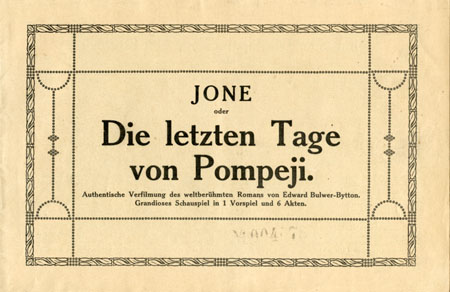
Oggi al Teatro alle Quattro Fontane avranno inizio degli spettacoli straordinari con Jone ovvero Gli ultimi giorni di Pompei, una cinematografia che in modo assolutamente mirabile e suggestivo traduce in dramma il celebre romanzo del Bulwer.
In questa film d’arte che assiede la Casa Pasquali di Torino fra le più grandi case editrici di films del mondo non v’ha nulla che possa, anche lontanamente, uguagliarsi e paragonarsi a quanto è stato sin qui tentato nel genere.
Tutto esso supera, tutto distanza, creando vasti e nuovi orizzonti all’arte novissima. Con una sapiente commisurazione di mezzi tecnici ed artistici al fine da raggiungersi, questa opera cinematografica riesce a darci una serie di sensazioni ed emozioni nuove, violente, difficilmente analizzabili, come sono quelle che derivano dalla visione di un grande e commovente dramma delle persone e dalla visione di un dramma delle cose, dallo scatenarsi delle cieche forze e degli impervi elementi naturali che tutto travolgono, tutto abbattono, ogni dissidio componendo nel loro immane impeto.
La proiezione sarà accompagnata da un’orchestra eccezionale la quale eseguirà una sinfonia che il maestro Berni ha tratto dall’opera di Petrella: La Jone.
Questo film sarà proiettato il prossimo 13 settembre al British Museum di Londra in occasione della mostra Life and death in Pompeii and Herculaneum.
Dopo Dante e Beatrice, rimanendo nel 1913 come anno di produzione, vorrei proporvi la visione di un film completamente diverso e disponibile “per tutti”.
Secondo me, Ingeborg Holm è un melodramma condotto con mano maestra da Victor Sjöstrom, magnificamente interpretato da Hilda Borgstrom. Come sanno quelli che seguono il blog, non scrivo mai recensioni sui film, limitandomi a pubblicare documenti d’epoca. Sempre secondo me e nel massimo rispetto di quelli che la pensino diversamente, la critica cinematografica è un po’ come i testamenti, risulta valido soltanto l’ultimo. Se questa regola può essere applicata a qualsiasi film uscito nei ultimi, mettiamo 50 anni, lo è ancora di più per i film del cinema muto che considero innanzitutto come documenti storici. Per questo motivo, per sapere cosa c’è scritto nel testamento Ingeborg Holm anno 2013, vorrei invitare quelli che leggono questo post a recensire il film inviandomi poi il link.
Tempo fa ho pubblicato una parte delle memorie di Victor Sjöstrom dove si raccontano alcuni interessanti particolari a proposito della realizzazione, e la polemica che sollevò in Svezia nel lontano 1913…
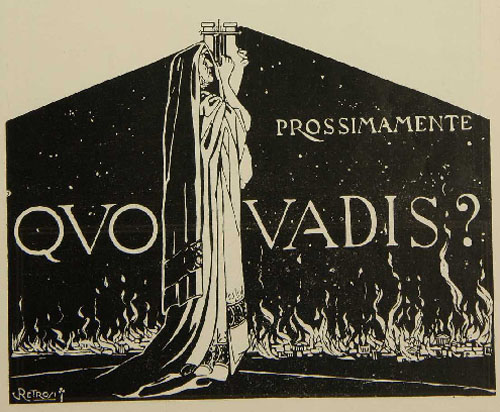
Coming soon “Quo Vadis?” (design by Retrosi, 1913)
1914. There are times when mere words appear totally inadequate to fittingly describe anything great and magnificent, and in attempting a pen picture of the colossal production of “Quo Vadis?” we find language almost fails us to convey anything like the beauty, fascination, magnificence, and power to enthrall the production possesses. The work of Henryk Sienkiewicz is an acknowledged classic and has stood out amongst works of fiction as containing the most faithful representations of Roman History round the time of the voluptuous Nero. In this great reproduction, the Cines Co. have faithfully followed the lines laid down by the novelist, and we have such a series of pictures as have never previously been presented to the public. Every incident of the novel appears to have been preserved with remarkable fidelity, and while every scene has its point of interest, there is a tenseness and gripping power throughout that cannot fail to impress. There is not a weary moment during the whole of the six reels. Interest is sustained from beginning to end, and when the curtain falls on the last scene, there is a feeling of regret that we have not more to witness, and a wonder that the kinematographic art has reached such a state of perfection. There have been in the past many delightful and remarkable productions, but it will be long before the Cines Co.’s wonderful masterpiece “Quo Vadis?” is surpassed, and we look forward with confidence to the subject proving a real source of pleasure to the public, and one of the most powerful attractions yet seen in the world of pictures.
On all points the subject is a wonderful production. The beauty and magnificence of the various scenes and incidents are remarkable. Whether it be the fascinating scenes in the court of the profligate Nero, the burning of Rome, the striking incidents connected with the persecution of the Christians, the great thrilling depiction of the sports and pastimes in the amphi-theatre at Rome, or the more subdued incidents in the development of the remarkable story, we find the same completeness and mastery of detail. No expense or effort has been spared in the production, which we can well understand has been a work of considerable time and unlimited expenditure.
There is a sharpness and conciseness in the whole production that is at once remarkable and pleasing, and the effect upon the spectator when the whole of the 8,000 feet have been seen is a desire for more. Of the photography we cannot speak too highly; it is beautiful throughout, whilst the acting is of a very high order. There is no exaggeration, but a natural depiction of every character, and while it appears invidious to particularise, we may mention specially the characters of Nero, Chilo, Petronius, Ursus and Lygia, which leave nothing to be desired, for they are portrayed with all the fire and spirit of the ancient Roman regime.
1996. For decades “Quo Vadis?” has been circulating in black and white dupe prints, which are just a pale representation of the original’s tinted glory. Co-ordinated by the Nederlands Filmmuseum in Amsterdam, three European archives – the NFM (Nederlands Filmmuseum), the Cineteca Italiana (Milan), and the NFTVA in London – have now combined to produce a full restoration of “Quo Vadis?” in its original tinted 35mm Italian version. All three archives hold beatifully-tinted original nitrate material: Milan has a Swiss distribution print, with German/French intertitles; the NFTVA holds a later Aubert distribution print with French intertitles; the NFM has a shortened reissue version with Dutch intertitles. All of these were examined, compared, and restored by the NFM. A black and white dupe negative was made in Holland by Haghefilm, and a colour print was produced by Bologna’s Immagine Ritrovata labs using the Desmet “flashing” method, developed by Noël Desmet of the Cinémathèque Royale of Brussels.
Unfortunately, it has not been possible to reconstruct the original Italian intertitles, as they no longer exist in Italy, nor in the Kleine Collection at the Library of Congress in Washington, D. C. An English-language version has been produced for international screening purposes, using translations of the French, German, and Dutch intertitles, plus the original novel.
2013. If you owned “Quo Vadis?”(1913), what would you do with it for his 100th anniversary?
 sempre in penombra