La poesia dello schermo secondo Abel Gance

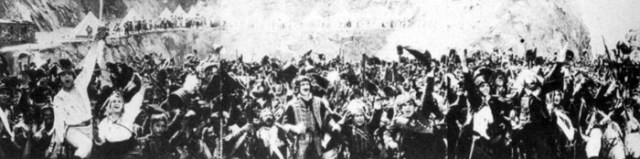
Una delle scena a triplo schermo nel film Napoleon (1927)

« Lo schermo triplo è una invenzione semplicissima. Mi stupisce che non vi si sia pensato prima d’oggi.

Si dice spesso che il bisogno crea l’organo. Ebbene è stato per questo che sono stato portato a cercare in questa direzione.

Ho molte volte sofferto per la dimensione dello schermo ordinario.

Quando volevo riprodurre una folla numerosa ero costretto a ridurre la scala a tali proporzioni che i personaggi si vedevano appena. Da qui l’idea di triplicare lo schermo quando ve n’era bisogno. »

Così dicendo Gance si dirige verso il fondo della sala, dove c’è uno schermo ordinario fra due tende nere, tira il cordone e le tende si aprono. Da ogni lato lo schermo appare in tutta la sua lunghezza. Sembra un grande affresco bianco.

« Pensate che cosa sarà quando questo affresco si anima. Voi ancora non potete immaginarlo con esattezza. È un colpo d’occhio formidabile, assolutamente nuovo. Tutta una battaglia che si svolge in questo triplo quadro, l’incendio di Tolone, la sfilata dell’armata d’Italia, le cariche, i combattimenti.

Tutta la scala è scalzata.

Tutto riveste una vastità, una dimensione nuova, assolutamente differente di tutto quanto si è visto in passato.

Questo apre il campo a mille possibilità che, sino ad oggi, erano irrealizzabili.

Per ottenere questi risultati tre apparecchi da presa girano contemporaneamente. Sono piazzati uno sopra l’altro, verticalmente. Questo tipo di riprese dovrebbero portare ad un piccolo spostamento dell’immagine, ma esso è insignificante.

La più grande difficoltà è di ottenere un sincronismo perfetto e ci si arriva essendo i tre apparecchi fissati sullo stesso tripode. Ma è necessario pensare ad ogni dettaglio: che le lampade siano le stesse, il voltaggio e l’amperaggio siano uguali.

Si può credere che lo schermo triplo serva soltanto alle figurazioni estese, ma esso servirà anche per il dramma psicologico, per i primi piani dei visi. Si può seguire il dramma interiore che ne risulta su tre diverse espressioni di un viso, e questo simultaneamente invece che successivamente. L’azione si trova così concentrata e ingrandita tutt’assieme. È la poesia dello schermo.

Questa e molte altre cose si possono fare con lo schermo triplo. Evidentemente non si potrà adottare subito questo schermo in tutte le sale, non essendo queste costruite per esso. »

(intervista di Pierre Lagarde ad Abel Gance, Comoedia, 24 dicembre 1926) 

How First Vitaphone Film Was Photographed

Don Juan (1926)
Don Juan (1926)

A. S. C. Member Has Soundproof Booth Built to Prevent Recording Studio Noises.

Du Par adapts Camera for Vocal Reproduction Work; Storage Batteries Used for Lights.

An interesting insight into the cinematographic difficulties which had to be conquered before the new celebrated Vitaphone process, used by Warner Bros, in conjunction with Don Juan, was reduced to the plane of commercial acceptability is shown in an account of the invention by E. B. Du Par. the A. S. C. member who surmounted its photographic barriers and thus made possible the actual application of the device.

Noise Cut Out

“First of all,” Du Par reports, “the noise incident to the taking of a motion picture made it necessary to shut the camera in a special soundproof booth. With the camera, I was locked in the booth. I shot through a small aperture, and looked out through a small peek hole. However, the construction of the booth does not permit of the booth’s occupant to hear anything from without. It is necessary to depend entirely on light signals for starts and fades.

Synchronized

“The camera is run by a motor which is synchronized with the recording machine motor. Instead of running at the regular speed of 16 pictures per second, we exposed at the rate of 24 per second! The recording machine is so located that it is in another part of the building, far enough away so that no sound can get to the actual place of photographing. The apparatus in the recording room is in charge of a recording expert. Another expert is stationed at the ‘mixing panel,’ as we call it, his duties being to listen to what is being recorded and also to watch a very sensitive dial that indicates every little variation of sound. When the dial starts to jump up to a certain mark, he has to vary the amplification on the microphone so as not to cut over certain high notes; high frequencies are apt to make the cutting point on the recorder break through the delicate walls of wax and spoil the record.

Far Removed

“The master recorder,” Du Par continues, “was stationed on the sixth floor above us. He is surrounded by dials whereby he can tell just what the vocal actions of the artists are. He is also attended by a large horn, about five feet square, in which he listens for any foreign noises. The microphones are so sensitive that he can detect if anybody on the set makes the least noise, such as walking, whispering or even the flickering of a light. If such are recorded, then the record is ruined. A flicker of a light sounds out like a pistol shot. This makes for a severe test on the lights. A number runs about ten minutes, or between 900 and 1000 feet. On some sets I have to use big storage batteries, weighing about 400 pounds each; seven of them are required to run a G. E. light of 150 amps. I use batteries to avoid generator noise. On the same lights, we had the gears changed from metal to fiber in order to eliminate gear noise on the automatic feed light.

Adapted Camera

“Since ! beginning this work,” Du Par states, “I have almost remodelled my camera. I use 1000-foot magazines, high-speed shutter, leather belt, special clutches on the take-up spool, and a light signal built right in the camera.

“There is somewhat of a difference in photographing motion picture and then grand opera stars. In the past several weeks I have filmed Mischa Elman, violinist; Efrem Zimbalist, violinist; Harold Bauer, pianist; Giovanni Martinelli, tenor; Marion Talley, and the New York Philharmonic Orchestra of 100 pieces.

“A strange incident occurred when we were taking ‘Swaunee River.’ Everything was still, and I had just received the signal to start; I flashed back the signal that I was fading in and everything was going nicely when I noticed frantic signals to stop. Looking out the peek-hole, I saw that every one was exceedingly excited. The cause, I learned, had been the screams of a colored janitress who claimed that she had seen the late Oscar Hammerstein walking across the balcony. It was eleven
o’clock in the morning, and it is said that it was his old custom to walk across the balcony at that time in the old Manhattan Opera House which we were using to work in. This was the third time that the janitor’s force had claimed seeing Mr. Hammerstein, and of course the commotion ruined that shot.”

(American Cinematographer, September 1926)

du_par_camera_vitaphone_1926

Dossier Cabiria Primo Episodio

Questo è il primo post di un dossier sulla riedizione, distribuzione e sonorizzazione del film Cabiria dal 1925 al 1936. Posteriormente, le inedite e importanti informazioni emerse da questo dossier (52 lettere e 13 telegrammi), corredate da immagini e articoli sulla stampa, verranno pubblicate in un e-book per celebrare il centenario della prima visione del film: il 18 aprile 1914.

Lettera del 3 gennaio 1925

Torino, 3 Gennaio 1925. Sigg. Ing. Sciamengo & Pastrone:

Con riferimento a pregiato Vostro ordinativo 28/11/1924, passatoci per Vostro riverito conto dal Signor Dott. A. Rossi di Torino. Nostra fattura 11 dicembre 1924 (Lire 6.179,05) – Una copia senza titoli di Cabiria – Maciste.

Ci richiamiamo alla stessa, a Vostre mani da tempo, e vi saremo grati se, con cortese sollecitudine, vorrete disporre sia per il ritiro delle copie di Vostra spettanza, sempre qui a Vostra disposizione, sia per il loro regolamento.
(Lettera della Cinestampa)

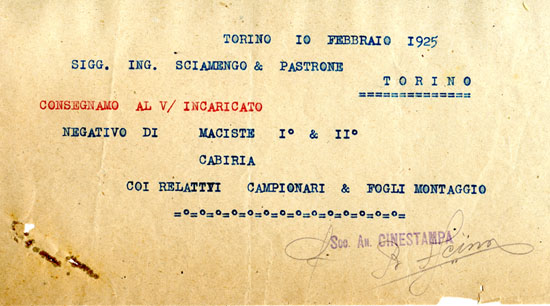
Torino, 10 febbraio 1925
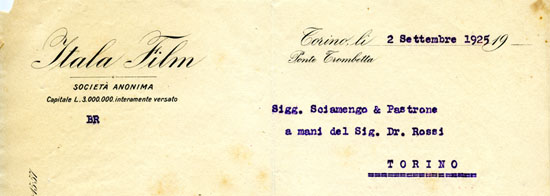
Torino, 2 settembre 1925

Torino, 2 settembre 1925. Sigg. Sciamengo & Pastrone.

In risposta alla pregiata Vostra di ieri, dobbiamo significarvi che nulla più ci resta di materiali a Voi appartenenti.

La stessa latrice della Vostra lettera, Signora Margherita Arbrile, ha fatto un sopraluogo al Reparto Fotografico, ma nulla ha trovato.
(Lettera della Società Anonima Itala Film)

Bologna, 13 Febbraio 1926

Signori Sciamengo & Pastrone.

Sarei disposto ad acquistare in esclusività per la zona Lombardia-Veneto-Terre Redente, una ristampa di Addio Giovinezza, e per la mia zona Emilia-Toscana, altre ristampe di films importanti, in riesclusività.
(Lettera Ditta Enrico Pegan)

Paris, 15 mars 1926
Paris, 15 mars 1926

Messieurs Sciamengo et Pastrone,

Je vous serai reconnaissant de bien vouloir me faire connaitre à quelles conditions vous pourriez m’adresser une copie sans titres de Cabiria sur Kodak ou à défaut sur Agfa, pour être exploitée an France.
(Lettera Ernest De Thoran)

Brunn, 18 IV 1926
Brunn, 18 IV 1926

Messieurs Sciamengo & Pastrone,

J’avais l’honneur de Vous demander, si je pourrai recevoir une copie neuf du film Maciste Alpino (sans titres) à prix de marché, sur matériel Agfa ou Kodak, et je me prend la liberté de demander, quelle somme sera enfin nécessaire et si je pourrais recevoir la copie contre remboursement par poste ou par ma banque ici a Brunn.
(Lettera Monopol – Ing. Karl Waldmann in Brunn)