October 1912. The Itala Film Co. of America, of which Harry R. Raver is the head, will soon issue for the American trade a series of long films composed of two and three reels each. For these special productions a coterie of noted artists have been engaged, prominent among whom are Gina Marangoni, Giuseppina Amici, Berta Nelson and Lydia Quaranta, all of whom are well and favorably known throughout the largest theaters in all Europe. Commendatore Ermete Zacconi, conceded to be the greatest living Italian actor, and perhaps the most prominent in Europe, will be seen in these forthcoming Itala multiple films.
The policy of the Itala Company will be confirmed to the appointment of exclusive agents in the United States, these agents to control certain territory. The first of the new Itala releases is called “Souls in Torture,” and consists of two reels. As the title infers, the subject deals with heart throbs and the bitter problems of life. Several elaborate scenes are unfolded as the story proceeds. A very large cast of players is used. A reproduction of a fox hunt with blooded horses and a fine pack of hounds adds to the exciting features of the story. “Souls in Torture” will be sold
to exclusive state right buyers through the Film Supply Co. of America. The headquarters of the company is at 805 Columbia Theater Building, New York
Scene fantastiche tratte dal celebre racconto inglese: The Babes in the Wood.
Pathécolor, 395 metri circa, bellissima partitura per orchestrina, del M. Louis Blémant.
E’ questa un’antica leggenda inglese svolta in un celebre racconto: leggenda dolorosa e poetica che raffigura lo sgomento di chi si perde nella foresta della vita.
I bambini perduti nel bosco seguono il destino di terrore e di angoscia che il caso ha loro segnato: e alla cieca baldanza con la quale si avventurano nel bosco tentatore seguono le inquietudini e le paure per tutti gli spiriti che si agitano negli alberi fatati.
Questa leggenda infantile, magnificamente riprodotta dal Pathécolor, è una grande fiaba per persone grandi.
La storia:
James Barfield morendo, ha istituito eredi universali i suoi due piccini, Harry e Lilly. In caso di morte degli eredi naturali, tutti i suoi beni avrebbero dovuto passare al suo fratello, lord Barfield.
Spinto dal suo egoismo, lord Barfield decide di sopprimere i due fanciulli, e li conduce in campagna coll’intenzione di mandare a effetto il suo piano, ma dopo infiniti tentativi, non ha il coraggio di compiere l’odioso atto. Li conduce allora in un rifugio di banditi e incarica uno di questi di uccidere gli innocenti.
Il brigante, non volendo avere la morte dei fanciulli sulla sua coscienza, li abbandona nella foresta. Ma la foresta era incantata e sotto ogni albero, dietro ogni roccia, si annidavano dei mostri strani. Degli esseri invisibili agitavano i rami delle foglie. Da un rigagnolo vicino emergevano delle sirene, che con la dolcezza della loro voce attiravano Harry e Lilly, Ma appena si lasciavano toccare, si cangiavano immantinente in piccoli gnomi orribili…
I due piccini, spaventati, si rifugiarono in una caverna, ma anche là una turba di fantasmi danzavano intorno e i due piccini, che sbigottiti e ormai senza forze, morirono di terrore e di sfinimento.
E degli angeli dalla bianche ali, portarono in paradiso le loro animuccie candide.
Il film fu presentato in Francia (titolo originale: Les enfants perdus dans la forêt), Italia, Spagna (Los niños perdidos en el bosque), Inghilterra e gli Stati Uniti (The Babes in the Wood) nel dicembre 1912.
The Babes in the Wood. — Released December 21st. Length 1,270 feet.
The Wicked Uncle schemes to rid himself of the two pretty Babes by endeavouring to throw them over castle heights and offering them cups of poison. Ultimately the Wicked Uncle, feeling himself unequal to the work of murder, approaches the robbers, and the children are dragged off into the forest. The great quarrel between the robbers ensues, and after the fight, the children, deserted by the remaining bandit, find themselves alone in the Enchanted Forest. Adventures follow upon each other with startling rapidity. They become wearied, however, by their exhausting wanderings through the thick forest, and when they reach a great cave it is peopled with ghosts, and the boy once more is called upon to fight for his life and that of his sister.
His strength is no longer equal to the task, and death comes to him just a few moments after the girl, having heard the call of angels, glides away into the Children’s Paradise. Her brother comes to join her, and midst the brightness of flowers the children pass on to join in the merry gambols of other tiny folk. (da Cinema news and Property Gazzette, London, December 1912)
Copia nell’Archivio del Cinema Muto (archivio inpenombra).
July 30, 1912. Mutual Film Corporation have procured exclusive United States and Canadian rights on the original One hundred one Bison, also Bison Broncho and Keystone films, effective two weeks from date. You can commence to buy immediately.
August 3, 1912. Keystone Films. Ready for release week of August 12th. Two releases weekly, Wednesdays and Saturdays.
Wednesdays: A split-reel comedy and always a feature, supported and made by Mr. Mack Sennett, Mr. Fred Mace, and Miss Mabel Normand, the greatest comediennes, all well known and popular players in motion pictures throughout the world.
Saturdays: A feature dramatic in one and two reels played by a strictly “All Stab” Stock Company, consisting only of “Stabs”, and only of the most prominent and popular “Stars” in motion pictures playing all parts in the cast.
August 10, 1912. Mutual Gets Empire Film Exchanges
Will Also Handle’ Bison-101 Pictures — Acquisition of Great Importance to Film Supply and Mutual Interests.
Developments of the greatest importance to exchange men and exhibitors allied with the Film Supply Company and the Mutual Film Corporation occurred during the past week. It had been rumored for some time since the Baumann and Kessel interests deserted the Universal Film Manufacturing Company, that an alliance with the Film Supply Company was a possible alternative outlet for the product of the New York Motion Picture Company. Negotiations were opened which culminated in an agreement between the Mutual Film Corporation and the New York Motion Picture Company whereby the Mutual will market the product of the New York company under the trade marks ‘”Bison-101,” “‘Keystone” and “Broncho” pictures.
The Mutual Film Corporation has also purchased the Empire Film Exchange, which operated four distributing offices, and the stock and equipment of these exchanges will be merged into branches of the Mutual.
The negotiations in these transactions were finally concluded on Monday, July 29, and are the most recent in a long series of steps initiated by a group of Western investors, under the leadership of Mr. H. E. Aitken, for the purpose of improving the organization and increasing the efficiency of the Independent film service.
Mr. Aitken came to New York in the Spring of 1911 and took over the old Hudson Film Company, changed it into the Western Film Exchange of New York, and improved the quantity and quality of its business. He then organized the Majestic Motion Picture Company, and that Company’s energetic assertion of its right to do business has been a great factor in the re-organization of the Independent film manufacturers. Having, in the meanwhile, acquired valuable patent rights through Precision Camera Company, these interests then purchased control of the Carlton Motion Picture Laboratories, making the “Reliance” pictures, from Baumann and Kessel.
The next step was the organization of Mutual Film Corporation, which took over, upon its organization, the Western exchanges in New York, Milwaukee and Kansas City, Majestic exchange in Chicago, the H. & H. Exchanges in Chicago and Des Moines, Lake Shore Exchange in Cleveland, and Cadillac Exchange in Detroit. Shortly thereafter the Mutual Film Corporation acquired the Michigan Film & Supply Company of Detroit, the Buckeye Lake Shore Exchange of Columbus, Ohio, and Progressive Exchange in Omaha.
Since its organization in February, the Mutual Film Corporation has opened exchanges in Boston, Indianapoli.-. Philadelphia, Toledo. Washington, D. C, Atlanta, New Orleans, Dallas and Cincinnati.
After the organization of the Mutual was well under way. Mr. Aitken, in co-operation with Mr. Charles J. Hite and others, negotiated Mr. Hite’s purchase of the Thanhouser Company.
In the meanwhile the suits brought by the Majestic Motion Picture Company against the Sales Company and its officers and constituents caused the disruption of the Sales Company, with the result that the Film Supply Company of America with its extensive programme was organized.
Most recently the Mutual Film Corporation, as before mentioned, made arrangements for the acquisition of the four Baumann and Kessel film exchanges in New York, and for the control of the Bison No. 101 film, and it is said that negotiations are on for other valuable film enterprises.
The results outlined above, have been achieved only after years of unremitting effort, and the present strong financial backing of Mutual Company gives great promise of achievements in the future.
The consistent purpose of this group of men has been to improve the character of the Independent film and to afford exhibitors an opportunity to purchase film of the highest quality manufactured.
It should be noted in this connection that the Mutual has moved its executive offices from 145 West 45th Street to 60 Wall Street, where a handsome suite has been engaged.
Baumann & Kessel Eliminate Politics
For many years aggressive leaders in the film business. C. O. Baumann and his partner, Addie Kessel, are divorcing themselves from the politics of the trade and henceforth will devote all their energy and attention to the production of film. This is made possible by the contract entered into with the Mutual Film Corporation, whereby the latter company has purchased outright the Baumann-Kessel exchanges in New York City, and has taken the agencies for the United States and Canada of “101-Bison,” “Broncho” and “Keystone” films.
Mr. Baumann stated to a representative of The World that he was much pleased with the arrangement made with the Mutual Film Corporation, which is composed of men of high standing in the business world and of undisputed integrity as well as possessed of tremendous financial support.
“‘We will deliver to the Mutual every week a minimum of six reels per week, consisting of 101 Bison one, two and three-reel subjects; Broncho films, which are similar subjects produced by different stock companies, and Keystone films, split-reel comedies and dramatic subjects in which appear many popular players. Mr. Max Sennett is the director of Keystone films, in which he will take part, supported by Miss Mabel Normand. Fred Mace and others.
“I am gratified at the reception the exhibitors of the world have given 101 Bisons, and with my mind now free from the perplexing worries which have hitherto prevented my giving my entire time and attention to the manufacture of films, I can promise even better subjects than have been previously released.”
The amount of cash involved in the deal between Messrs. Baumann & Kessel and the Mutual Film Corporation runs into high figures, making it one of the most important transactions that have taken place in the trade for years.
August 24, 1912. Keystone Films are new in name only. They are produced by the company heretofore with the Biograph Co., and directed by the same man Mr. Mack Sennett. The quality of these films is well known to exhibitors.
Mack Sennett 1912
August 28, 1912. Mack Sennet, director, and Mabel Normand, leading woman, of the Keystone company of the New York Motion Picture Company, arrived in Los Angeles August 28 as the advance guard of a new company which is to be located in the old Bison plant at Edendale. Both were formerly with the Biograph Company, and others from the same company are said to be coming later. The Keystone brand of films, according to report, are to be produced from Los Angeles hereafter.
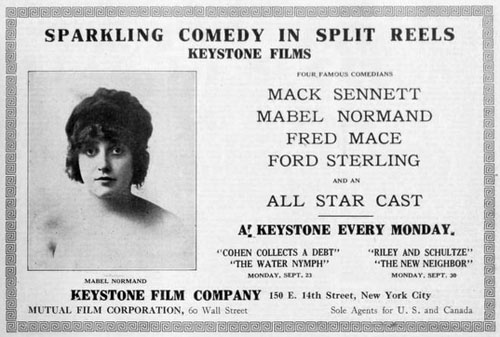
September 14, 1912. The Mutual Film Corporation will make the first release of Keystone films, for which it holdes the exclusive agency for the United States and Canada, on Monday, Sept. 25, with a split-reel comedy, “Cohen Collects a Debt” and “The Water Nymph.”
The leading parts in Keystone films are played by Mack Sennett, Mabel Normand, Ford Sterling and Fred Mace, supported by a strong cast. This quartet comes to the Keystone Co. from the Biograph, and their work is well known throughout the world. Mr. Sennett continues as director.
Shortly after Sept. 25 two reels of Keystone will be released, the reel made by Mr. Sennett and a dramatic production by another stock company, of which full particulars will be given when release dates are fixed. The Keystone comedy on Monday will always consist of two snappy subjects.
September 21, 1912. Doings at Los Angeles
Many Extensive Improvements Being Made in Picture Studios
Extensive improvements are in progress at three of the motion picture studios in this city. A large force of workmen is now engaged in erecting the new buildings at the plant of the Brand Advanced Motion Picture Co., located on a 40-acre tract in the San Fernando valley near the town of Burbank. The Universal people are spending a great deal of money on their new outdoor studio at Oak Crest near Los Angeles, where they have bought and leased a tract consisting in all of about 20,000 acres and are planning to build the largest motion picture plant in the world. James Young Deer, director of the Pathe Western company, has practically concluded the negotiations for the purchase of 35 acres of land at Edendale and architects are now at work on the plants for his studio, which if it will not be the largest in the world will be one of the most modern and one of the best equipped.
Preparations are also being made at Edendale for radical changes and extensions of the old Bison plant of the New York Motion Picture Co. Charles O. Baumann and A. Kessel are here from New York for a personal inspection of the plant and Mack Sennet, the director of the new Keystone company, preceded them by a couple of days. Sennet, with the assistance of Mabel Normand, Henry Lehrmann and Ford Sterling, who came from New York with him, and Fred Mace, former director of Imp comedies, is already at work at the Edendale plant making comedies for future release. The balance of the company was employed here, being recruited from the ranks of other companies on the ground. Fred Balshofer has announced that there are to be two Western releases a week by Ince and Ford, two split reel comedies, one by Sennet and the other by Mace, and one dramatic by a director who is coming on in a few days, but whose identity is not to be revealed at this time. It is reported that Baumann and Kessel, before they return to New York, may have other important revelations to make.
Mabel Normand, Keystone Films 1912
(news & images from The Moving Picture World July-September 1912)


 sempre in penombra