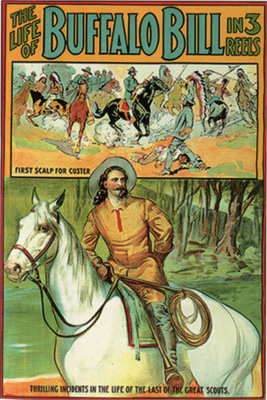
New York, August 1912. Attractive posters have long played the most important part in the proper presentation of feature films. Often companies putting a feature on the market or releasing a feature film, overlook this important part of the business. Instead of making posters of every size depicting many of the important scenes, they have a one and three-sheet posters made for their production, which results in dissatisfaction among the exhibitors. This compels them to buy left-over paper of “melodramatic” days.
To prevent this shortage of paper, the Buffalo Bill and Pawnee Bill Film Company, of 145 West 45th Street, New York City, have provided a full variety of posters for the proper presentation of their great Western three-reel subject “The Life of Buffalo Bill.”
Mr. Gaston Melies, who is seeking the unusual and as yet unpictured local color of the South Pacific, has with Mrs. Melies and his company, reached his first stopping place al Papette on the Island of Tahiti, one of the Society Islands, known once as the Sandwich Islands. What a golden mine of romance is waiting for this adventurous picture maker! It was in this neighborhood that Robert Louis Stevenson lived for so long and where so main of his best romances were written. It has been said that here is romance’s last great stronghold and that it can be found nowhere else on earth as here.
There are stories like fairy tales of strange gods and of magic, and there are stories of beautiful Polynesian princesses (they usually have a hibiscus flower in their hair) who swim like mermaids. There are also stories, quite historical, of great warriors and heroic deeds of valor, of gun-runners, of diplomatic intrigues, of treasure hunters, and no one before this has been on the spot nor dared to make pictures of island life; because they lacked the local color. Mr. Melies has had the boldness and is likely to reap the rich harvest that is waiting for him.
Of course, to take a large party (there are sixteen players and operators) on so long a trip is a very expensive undertaking. They intend to take pictures in many parts of New Zealand after leaving the South Sea Islands, and before they return they will have crossed Australia and taken pictures in Java, where the life and customs are radically different, in India and elsewhere. The pictures that Mr. Melies intends to produce will include dramas and comedies as well as educational films. A taste of the life of these strange lands will be in the dramas and in them will probably be shown the life and experiences of white settlers with natives around them. The educational films will be of great value. The purely native life in many of these out-of-the-way corners of the world is fast changing into a hybrid life. To catch what may still be found of ceremonies and customs of the simple South Sea Islanders is as worthy a work as can be found for a motion picture camera. We have no doubt that it will repay Mr.Melies many times over, although he expects that the trip will cost something like $200,000.
These pictures that he will take, in all probability, rise above an unfortunate condition of the picture market that producers have found it hard to contend with. This difficulty is the purely local popularity that certain types of pictures have found. It is, perhaps, more noticeable in the type of picture called “Western,” the picture exploiting cowboy and Indian life. These are very popular in the South; but are not very acceptable to spectators in the Northwest nor on the coast. The picture of any kind that will be liked abroad is seldom the best kind of picture for American audiences. Hut pictures of life in the South Seas, of life in New Zealand, of life in the Dutch provinces, of Java, of India and Ceylon, etc., will have so great an interest that they will find no hindrance in local requirements, but will appeal as strongly to Americans as to Europeans; they will also appeal to the cultured and the unlearned, for both will find entertainment and the best instruction in them. Things that are new and strange, yet true, are greatly desired. If such are not to be found in the South Sea Islands and in Java, where on this earth, except in Thibet, will they be found? We are looking forward with the greatest eagerness to the releases that the travelers will send back, like letters home, to us. Perhaps the first, which will be sent from Tahiti, will be released late in September.
The purely educational films will be made by George Scott, who has managed the Melies factory for many years. He will travel much alone, taking with him only a carrier to help with the apparatus, and may make adventurous excursions “into the interior” for special films. We hope he will be adventurous not too adventurous. It would be too bad to lose one’s life for a picture. Then, also, some good films may be lost, if a headhunter chief should become very much irritated, for instance.
The dramatic stories will be prepared by Edmund Mitchell, about whom “Who’s who” has a long paragraph. Mr. Mitchell is a much-traveled man and has written a shelf full of novels, as well as guide books, etc., to parts of India. He is thoroughly familiar with the islands in the South Sea and with Australasia, and has written many able articles about them. Among his novels are “The Temple of Death” a story of Bombay and Central India, and “The Lone Star Rush” a story of western Australia. These, with many other works of fiction by this author, have, according to competent critics, strong plots and vivid local color. Mr. Mitchell’s presence with the company promises stories that will be very well worth while.
Besides these two men the full troupe consists of Bertram Bracken, the director; Hugh McClung, dramatic operator; Gustave Henschen, photographic operator: Samuel Wiel, stage manager; John Ortega, master of transportation: Henry Stanley, characters: Wm. Ehfe, juvenile lead; Ray Gallagher, heavy: Leo Pierson, juvenile; Miss Mildred Bracken, juvenile lead: Miss Fanny Midgley. character; and Miss Hetty Tracy, ingenue. The photograph printed herewith shows the party on the ship Manuka, just before sailing.
By Hartford C. Judson (Moving Picture World, August 24, 1912)
London, August 1912. Splendid success have the Hepworth Company made of Charles Dickens’s greatest story, and while everyone, from artistes to operators, is to be most heartily congratulated upon a real achievement in placing this world’s classic on the screen in such a masterly manner, yet we are inclined to give our highest meed of praise to the brain from which emanated the original idea of picturing the moving and human story of the workhouse foundling.
It was an ambitious scheme in the first place, for perhaps of all the great novelist’s works there is not one which needs such a wealth of setting, such a variety of scene and such a close attention to detail as “Oliver Twist.” Every scene, incident, and character in this greatest drama of real life is so intimately familiar to the public, that the least divergence from the story would be a serious drawback to the popularity of the film. That we, as perhaps exceptionally close students and lovers of Dickens, were quite unable to find a flaw in the truth of detail, of costume and of incident, is the best proof we can put forward that “Oliver Twist” on the latest “Hepwix” film is a worthy representation of the “Oliver Twist” that Dickens penned. Can we say more in its favour? We doubt it!
A three-reel film, and when we saw it, running in length to some 3,500 feet, this latest masterpiece of the Denman Street house deals with practically every prominent incident in the novel, from the famous entry of Oliver into the story on the occasion of his “asking for more,” to end effectively and suitably with the reunion of Oliver with the Brownlow family and the heartfelt toast they are shown drinking to future happiness. It would be impossible, and indeed unnecessary, in a review of this length, to attempt to record in detail each sharply outlined scene as the one merges into the other in the pleasing manner which is one of the many likable features of the films of this house. But we must find space to record our high appreciation of the effectiveness of the setting of the scenes en plein air, and more of particularly those showing the scenes on the road to the house at Chertsey where the burglary was committed — where Sikes threatens the shrinking boy beneath the arch of Chertsey Bridge, and ostentatiously loads and primes his pistol to strike fear into his poor little victim — one can almost imagine the actual scene before one. And, be it remembered, that we who write this have to see miles of film every week.
We have referred before to the excellent acting of the characters in this fine film, but we feel that we are not going too far in our eulogy when we say that it is a very long time since we have seen such forceful and yet restrained acting, and such expressiveness of gesture and movement, as are displayed by the actors and actresses in this piece.
This becomes the higher praise when we are forced to add that in our opinion there is a notable tendency to exaggeration in these points with many artistes, a weakness which was perhaps somewhat excusable in the early days of picture plays when the artistes had not become accustomed to the deprivation of the spoken word to aid in their efforts, but which should have become less pronounced, with the greater appreciation of the art of picture acting by the public, and with the immensely increased help given by perfect setting. Even if one could, it is unnecessary to select any special artist for sole mention in a cast which employs only four principal characters, and so we may justly say that Miss Ivy Sillais as Oliver, Miss A. Taylor as Nancy, and Messrs Harry Royston and McMahon as Bill Sikes and Fagin respectively, all employ their opportunities to the fullest possible extent. Miss Taylor, we would add, could not be surpassed in her rendering of the part of the tender-hearted and loyal Nancy.
We look with every confidence to a record success for this really wonderful film, and the exhibitor who secures this ” exclusive ” for his district should be free of the worry of empty seats for at least as long as he is showing it.


 sempre in penombra