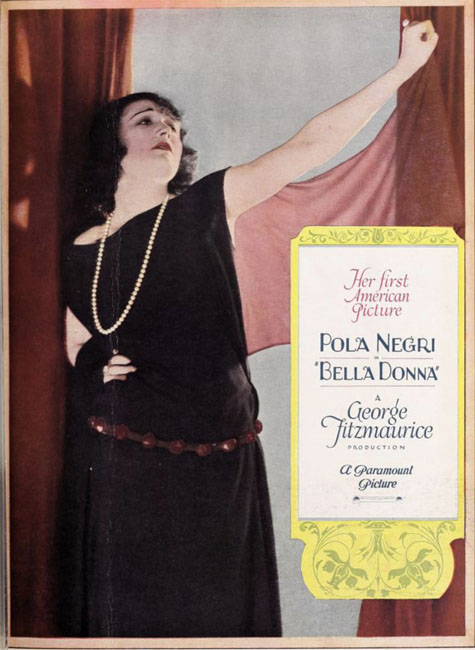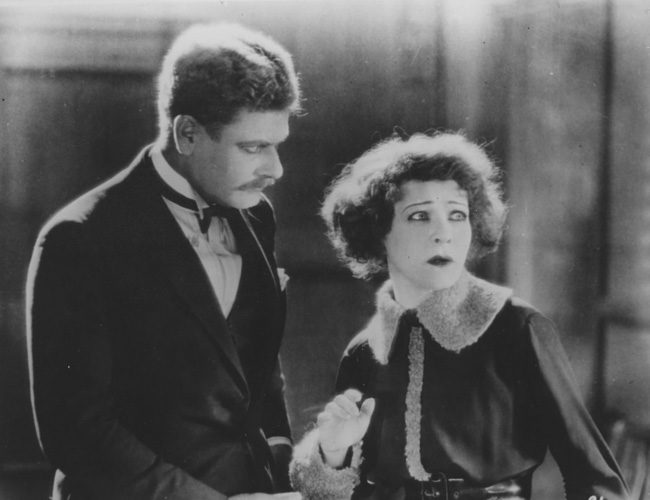
Pola Negri in Bella Donna

The Elegy of Pola

Pola Negri in Bella Donna

The Black Lotus Flower of Europa has been transplanted to America… but…

A shriek rent the air. It was the climax.

The torment of music ceased, and Pola Negri a quivering, throbbing, brooding black mound of nerves lay huddled together upon the floor in front of the gilt doorway.

Slowly, almost tenderly, to an accompaniment of plaintive melody, a half-naked Nubian slave bent over her, touched her and then, with the semblance of a deep sorrow etching his face, lifted her to her feet. As he wound about her the lace of a mantilla, she stood swaying a moment, her eyes listless—empty their wells of feeling, her head beating back and forth in a dull rhythm. Then, step by step, hesitatingly, uncertainly, she half tottered out beyond the range of lights, beyond the camera itself, lost seemingly in a hypnotic mood that overhung scene and setting and onlookers, a mood nocturnal and vast as the surging, passionate desert blast that had swept and wasted and finally was destroying the bloom of its exquisitely deceptive flower— Bella Donna.

I had been watching one of the final scenes in Miss Negri’s first American picture. Nobody but would have admitted this a privilege. It was, in fact, almost lese majesty for any stranger to be on the set. Nearly as many permissions had to be obtained to enable me to look on as are required for an audience with a Grand Lama. At least, I was told that they had been obtained, but the possible significance of this excess of formalities was absolutely lost on me once I came aboard Baroudi’s love barge, where it was securely moored to the floor of the studio stage. I am not particularly concerned with formalities, anyhow, not even when they concern Europe’s most celebrated screen actress.

Baroudi’s love barge was the background for the culminating emotional scenes of Pola Negri in “Bella Donna.” The hysterical episode I had just observed, with, I might say, almost bated breath, was one of these. The heroine had just received her blunt congé from the sheikish Oriental exquisite, who had ensnared her. She was left quite alone in a world that did not love her and did not want her. The dark lotus of her charm was broken, the leaping flame of her youth was dying away. Destiny’s tragic claim was written on her brow, and one sensed for her the approach of the blackest hour:

Less than the dust beneath thy chariot wheel,
Less than the rust that never stained thy sword,
Less than the trust thou hast in me, my lord,
Even less am I, even less am I

Truly, I believe, you have never yet really seen Pola Negri on the screen. Always there has been some obscuring fault of make-up. Even as it has actually clouded her resplendent beauty, so, too, I feel, it has but half disclosed her radiant art.

To behold her now, fully illumined by the dazzle of our insurpassable lighting, and the minute excellence of our photography, will be like a glorious revelation. Lily-white her hands and face, orchidlike the spirit of her beauty. She is at once the sinister nightshade, and the white lotus, a blossom of ecstasy and a bloom of torment

A dark cool night, and oversweet
With tuberose breath;
A jeweled javelin in the heart,
Ecstatic death.

Those who have appeared in her picture have confessed to me their absolute inability to cope with her. They accuse her, in fact, of not giving a single thing. She rules the set absolutely as its mistress, and that is something that can well be understood after one watches her and realizes how much of herself she literally hurls into her acting.

She has been known to stand for minutes before a mirror, pretending to be making up her lips or her eyes. In reality she was not making up at all. That was only a pretext. She was going through her preparations for the next episode. She tested every expression of her face, studied it from every angle, endeavored to get over some undreamed-of nuance of feeling, some absolutely new light of eyes, curve of lips, engraving of forehead, to eliminate if possible a spoken title, which titles, she frankly admits, and with a positive venom in her voice, “I hat’.”

To Pola Negri music is the essence of her art. One might almost say that it is also the essence of her being. To it may be ascribed the vivid fluency of her acting. In Europe she was accustomed to have only the finest sort of compositions to accompany her acting — Tschaikowsky, Beethoven, and sometimes—though rarely, because he depresses her—Wagner. On her arrival in Hollywood she cast out all the jazz ensembles that were brought her as if they had been the seven devils. It was only after many fits of temperament and finally an absolute refusal to work, I believe, that she finally obtained a makeshift of piano and cello that pleased her. A feverish Lament of Grieg had been selected as the motif for her closing emotional tempest in “Bella Donna.” The melody tossed and undulated beneath the bow of a cellist, becoming every moment more languishing, more restless. As Pola faced Baroudi, and learned that, after her bitter sacrifice of Nigel, the Oriental no longer wanted her, that, in fact, a new Circe had already captivated him, the elegy in tone became a veritable delirium. One sensed almost a demand from the actress that the music should be her stimulus; one felt that the players played for her as they had never played before. Such, indeed, is the magnetism the well-nigh uncanny bewitchment of Pola.

Strangely, fantastically, in tune with her desespoir, the while, was the love boat’s Nirvana harmony in black and gold—a subtle Oriental harmony built on one of those weird scales of tone that come out of the heart of the Far East. The deep inlays and intricate patternings of the narrow doors became momentarily deeper and darker. The grilled windows, fretted with a design as dainty as Chantilly lace, were lost in the febrile mists. The deep divan cushioned with inky and yellow silks, became wan as in the light of dawn, its fitful purple scarflike coverings softening to amber, and its rose and fuchsia hangings to a methitic mauve. One sensed, too, almost the sick lapping of the waters of the Nile, and the oppressive portents of pyramids and sphinx and desert waste.

I know of no other setting that more admirably. seemed to accommodate itself to the moods of its star, even as it also breathed so much of the storied wonders of the incensed far away. The skill of George Fitzmaurice, the director, who promises to become truly recognized as an artist of the screen, I sensed, had been at work again, and this time for the sake of a locale that had stimulated all his fancy for the exotic, even as “To Have and To Hold” had caught his imagination in the web of the romantic.

The story of “Bella Donna” has, of course, been modified. A reason has been given for the heroine’s malefic character. Ouida Bergere, the scenarioist, told me that she felt this was justified because the original Bella Donna of the Hichens novel, while she was sirenically alluring as colored with literary descriptions, would not produce the same illusion of enchantment when coldly lighted in the silver shadows. Also, I have no doubt, Bella Donna, thus portrayed, would be far too pathological a specimen for the sensitive dispositions of the censors, and rather than risk her mutilation, it was decided to temper her. This was accomplished by allowing her to suffer an unhappy marriage before the main story opens. We sense Swansonian wormwood here, but what of it? Pola herself approved, for to me she repeated her oft- heard assertion that she docs not “want to play ze bad ladies.”

What she really means by this is that she does not want to play rôles without sympathy—straight vampire roles, sans raison d’être. She wants to reach the heart of her public as well as its mind. Will she? I wonder. Pola and the public’s tears? Somehow they seem incompatible. Yet it is for those tears that she seeks and strives and struggles with the frenetic intensity of her art, showering in diamonded cascade the scene with her own unleashed grief.

“When I weep it is not for myself alone ; it ees for everybody,” she told me, half chanting the words. “I theenk always of audience, people, everywhere, all, sorrowful weeping wiz me. I poot my whol’ heart, my whol’ soul into my art, my expression, my tears, so zat zey may feel wiz me what I feel, so zat zey perhaps suffair what I suffair.

“I want to play Bella Donna sympathetique. I do not believ’ she should be play’ like bad woman—like vampir’—I do not believe that woman ar’ evair vampir’ by natur’. Woman become vampir’ because of situation, circumstance—what you call—fate! No woman become bad by natur’, but by fate.”

“And because.” I ventured, perhaps…because, of some man? I mean that woman’s wrongdoing is contingent—dependent sometimes on the wrongdoing of some man.”

There was a subtle flash between us. And then, a moment’s pause, and

“That is an interesting psychological question, but”—and this was delicately yet, I might say, nearly tigerishly emphatic—‘“I do not care to discus’…!”

There was finality in the answer. Our talk ended shortly after. It taught me that Pola is not given to gossiping about the questions of life as we in America do quite casually and on every street corner. Her experience with telltale interviewers has, perhaps, made her more cautious than ever! Anyway, she cares only to converse regarding her art, and life only as it is related to her art. To all queries aside from this she generally replies now, “I do not care to discus’ ’’—even as, to the inquiries concerning her rumored marriage to Chaplin, she has maintained a frigidly dynamic silence. You can guess, if you will, what her views and her sentiments are regarding life and its personal relationships, but you can only know her through her art. There is about her consequently something enigmatically alluring, and that, I believe, is her highest enthrallment, that and her marvelous treasure of talent and emotion.

Will America change her? One wonders, because one can only wonder. She may remain here for the space of two years now, and in that time what may not happen! America has always been reckoned a great melting pot for all. Yes, perhaps. For nearly all, but there are some… like Pola.

Edwin Schallert
(Picture-Play Magazine, March 1923)

Maria Jacobini

La lenta agonia dell’industria italiana

Maria Jacobini

L’esodo degli italiani all’estero – L’invasione degli stranieri in Italia

Torino, Marzo 1923

Il film: La Vie de Bohéme, ha ottenuto a Berlino un successo addirittura entusiastico, decretato da un pubblico sceltissimo, composto di alte personalità politiche, artistiche, letterarie. La presenza dell’Ambasciatore d’Italia, del Corpo Consolare e di un centinaio di giornalisti, ha dato alla visione un vero aspetto di avvenimento mondano e ne ha fatto un’affermazione d’italianità grandiosa.

Questo ci trasmette il nostro corrispondente (come in altra parte della Rivista pubblichiamo) e questo riferiscono i giornali berlinesi d’ogni forma e colore.

Ci sentiamo lusingati e i nostri migliori sentimenti d’italianità, non mai smentiti, sorretti da una fede indistruttibile in noi e nel nostro avvenire, si gonfiano di legittimo orgoglio. Che Gennaro Righelli fosse un maestro dell’inscenatura cinematografica; che Maria Jacobini fosse un’artista somma, tale che nessuna tedesca può pareggiare, sapevamo è ne eravamo persuasi; ma ci piace che il Neue Berliner 12 uhr an Mittag e il Vorwärts ce lo confermino dalle loro colonne non certo use a portare ai sette cieli l’opera di stranieri.

Tutto questo è bello, commovente se vogliamo, per ciò che riguarda la nostra idealità…

… Ma se, dopo il primo impeto di soddisfazione ideale scendiamo un po’ più terra terra e pensiamo alla praticità, a quel sacro egoismo che non certo solo di ideali si nutre, ma ch’è dovere d’un qualunque figlio d’una qualunque nazione…; se scendiamo ad analizzare in breve le conseguenze che tali successi (questo di cui parliamo non è nè il primo, nè l’ultimo del genere) sono per produrre alla causa cinematografica del nostro Paese, la gioia lascia in breve il posto allo sconforto, l’orgoglio alla vergogna, al dubbio, alla sfiducia,

I nostri migliori artisti, i migliori ingegni che l’Italia abbia prodotti nel campo dell’arte muta; quelli che gli stranieri ci invidiano e non osano uguagliare; quelli che il nome d’Italia fanno risonare alto e rispettato nelle platee dei teatri esteri, sono perduti per noi. Dopo aver resistito con tutte le loro forze alla crisi da noi imperversante, dopo aver tentato invano di esplicare le loro attitudini sotto il nostro ironico bel cielo, prima l’uno, poi l’altro, prima separatamente, quasi di nascosto, poi a frotte, hanno emigrato per lontani lidi: hanno dovuto emigrare là dove il lavoro è più sicuro, più saldamente organizzato, più rettamente condotto, e le Case estere si fregiano dei nostri più bei nomi e si valgono di essi.

Così, quando noi vorremo vedere le interpretazioni dei nostri migliori, dovremo comperare le pellicole dall’estero; e stranieri porteranno per i mercati di tutto il mondo i più quotati nomi italiani. Si vestiranno della pelle del leone, in apparenza, ma in effetto ne avranno tutti i guadagni e terranno per sé le spoglie opime.

E noi? Quando avremo una ripresa della nostra lavorazione — se pur l’avremo, è ormai il caso di dire — ci contenteremo di… ciò che ci rimane e che l’estero non ha voluto, e ci vedremo, naturalmente, sempre più chiuse le porte alla nostra produzione, mentre gli altri se le faranno spalancare alla propria dal lavoro e dall’ingegno italiano.

Risultato oltre ogni dire umiliante, oltre che economicamente disperante.

Abbiamo detto « se pur l’avremo », parlando della ripresa della nostra produzione, e con profonda malinconia, con amarezza somma abbiamo espresso questo dubbio angoscioso.

E tuttavia oggi, ormai, la superproduzione nostra è finita, la fabbricazione nostra, nonché bastare a mercati lontani, neppur più è tale da sopperire ad una parte della richiesta di films per i nostri teatri. Infatti, da tempo, nelle nostre sale non si proiettano quasi più che lavori stranieri, alcuni bellissimi, molti buoni, alcuni mediocri o scadenti addirittura, ma sempre tedeschi, americani, inglesi, scandinavi….. — Italiani? Gli ultimi che rimangono, da parecchi anni editati, anche; le scorie che finora erano state tenute in disparte, gli aborti da prima scartati. Non ce n’è altri, e nessuno ne fabbrica di nuovi.

Si assicurava che la primavera avrebbe portato un rifiorimento di lavoro; tutto faceva apparire logica la cosa. Riaprirà Tizio, riprenderà Caio, lavorerà Sempronio…

Ma la primavera è venuta, il tempo è più propizio, il mercato ha sete di lavori e li cerca lontano non trovandone in casa; e le Case cinematografiche rimangono ostinatamente chiuse. I nostri teatri, i migliori d’ogni luogo senza alcun dubbio, che non domanderebbero se non un più moderno e completo impianto di luce artificiale per essere insuperabili; vedono crescere le ragnatele sotto le loro volte vetrate, o si trasformano in magazzini…

Intanto, a Roma, a Napoli, nelle località più belle, più suggestive della nostra Italia, troupes di Case americane, ogni giorno più numerose, girano i loro films, magari ammettendo nelle loro file qualche elemento italiano, ma rubandoci il nostro cielo, il nostro mare, le nostre sublimi, storiche bellezze naturali, i nostri magnifici sfondi, i panorami invidiati, la nostra arte che nessun luogo e nessuno potrà mai uguagliare.

Così, mentre i nostri artisti lavorano per gli uni, gli altri sfruttano il nostro Paese. Rimarremo dunque inerti e passivi finché vedremo troupes d’italiani girare in Italia, usufruendo anche dei nostri teatri, a tutto vantaggio di Case straniere?

E poi ci si lagna se i mercati d’oltr’Alpe o d’oltre mare son chiusi alla nostra produzione… quando tutto quanto noi possiamo dare in uomini e in natura è da essi posseduto senza ricorrere a noi!

I nostri industriali non hanno capito ancora — forse non capiranno mai — che questa è la tomba della cinematografia italiana in quanto industria. Ma qualcuno più in alto di loro dovrebbe pur vedere quale fonte grandissima di guadagno si sta inaridendo; dovrebbe vedere tutta la convenienza economica, non solo, ma morale e politica (anche politica, sì) che sarebbe per l’Italia il far da sé e per sé anche nel campo cinematografico.

E tutto ciò non potrà essere compreso che da un Governo illuminato qual’è l’attuale, e geloso custode di quanto sia italianità, nazionalismo ben inteso.

Già prima che questo Ministero sorgesse, un Ministro, S. E. Teofilo Rossi, aveva ricevuto a Roma tutti i maggiori esponenti della cinematografia e aveva ascoltato le loro proposte, i loro desideri, le loro necessità. Oggi egli stesso dovrebbe convocarli nuovamente, per concretare con loro un piano di lavoro pel quale non dovessimo diventare completamente schiavi dell’estero, proprio in una industria ch’era nostro vanto e ch’è stata un tempo quasi nostro monopolio nel mondo.

Siamo in tempo ancora, oggi.

Domani, chi sa?

La Vita Cinematografica

Sarah Bernhardt

Mme Sarah Bernhardt tourne un film chez elle

Paris, mars 1923

La grande tragédienne joue un role de voyante paralysée vivant dans une mansarde en compagnie d’un chimpanzé.

On tourne actuellement un film chez Mme Sarah Bernhardt, et on le fait dans le plus grand secret, pour lui éviter les fatigues de l’interview et des visites inutiles. Tous ceux qui participent à la prise, y compris les mécaniciens, se sont engagés par contrat à observer le plus rigoureux silence à ce sujet. C’est donc un secret bien gardé, mais l’illustre tragédienne ne peut s’isoler du monde sans éveiller la curiosité professionnelle des journalistes, dont le métier est précisément d’être curieux et indiscret.

Des confrères américains remarquèrent à la porte de son hôtel du boulevard Pereire les camions fournissant la lumière électrique avec les câbles, qui étaient une suffisante indication. L’un d’eux se mit sur cette piste. On tenta de l’en éloigner en lui parlant d’une simple opération de nettoyage par le vide. Il voulut connaître le metteur en scène, son compatriote, mais il perdit son temps. Après trois semaines de travaux d’approche, il avait un plan assez romanesque pour intéresser ses lecteurs, assez simple pour réussir. M. F. K. Abbott se contenta de revêtir une combinaison bleue d’électricien et il se présenta en disant qu’il faisait partie de l’équipe. Devant le chef de celle-ci, il demanda du travail et se fit embaucher à raison de 20 francs par séance. Il n’était pas sans émotion. C’est que, d’autre part, il a la plus grande admiration pour Mme Sarah Bernhardt, et que, de l’autre, il ne possède en matière d’électricien que des notions insuffisantes pour faire figure d’électricien. Par bonheur, on se borna à le charger du maniement d’un petit projecteur, et on ne jugea pas utile de lier cet « extra » par le secret professionnel.

Dès qu’il fut un peu à l’aise dans la place, il put constater que la grande pièce appelée « le conservatoire » avait été aménagée en studio, non sans avoir été sensiblement modifiée. Une fenêtre est devenue une porte, une fausse fenêtre donne sur un décor représentant Montmartre avec le Sacré-Coeur.

Je me suis mélé au groupe des électriciens avant le travail, comme cet ingénieux confrère. Nous avions tous le chapeau sur la tête et la cigarette à la bouche. Au moment où l’on annonca: « Madame vient », les cigarettes disparurent et les chapeaux furent enlevés. Le silence remplaca le bruit des conversations et ce fut une minute impressionnante. Ce que l’on respectait le plus, c’est l’exemple de travail que donne encore un être qui a derrière lui toute une vie de gloire et de labeur quotidien. Léon Abrams, qui est son propre metteur en scène, a composé pour elle un scénario qui la présente telle qu’elle est. Elle joue un ròle de voyante paralysée, vivant dans une mansarde, et elle n’a qu’une seule compagne, qui est en même temps sa servante: Jacqueline. Jacqueline se tient sur le dossier de son fauteuil et elle est aussi preste que sa maîtresse est prisonnière de son mal. D’un bond, elle descend, ouvre la porte ou la fenêtre, et d’un bond elle se réinstalle sur le sommet du siège, car Jacqueline est un chimpanzé. Le maître de cet intelligent animal se tient en dehors du champ et se fait obéir rien qu’avec la parole, mais il arrive, qu’il faut tourner la mème scène cinq ou six fois avant d’être sûr du résultat. Jamais Mme Sarah Bernhardt ne se plaint. Lorsque sa secrétaire, Mme Normand, dit : « Vous ne croyez pas qu’elle est un peu fatiguée? » Elle intervient pour que la séance continue: « Mais non, je suis si contente de travailler! »

« Dès qu’elle ne tourne plus, on lui met des lunettes bleues pour reposer les yeux qui subissent la dure épreuve de la lumière. Elle s’intéresse à toutes choses autour d’elle et s’émerveille, par exemple, de l’accent du metteur en scène qui n’est en France que depuis deux mois.

« Les deux serviteurs qui la transportent sur sa chaise sont parmi les dévouements qui l’entourent. L’un d’eux, Arthur, est à son service depuis plus d’un demi-siècle. Pour qu’elle entre dans le studio, on retire la barre de la fausse fenêtre et elle arrive toute prête, maquillée. Elle est vêtue d’une robe de chambre bleue aux longues manches de dentelle qui recouvrent les mains jusqu’aux doigts.

« J’ai eu souvent peur de me trahir par un mouvement maladroit, mais je braquais sur elle le projecteur de telle façon que je pouvais la voir sans qu’elle me remarquât. Ce que les lecteurs américians comprendront c’est le courage étonnant de la plus grande tragédienne de notre époque. »

(La Cinématographie Française)