Cines Rome International Dramatic Competition

cines
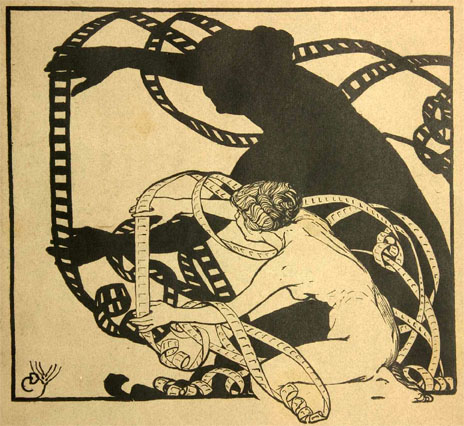
Cines trademark by Duilio Cambellotti

The Italian Society “Cines” of Rome, is studying the strongly educative influence of the cinematograph on the people with a view to elevating its productions and has decided to open an international competition for cinematograph dramas with prizes of considerable value. The Honorable Ferdinando Martini, Prof. Albert Besnard, Director of the French Academy at Rome, and the Honorable Vittorio Emanuele Orlando have agreed to head the commission, on which will figure the names of the most conspicuous personalities in the world of art and letters of different countries.

The prizes which will be awarded by the Society “Cines” are as follows : First, 25,000 francs; second, 5,000 francs; third, 2,500 francs; fourth, 1,000 francs; fifth, 500 francs. Other prizes of 100 francs will be awarded as arranged in the conditions.

The competition will be opened in the first days of November, 1913, and will close on April 30, 1914. All those, desiring to compete, can demand the conditions of the competition from the directors of the Italian Society “Cines,” 51 Via Macerata, Rome.

The Birth of Biograph

september 1895
September 22, 1895

This photograph records the first meeting of all of the members of the K. M. C. D. Syndicate, September 22, 1895, at Canastota, N. Y. Left to right—H.N. Marvin, W. K. L. Dickson, Herman Caster, E. B. Koopman, founders of the world famous American Mutoscope & Biograph Company, later known to the screen world as “Biograph”.

When Henry N. Marvin saw Edison’s kinetoscope he thought that a simpler machine could be built to present the peep show pictures and do it better. When he and Herman Casler had built the machine they sought Edison pictures to put in the machine.

“No,” was the decision from the Edison plant. Right then and there was the motion picture’s biggest moment. Marvin and Casler had to invent a machine to make their own pictures.

Out of that moment came the force that through a long series of dramatic sequences brought to the motion picture and its world the names of Griffith, Pickford, Sweet, Marsh, Gish, Normand, Nielan, Ince, Sennett, and all that glory that was Biograph.

Itala Film Turin to release long films

October 1912. The Itala Film Co. of America, of which Harry R. Raver is the head, will soon issue for the American trade a series of long films composed of two and three reels each. For these special productions a coterie of noted artists have been engaged, prominent among whom are Gina Marangoni, Giuseppina Amici, Berta Nelson and Lydia Quaranta, all of whom are well and favorably known throughout the largest theaters in all Europe. Commendatore Ermete Zacconi, conceded to be the greatest living Italian actor, and perhaps the most prominent in Europe, will be seen in these forthcoming Itala multiple films.

The policy of the Itala Company will be confirmed to the appointment of exclusive agents in the United States, these agents to control certain territory. The first of the new Itala releases is called “Souls in Torture,” and consists of two reels. As the title infers, the subject deals with heart throbs and the bitter problems of life. Several elaborate scenes are unfolded as the story proceeds. A very large cast of players is used. A reproduction of a fox hunt with blooded horses and a fine pack of hounds adds to the exciting features of the story. “Souls in Torture” will be sold
to exclusive state right buyers through the Film Supply Co. of America. The headquarters of the company is at 805 Columbia Theater Building, New York