Again I find pleasant occasion to quote from the New York World- this time from the evening edition. From a leading editorial entitled “Posing for Posterity” I select the following excellent extracts:
Moving Pictures of the burial of the battleship Maine, which took place March 16 th, have arrives in this city and are being shown to the public. Wonderful vividness the Moving Pictures promises to lend to History! The preservation of films of special public interest begins to be already a metter for the Government to consider. There is n reason why our grandchildren and great-grandchildren a hundred years hence should not see faithful reproductions of Mr. Taft signing the Statehood Bill for Arizona and New Mexico, the Durbar of King George V, and even more important events. What would we not give to-day for a Moving Picture of the signing of the Declaration of Independence? Or of Washington taking leave of is officers? Or Lincoln at Gettysburg? Is it not, after all, our duty carefully to record and preserve as archives such Moving Pictures of contemporary scenes and public persons as may have first-rate interest to posterity? Will not cities, libraries and schools all over the world desire such records?
And this prompts the question: What are we doing to preserve all these historically important film that are being made every day? If the manufacturers do not get together and preserve these prints and the negatives, the preservation of these films will become a public charge.
The Photoplay Philosopher (The Motion Picture Story Magazine, August 1912)
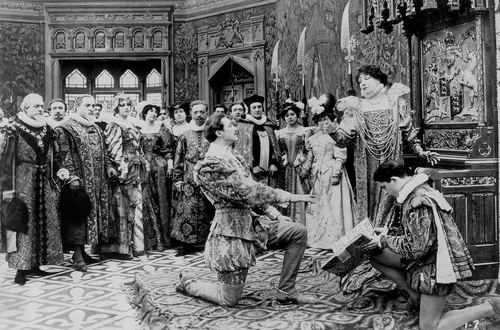
Sarah Bernhardt, Les Amours de la reine Élisabeth (1912)
Strange as it may seem, motion pictures have done much in cultivating the public. The year 1911 saw a number of natural developments in the growth of the “Silent Drama.” Perhaps one of the most important of these is the tendency towards longer subjects. Films of more than one reel are no longer a curiosity and have been received with much favor. Ancient and modern history is brought back to our memory in an interesting way, while, were these same subjects to be put in a stage, the companies would be received with empty benches.
Dickens’ “Becky Sharpe” and Julia Ward Howe’s ” Battle Hymn of the Republic” have been pictured in an instructive and impressive way. While it cost more than $100,000 to put on Dante’s Inferno, just twice as much as to produce the play of Ben Hur, The Fall of Troy, The Crusaders, Cinderella, and a Tale of Two Cities have cost many thousands. As illustrating the progress of the “Silent Drama.” the Milano Film Company, of Italy, which evolved Dante’s Inferno, now announce the completion of Homer’s Odyssey. This immense production evolved an expenditure of thousands of dollars and was two years in preparation. This will show that the picture play is being developed in a very high class scale as to authors, actors, and elaborateness of staging. The best plays are being chosen and the most eminent actors have succumbed to the inducements offered by picture companies. Among the celebrities who have become allies to the camera may be named McKee Rankin, Sydney Booth, Nat Goodwin. Charles Kent. Mary Fuller, and others. An English writer recently asked Bernhardt if she did not consider her posing for the camera a retrograde movement, to which she replied: “I am playing for posterity. Art is always Art. no matter where it is or what the environment. What would we all give if the art of our Rachel could have been preserved in this manner, and who does not regret that science and invention could not have been resorted to in the days of Keene and Garrick.”
Perhaps the most important achievement is that “Salvini,” whom Charlotte Cushman pronounced “the greatest actor the world ever saw,” now over 80 years of age, has consented to produce his sublime portrayal of “Othello” before the camera. Among the many admirers of motion picture; are “Tetrazzini,” the famous opera singer, and Professor Starr, of the Chicago University.
Professor Starr has pronounced “the moving picture” the highest type of entertainment in the world, and Mark Twain, shortly before his death, said: “The motion picture show makes me feel brighter, healthier and happier.”
The “motion picture” is fast becoming a great factor in educational work. Do you remember how you used to brood over the crude pictures in the little old geography? And how you promised yourself that some day you would see these places of interest? If any one would have told you then that, in comparatively a short time, scenes of pulsing life, with all the action and color of the original events, would be flashed on the class-room wall, you would have talked of fairy tales and scoffed at the notion. Yet this is the latest and perhaps the biggest step in education. Already in New York City a movement has taken form to provide for the schools, colleges, churches, social settlement, and every center where education is an object, exhibitions of motion pictures. They are presenting in a fascinating way the most direct and exclusive information on given subjects.
Instead of the “Declaration of Independence” being read in the old boresome fashion, the very men who gave life and force to the document by signing it, will seem to gather at an end of the class room. Already in our State at the Boulder School for the Deaf and Blind they have pictures which are being successfully used to teach the deaf and dumb the scenes of mining and agriculture. One of the most fascinating uses made of the motion pictures has been to entertain and suggest normal thought to the insane.
I sat by the fireside dreaming of days of long ago,
And pictures seemed to form in the midst of the ember’s
glow
But faded e’er I could catch them, the coals to ashes died,
E’en as my hopes had perished and the heart within me
sighed.
I left the dying firelight, and the lonely, cheerless room
And wandered down the avenue, seeking to lift the gloom
When I heard the sound of music, saw countless lights
agleam
And suiting an idle fancy, I entered as in a dream.
I entered into darkness, but sudden, before my eyes
On a curtain of white, came pictures and I stared in mute
surprise,
Pictures that world! In wonderment I quite forgot my pain.
Pictures that lived! And with them I lived my youth again.
The North, the South, the East, the West were all at my
command;
The whole world came before me. at touch of an unseen hand.
Ah! the pictures by the fireside may fade and die away,
But those on the magic canvas live anew for me every day.
From a Paper by Hattie M. Loble. Read at a Meeting of the Daughters of Confederacy, Helena, Mont., Tuesday, March 19, 1912.
Mentre Narsete si preparava a discendere in Italia, subbentrando al comando di Belisario, propositi di resistenza e di lotta premono tra il popolo che si ribella ad Orso Faledro di Aquileia, ed elegge tribuno in vece sua Marco Gratico.
scena di La Nave 1912
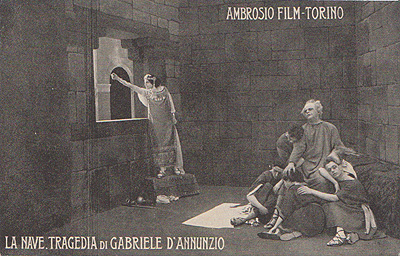
Ma Basiliola, figlia d’Orso Faledro, per vendicare il padre ed i quattro fratelli accecati (secondo l’uso di Bisanzio) e che vanno randagi, senza meta per la città, si scopre al tribuno e con le sue bellezze gli accende nell’animo una passione funesta.
La Nave 1912
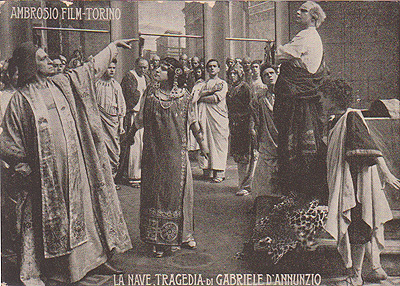
Ciò ottenuto, Basiliola, con fine arte trascina ad odi interni la casa Gratica e mette l’uno contro l’altro armati i due fratelli, cioè, il vescovo Sergio Senzapollice ed il tribuno Marco Gratico; questo avviene nel cospetto del popolo convenuto al sacro banchetto dell’Agape.
scena di La Nave 1912
Presso il cadavere ancora caldo di Sergio, Simon d’Armario annunzia a Marco Gratico che Giovanni Faledro entra nel canale Fannio. Il popolo corre alla grande Nave, pronta a scendere nell’Adriatico, ma alla Nave, dice Marco Gratico, manca la figura di prua, ed egli che ha scoperto tutte le vendette macchinate da Basiliola, ordina di inchiodarvi la ragazza. Ma Basiliola getta al tribuno un’ultima sfida: è capace di darsi la morte quale ella vuole, e si precipita sull’ara immergendo il viso nelle fiamme.
…………………………………..
Il Cinematografo al Vittorio Emanuele e la Nave della Soc. Anonima Ambrosio.
Torino, 15 luglio 1912. Il vastissimo teatro di via Rossini, il classico teatro delle grandi stagioni di opera popolare, ha spalancati i suoi battenti al cinematografo.
Si sono inaugurati gli spettacoli, il 4 corrente, colla Nave la grandiosa tragedia D’Annunziana, ridotta a scene cinematografiche dalla Casa Ambrosio, ma francamente dobbiamo lamentare l’impreparazione della impresa esercente il teatro, che non seppe o non volle presentare un impianto che permetta una chiara e nitida proiezione: il quadro è perfettamente al buio ed il pubblico non mancò di protestare e palesare il suo malcontento.
Così il bellissimo lavoro della Casa Ambrosio non ha potuto essere apprezzato convenientemente, e su di esso nessun giudizio spassionato si può dare fino a che non venga proiettato in altro locale, dove non sfuggiranno, e la grandiosità della messa in scena, l’ottima interpretazione artistica ed il movimento delle masse.
Qui nulla di tutto ciò abbiamo potuto vedere: il quadro, ripetiamo, è una nebulosa, tutto è avvolto in un denso strato di caligine… che fra le altre cose è molesto alla vista.
Siamo spiacenti di dover constatare questa imperdonabile deficienza, che si risolve in una danno per la stessa impresa; il pubblico pagante va al cinematografo non per soffocare di caldo in questa afosa stagione, ma per godere uno spettacolo. E siccome in Torino non difettano locali dove le films si proiettano a modo, è in questi altri che si riversano i frequentatori del teatro silenzioso.


 sempre in penombra