Motion Pictures in Europe, May 1912

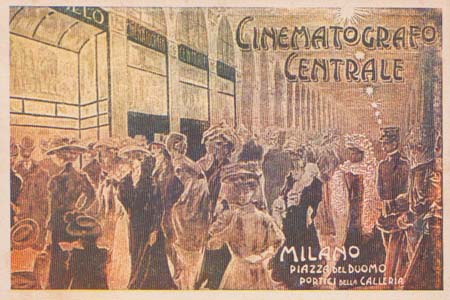
Cinematografo Centrale Milano

MOVING PICTURES in Rome—what a contrast! Hoary ruins and ragtime, the Coliseum and the Biograph! But, most appropriately, the theater was adorned with tall marble columns and a great flight of stone steps that suggested trailing togas and sandaled feet. Such a theater the ancient Roman might have entered on his way to the Baths of Titus, or as he rattled home in his chariot from a hard day’s work in the Senate House. Indeed, it seemed so much like going to the Temple of Minerva to see Moving Pictures, or expecting vaudeville in the catacombs, that we hesitated before entering. Perhaps this was just another “sight,”  and we were distinctly weary of sight-seeing and a bit homesick; but, no—there were the red and yellow posters of cowboy heroes on bucking broncos, and lovely Indian maidens, looking as familiar here in this hot, sleepy Roman square as they do on Fourteenth Street, in spite of the strange words in the voweled Italian tongue above them. A cowboy by any other name would be as thrilling! So in we went. Indoors, the classic illusion vanished. We were shown to comfortable leather chairs by a dark, smiling usher. The programs were printed in Italian, French and English, but the explanations of the pictures were all startlingly foreign. The somewhat limited Italian vocabulary that we had collected so far being “quanta costa” and “gratia,” we had to depend entirely upon the pictures themselves for the story, and I had never realized before how perfectly pantomime can supply the lack of words. The films were all of American make and American subject matter, picturing a sky-scraper in the making on Broadway, a Kentucky feud and a Western round-up.

But it was the audience that interested us most. There were Italian ladies in low-necked velvet gowns and diamond-bright hands. The men with them bowed them into their seats with faultless politeness—and sat beside them during the entire performance with their hats on! Dingy Street laborers with red neck-kerchiefs rubbed elbows with gentlernen in correct evening dress. And such a responsive audience! They sighed at the pathetic parting of Cowboy Jim and his white-haired mother, laughed when the fat policeman kist Mary Jane and received a frying pan on his head, and hissed threateningly when the villain in top-boots tied the sheriff’s daughter to a log in the sawmill. The pianist was an artist—all Italians are artists in some way—and his music shaded off from gay to grave to the movement of the pictures, more sympathetically than I have ever heard it done in America.

From Rome on, we watched eagerly for the Motion Pictures and never failed to find them, tho not in such quantities as in America. In Florence the principal picture theater was on one of the level, sunny squares, where the pigeons tumble musically about the crumbling stucco of the Monastery of Savonarola.

In Venice we were rowed to the Pathé Frères in a gondola across the Grand Canal.

The Apollo Theater in Lucerne is on a back Street beyond the big arcade and the brilliantly colored postcard booths. Here the seats are divided in Continental fashion into first, second, and third class, with a varying scale of prices. A small boy with a dark-lantern guided us to our seats by throwing a circle of light on the floor. A chime of bells tinkled when the pictures were changed, but there was no other music. It was an exceedingly artistic performance.

The English Motion Picture shows are characteristic. Since no true British man, woman or child can enjoy him or herself thoroly without a cheering cup of that national necessity, tea, the Motion Picture theaters bear placards over the door, “Afternoon tea served free during the performance from three to five.” It is a pleasant sight to see the round-faced ushers distributing trays of this steaming liquid, while hair-breadth escapes, hold-ups and frenzied lovemaking go on unnoticed upon the screen. In war, in peace, in love the Englishman must have his tea. It is fortunate for the pocketbooks of American owners of Moving Picture shows that the Boston tea-party lessened our inherited thirst, for it must be a large added expense to furnish unlimited cups of even very weak tea every afternoon.

When we arrived in London the British enthusiasm over their recent king-making was still echoing in the Pageant of Empire at the Crystal Palace, and in the Kinemacolorgraph
—the Motion Pictures of the coronation colored to life by a new process. We had not been a part of that frenzied horde of curious tourists that flocked to England in June, but our second-hand peep at the coronation, on the screen, gave us probably a better—certainly a cooler—idea of the royal “show.” Taken off their guard by the malicious camera, the dukes and lords appeared in delightfully unconventional postures, and their heavy velvet robes looked realistic in color and warmth.

European audiences go to the Moving Picture shows to see the pictures, not to use them as an excuse for conversation. No whispered receipts for gingerbread or lemon pudding interrupt the dark grandeur of the Milan pictures of Dante’s Inferno; no confìdences about Harry or Charlie mingle with The Indian’s Sacrifice. They give the pictures the same respectful attention that they would a regular theatrical performance, and the result lifts the audience to the artistic level of the pictures themselves. “American papers please copy !”

Dorothy Donnell (The Motion Picture Story Magazine, May 1912)
Il Pathé-Palace a Parigi, maggio 1912

Una delle più grandi attrattive di Parigi è il Pathé-Palace, il nuovo grandioso cinematografo che accoglie giornalmente migliaia di persone attratte dalle proiezioni delle attualità e della produzione cinema-teatrale del Consorzio Pathé.

Il Pathé-Palace può considerarsi una vera istituzione parigina — poiché tutte le classi della popolazione della capitale lo considerano ormai un elemento indispensabile della vita moderna, per il quale, anzi, la vita moderna viene ad essere ampliata e fatta più profonda.

Siamo ben lontani dall’epoca nella quale le notizie venivano recate da un paese all’altro dai mercanti in occasione delle fiere, e adornate di fantastiche leggende dai viaggiatori avventurosi.

E siamo anche lontani dal tempo che il teatro era privilegio della Corte di Francia e della nobiltà, e costituiva un godimento pei raffinati e pei ricconi.

Il cinematografo, ch’è l’invenzione più democratica del secolo, ha reso possibile la trasmissione visiva delle notizie a distanze enormi con una rapidità prodigiosa, e ha portato il teatro a un grado da essere in facoltà di tutti goderne i diletti migliori.

Questi due benefici danno, in una capitale come Parigi, risultati che per l’eloquenza loro meritano di essere segnalati, anche perché rappresentano, in grande, i risultali di pressoché tutti gli esercizi cinematografici del mondo.

Il Pathé-Palace occupa a Parigi un locale per il quale paga 200.000 franchi all’anno di affitto — situato sul Boulevard des Italiens. Nella elegantissima sala, che è capace di non più che settecento persone, si da convegno tanta parte della popolazione da produrre un introito medio giornaliero di 2.500 franchi, con un massimo di 5.000 franchi in un giorno. Tutto ciò, notiamolo, è ottenuto colla sola produzione del Consorzio Pathé.

Sull’area adiacente al Pathé-Palace si sta ora costruendo l’immenso Palazzo il quale sarà occupato interamente dal Salon du Pathéphone e dagli uffici del Pathé-Journal.

Le Palais des Etablìssements Pathé occuperà di facciata la nuova Rue des Italiens che sarà aperta nel centro di Parigi — e sarà tale che la Casa Pathé ne pagherà l’affitto formidabile di 600.000 franchi all’anno, cifra assolutamente inaudita finora tanto in Francia come in Italia.

Queste cifre non sono che un’indicazione, un esponente di ciò che rappresenta, economicamente parlando, l’arte e l’industria cinematografica: quell’arte che è teatro – cultura – scienza e diletto per tutti; quell’industria cui collaborano in folla, gli inventori più geniali, gli operatori più abili e arditi, gli operai più modesti nei laboratori oscuri….

Se si riflette che la Casa Pathé produce ogni giorno uno spettacolo teatrale e pubblica il suo giornale, riesce facile capire come ormai Parigi non possa più fare a meno del Pathé-Palace — che è il suo teatro e il suo giornale favoriti.
(dalla Rivista Pathé, 26 maggio 1912)

100 anni dopo, il Pathé-Palace è ancora al Boulevard des Italiens 32, nel frattempo è diventato una multisala  l’UGC Opera. (sito Cinema Treasures)

Corriere del Cinematografo Maggio 1912

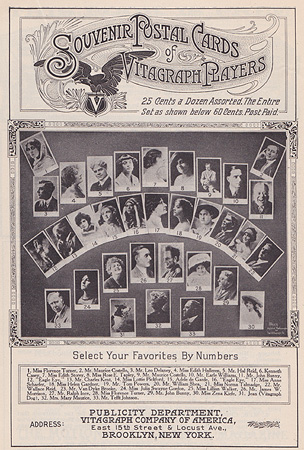
Souvenir Postal Cards Vitagraph Players, maggio 1912

Filoteo Alberini di Roma ha fatto brevettare in Germania un nuovo apparecchio cinematografico nel quale è riunito l’apparecchio cinematografico con una camera panoramica che da delle immagini cinematografiche di una larghezza d’angolo superiore ai 110°.

La réclame della Vitagraph Comp. in favore dei suoi artisti e delle sue films è assai pratica. Essa fa stampare una grande quantità di cartoline illustrate con i ritratti dei suoi artisti più popolari e le vende al pubblico a poco prezzo: una collezione di 20 per circa 60 centesimi. Questa innovazione è la migliore prova dell’interesse enorme che il pubblico americano ha non solo per la cinematografia in generale, ma anche per i suoi artisti, i quali, quantunque muti, acquistano una fama mondiale.

Album per vedute cinematografiche. Quest’idea assai originale ci viene, s’intende, dall’America, ove Mr. e Mrs. Daniel-Marvin di New York si sono fatti cinematografare durante il matrimonio. Altrettanto intendono fare per tutti gli avvenimenti importanti che avverranno nella futura famiglia, in modo che essi stessi ed i loro figli potranno nelle ore di ozio leggere, come in un libro illustrato, la loro vita passata. E’ semplicemente l’applicazione alla vita privata di quanto alcuni Stati e città (Amburgo, Brema) hanno già fatto per il loro paese ed i loro abitanti.

I guadagni dei teatri cinematografici debbono raggiungere somme ben considerevoli, se si giudica dai fitti che si pagano per i locali. Cosi ci consta che un cinema di una grande città d’Italia che sei anni fa pagava ancora lire 4000 annue, paga ora per il medesimo locale lire 35.000. Un altro cinema di un’altra città che ora si vende per 100.00 lire paga per solo fitto annuo anticipato lire 45.000.

Il triplo cambiamento dei programmi nei teatri cinematografici. La caratteristica dei cinema è anzitutto la facilità con cui sanno attirare il pubblico e tenerlo lontano dai teatri. In questo solo punto tutti i teatri cinematografici vanno perfettamente d’accordo. Ma non mancano poi le disparità di vedute, ad es., sulla frequenza del cambiamento del programma. Scrive un personaggio assai conosciuto nell’ambiente cinematografico di Berlino: «Un cinema con triplo cambiamento di programma settimanale non è un teatro, ma una sala d’aspetto, che all’esterno perde di serietà per la sua troppo mutevole réclame e nell’interno è nella impossibilità di curare l’arte e l’armonia. Noi condanniamo — così dice l’autore nel suo invito all’assemblea di protesta — il triplo cambiamento settimanale del programma dappertutto anche nei centri minori, così pure il duplice cambiamento nelle città con più di 15.000 abitanti». La protesta di questo signore avrà poca probabilità di risultato, poiché esso sarebbe contrario anzitutto all’interesse dei fabbricanti.

Il primo cinematografo ufficiale al servizio della scuola tedesca, è quello che funziona regolarmente nella scuola elementare di Zella-St. Blasii (Turingia). La scuola ha fatto con spese considerevoli i necessari acquisti e se ne serve regolarmente per la geografia e la storia naturale. A Bonn il partito socialista dell’Amministrazione Comunale ha proposto l’acquisto di un cinematografo a spese del Comune per scopi pedagogici. Nello Stato di Connecticut si è deciso l’acquisto dei cinematografi su vasta scala per tutte le scuole che saranno munite di apposite sale di proiezione.

L’Elektrizitätsgesellschaft « Sanitas » di Berlino ha costruito un apparecchio assai interessante per i fotografi: un generatore d’aria calda e fredda: « Fon », di piccole proporzioni e del peso di soli 950 grammi. Questa specie di ventilatore, in alluminio, si impugna come un « revolver » o si fissa su apposito piedestallo. È mosso elettricamente ed è munito d’un interruttore per aria calda e fredda: il consumo d’energia è minimo e la corrente — che si può intensificare o diminuire, a seconda, con piccoli moderatori facilmente applicabili — può essere fornita da qualunque attacco murale o da lampada comune ad incandescenza. In fotografia, questo apparecchio serve come prosciugatore : infatti la corrente d’aria generata, concentrata e diretta opportunamente, favorisce mirabilmente l’evaporazione e l’essiccamento: lastre, pellicole, stampe, sottoposte al soffio caldo, asciugano in pochi secondi, senza alterazioni di sorta. Il risparmio di tempo, naturalmente, con la notevole accelerazione nei processi produttivi, permette una maggiore utilizzazione dei macchinari e degli impianti fissi.

Una curiosa applicazione del cinematografo, che fa pensare a futuri fantastici sistemi, è quella adottata dal municipio di Berlino. Avendo scoperto irregolarità negli incassi delle tasse per il culto, esso ha fatto fotografare i 30.000 fogli circa, che compongono i registri dei ruoli, su di una film che risultò lunga circa 60 metri. Essa verrà letta mediante un apparecchio speciale con lente d’ingrandimento e, per le sue piccole dimensioni, può essere tenuta in una cassaforte. Terminato il lavoro in 4 giorni, con una spesa d’impianto di 5000 marchi e 800 d’esercizio, le liste sono passate nelle mani degli esattori. Oltre ad una grande facilitazione di controllo, il municipio ha trovato anche un guadagno nella forte diminuzione di spesa per la copiatura delle liste. Ecco dunque il cinematografo anche negli uffici della burocrazia!…

Secondo un’informazione del Corriere della Sera, il Papa ha permesso l’uso del cinematografo nelle chiese, previo permesso del vescovo e a condizione che il S. Sacramento sia ritirato dalla chiesa; questa sia sempre illuminata salvo durante le proiezioni, le donne siano separate dagli uomini ed il curato sorvegli attentamente la situazione.