Picture-Players I Know

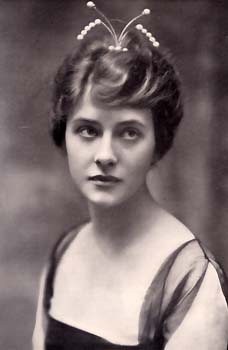
Elsie Ferguson 1914
Elsie Ferguson 1914

Some Reminiscences of Albert Kaufman, Studio Manager told to May Herschell Clarke.

Recently I had the pleasure of meeting Albert A. Kaufman, brother-in-law of Mr. Adolph Zukor, and co-worker with that great pioneer of filmdom. Mr. Kaufman has been associated with the motion picture from its earliest infancy in the days of the penny arcade, when, as series of jerky, crude photographs in a “twirl-box”, it first came into being.

Later, when Mr. Zukor, having seen and developed the possibilities of these penny arcades, converted them into the exhibitors end of the business, where he remained for five years.

Then, when the Famous Players Film Co. was formed – the Lasky was added later – Mr. Kaufman became, in 1913, manager of its studio, his connection with that organisation remaining unbroken since that time, except for two years which he spent in the U.S. army.

Memories of Mary Pickford

But it was of some of the famous picture stars who have come under his management from time to time, rather than of himself, that Mr. Kaufman chatted during the very enjoyable afternoon I spent  in his company, and what more natural than that he should commence with Mary Pickford?

“She was the first  big star who came to our company,” he said. “Speaking of her reminds me of one of her most popular pictures, ‘Rags,’ in which we encountered the only difficulty we have ever been unable to meet, and in this instance we were baffled by a dog.

“You remenber the canine actor in ‘Rags’? Well, he was a cur, and came from a lost dogs’ home in California, where we rescued him from the lethal chamber to play opposite’ Mary. He became quite a studio pet, and made his picture debut in ‘Rags’ successfully. At last we had got to the part where Mary leaves her country home to visit relatives accompanied by her dog. This scene was shot and then the dog developed hydrophobia and died! For the first time in our experience we, who hitherto had always been able to find a substitute for an actor could find no duplicate of this four-footed one, and so you saw the little heroine arrivong at her destination minus her pet, while an extra sub-title had to be inserted in which the great Mary Pickford was forced to own ‘On my way here my dog died.’ ”

Stars of the Stage

From the “World’s Sweetheart” it was an easy step to Marguerite Clark, and Mr. Kaufman related the history of her entrance into her film kingdom.

“Miss Clark had been a tremendous success on the legitimate stage, and it took us six months to persuade her that fame awaited her in pictures. In the end she consented to sign a contract to work but ten weeks a year for three years, so that she might devote her main time to the theatre, because she felt sure she would never be a success in pictures. She has been in them five years now, and has never been on the stage since that day!

“Elsie Ferguson was just as hard to convince as Marguerite Clark. When we forst approached her she was receiving a very high stage salary, was very popular, and was known as the best gowned woman on the American boards. She, likewise, never thought she would succeed in pictures, but eventually she was persuaded to sign a contract. She scored and instant success both in America and over here, but when she first saw herself on the film she almost broke down. Even then she felt sure she had no chance of success: she could not work nearly as naturally before the camera as on the stage, she said. Nevertheless, she remained in pictures, and look where she is to-day. And she, like Miss Clark, has never appeared on the legitimate stage since her film début.

These two instances I have quoted will show you how big artistes sometimes underrate themselves, being unable to foresee the public favour awaiting them.

“We are expecting Miss Ferguson over here soon, and she will then appear in the film version of Pinero’s play, ‘His House in Order.’ She is a very lovely girl, and still sets the fashions in America.

(to be continued)

The Real Charlie Chaplin

Charles Chaplin
Chaplin at home (1919)

To most men there is one thing that is above all things sacred, and that they would guard from the prying gaze of a curious world. This place they call “Home”.

The movie star, however, lives in the limelight, and earning a colossal salary, likes to have something to show for it. Which perhaps explains why the American magazines are full of flamboyant descriptions of the palatial residences of these super-twinklers on the film horizon.

There is one man, however, whose home is a sanctuary in the truest sense of the word, for Charlie Chaplin rightly argues that the man whose work places him continually in the public eye can only preserve his sanity and a wholesome outlook on life by reserving for himself a refuge to which he can retire, and, for a space, be – just himself.

Chaplin’s home is neither sumptuous nor Bohemian. Everything in his surroundings testifies to his excellent natural taste. He likes quiet, restful colours, comfortable furniture meant for use, and plenty of flowers. He is a great reader. I think music is his only real hobby outside his work, and a fine concert “grand,” his cello and violin, are the only articles of luxury in Charlie “den.”

He loves Work

Chaplin is first and foremost a worker. On his desk there ere always numerous scraps of paper full of comedy inspirations in his nervous, characteristic hand, and there is a dictaphone at his bedside to record any brain-waves that “happen along” during the night.

Charlie is naively detached in his attitude towards his wealth. He hates to be bothered with money, and when travelling, his secretary settles all his bills, and merely reminds his absent-minded “boss” of a morning that he has put a few banknotes into his pocket against emergencies. On a certain occasion, one of Chaplin’s bankers sent him a hurry call, as an important investment needed his personal attention. The messenger was  sent back with the answer that Charlie was open to discuss the matter if the manager would take a walk with him in the park. “I hate banks,” was the only reason he gave, “and I hate talking to men behind desks. I guess it’s because of the memory of the time when I was a little boy and went hunting for a job.”

His Early Struggles

He loves harmless fun and a good story, but fundamentally he is a serious man, and I think the memory of his early struggles has left a mark on his soul that time will never efface. “What I need, you know,” he once said in his quaint, whimsical way, “is someone to keep me from feeling pathetic about myself; someone to say, ‘Here, you poor little devil, what business have you to feel sorry for yourself, you poor lonely child, with non one to love you, and only about one million pounds between yourself and starvation? Come, get up here and work!’ That’s what I need.”

Charlie’s warm and unspoilt nature is best show in his passionate love of little children. There is a big hotel at Pasadena, and when he takes a day off from his work, he slips down there, gathers the children around him on the sunny porch, and tells them stories. Every child loves him, for he is still a child at heart, and they just feel he is one of themselves. His weekly post runs into thousands of letters, but those he treasures most are the ones that come from his little friends, telling him about all their joys and sorrows that mean so much to every child.

The Portrait Of A Woman

To conclude. Showing some pictures one day to a friend, Chaplin came to one, a woman portrait, at which he gazed for a time with loving, tender eyes. “My mother!” he then said simply. “To her I owe everything and all that I am to-day.”

And, knowing that a great son is invariably the work of a great mother, I still like to recall that memory of little Charlie Chaplin gazing with dim eyes at his mother’s picture.

E.C. (from The Picture Show – May 3, 1919)

Tell Your Story by Mary O’Hara

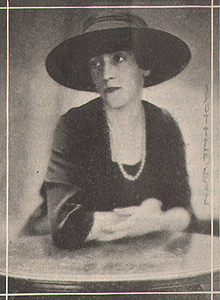
Mary O'Hara
Mary O’Hara

More on writing for the movies.

Los Angeles July 1922. As scenario writer to Rex Ingram, noted director, and adapter of  his two latest photoplays, “The Prisoner of  Zenda” and “Toilers of the Sea,” Mary O’Hara has climbed to a high place in the screen world. The secret of her success, she states, is contained in the words: “Tell your Story.”

Probably very continuity writer has some simple little recipe which helps him or her to get ready, set, go! A blank sheet of paper staring at one from the typewriter can be rather appalling when one realizes that it is only the first of a hundred or two blank sheets waiting to be filled up with good picture material.

My recipe is just this: Tell your story.

I have been asked so often how it is that I have mastered the trick of continuity writing in so short a time (for my first continuity, “The Last Card,” directed by Bayard Veiller, was made only a little over a year ago) that I have searched for the reason myself and have found it in my recipe, Tell your story.

I have always loved to tell stories. When I was ten I was telling stories to my nine year old sister. Many of them were serials that took six months or more to reach the end. Needless to say, it was always a happy end with the bride and groom at the altar, and the bride’s hair flowing in a cascade down the back of her satin gown. I usually, for good measure, threw in a pair of twins, born to them during their dignified walk back from the altar to the church door; twins because, if only one were bron, into which pair of arms, his or hers, should the infant drop on high? In fact, my sister and I had such heated discussions on this point that we finally settled upon twins as fairer – one for each.

In all this story telling, my greatest interest and my inspiration was my sister’s face; in scenario language, my “audience reaction.” If too many minutes passed without her eyes popping or her breath catching I would pile on the melodrama. When I thought she had giggled long enough I would try for tears.

I have never outgrown this habit of telling stories. Now I am telling them to the public with one eye on my typewriter as I compose ans the other eye, figuratively, on the face of the public, looking for its tears and laughter, its eyes popping, its breath catching.

To be a little more definite in describing my system – when I start a continuity, with the material well in mind, in imagination I place a listener in a chair opposite me. If my story is an adventuresome tale my listerner is a child. If it is a psychological drama my listener is an older person of average intelligence, for we all know that we would tell a story one way to an intellectual person and quite differently to one more simple minded.

Then I proceed to tell them the story. Introductions of characters, descriptions of time and place logically come first; then out of the characters and their relation to each other, the threads of the plot, and before I know it I am in full swing. The eye of my imaginary listener leads me on, I sense his interest or ennui, and above all, I am held to the neccessity of making the story clear – clear – clear.

Mary O’Hara (Photodramatist, July 1922)