La Morgana Films

Logo della Morgana Films

La Fata Morgana ha oggi dato il suo nome alla nuova Società che si è costituita a Roma sotto la valida direzione artistica di Nino Martoglio (il valoroso drammaturgo del teatro siciliano). A Roma già esiste la Film d’Arte, la quale corrisponde alle esigenze del momento. La Morgana Film compresa la necessità di estendere sempre più nel nostro campo il senso puramente artistico ed intellettuale dà inizio al suo lavoro con incrollabili appoggi. Non solo Nino Martoglio ha dedicato tutta la sua intelligenza ed attività per l’attuazione del vero ideale, di quell’ideale santo che si chiama arte, per il quale noi abbiamo sempre combattuto e lottato. I films a lungo metraggio per lo più sconclusionati, senza una vera impronta psichica razionale, è oramai tempo che finiscano; l’esigenza dell’oggi, l’onda infrenabile della cinematografia, ha bisogno di menti già provate, di intelligenze che hanno lavorato e sudato pro del nostro teatro — che si sono emancipate dalla cerchia dei lavoratori del pensiero. A Nino Martoglio, si sono uniti Roberto Bracco, l’autore del Diritto di vivere, di Piccola Fonte e di Sperduti nel buio, e Salvatore di Giacomo, il delicato poeta napoletano, al quale non solo Partenope ma Italia tutta è riverente — I nostri due commediografi, da come risulta dal Giornale d’Italia, han ceduto alla Morgana Film uno dei loro capolavori. Roberto Bracco gli Sperduti nel buio e Salvatore di Giacomo Assunta Spina. Quale esordio migliore potrebbe avere uno Stabilimento di posa, quando si pensi che Roberto Bracco, alieno a qualsiasi riduzione cinematografica dei suoi lavori, oggi ha ceduto il suo celebre dramma alla Morgana Film? Esecutori principali ne saranno Giovanni Grasso, il grande attore siciliano del quale si può affermare che il gesto è parola vivente, ed Adelina Magnetti. Queste due forze espressive riunite in una sola trama, mosse ad espandere tutta la loro passione nella grande opera del nostro autore, daranno tanta verità alla riproduzione del dramma da poter svelare allo spettatore la vera sintesi del lavoro, che il pubblico ha dimostrato non capire. Per questo Roberto Bracco si è deciso ad interrompere le trattative che aveva con alcune case estere ed affidare alla Morgana Film l’insceneggiatura di Sperduti nel buio, — e non ci pare fuori proposito riportare un piccolo brano di una intervista che il Giornale d’Italia gli ha fatto:

— Il mondo artistico italiano, ormai, non è che una gara industriale. Del resto, la Casa a cui ho ceduto Sperduti nel buio mi rassicura per i suoi intendimenti d’arte. S’intende che la visione cinematografica avrà una finalità diversa da quella della visione scenica, ma il mio dramma non subirà offese. E, anzi, il pubblico, che così spesso si lamenta della sintesi eccessiva delle mie opere drammatiche, avrà finalmente il piacere di conoscere tutto ciò che, negli Sperduti nel buio io ho preteso affidare al suo intuito e alla sua transazione.

Salvatore di Giacomo ha seguito le orme del suo concittadino ed infatti lo stesso giornale così riporta le sue parole:

— Si è piegato a consentire che un suo nobile suggestivo lavoro sia cinematografato un insigne scrittore di grande sensibilità ed onestà artistica: Roberto Bracco. Ha convenuto forse egli, come convengo io, che l’azione di Sperduti nel buio debba nel cinematografo essere più diffusa e variata e che un necessario ordito più peculiare debba esprimere tanti movimenti di quella dolorosa concezione che il drammaturgo ha in origine separata dalla sua esposizione così complessa, rapida e serrata com’è. La sua fantasia si eserciterà a comporre questo nuovo materiale quasi sussidiario, e l’esperienza di un nostro collega valoroso, Nino Martoglio, il quale già si è più avvicinato alla conoscenza tecnica di questa nuova forma di spettacolo, aiuterà il mio caro amico e concittadino. Il suo esempio m’incoraggia perché mi viene da un artista col quale ho vissuto i primi anni di giovinezza, e che mi è stato di esempio ancora nell’amore per l’arte e nel rispetto per l’arte.

Sotto questi auspici si inizia la Casa romana, sotto questa aureola di luce e di forza suggestive, e noi abbiamo piena convinzione che con il valido ausilio di Nino Martoglio e del signor Clemente Levi, (direttore amministrativo), ella occuperà ben presto il posto che si merita non solamente nell’Italia nostra, ma anche oltralpe.

Mario Woller Buzzi
(Il Maggese Cinematografico, 10 febbraio 1914)

Nota: La Morgana Films – Edizioni d’Arte è costituita come società di fatto nel gennaio 1914 a Roma.  Nino Martoglio, che lavorava come metteur-en-scène per la Cines, si era dimesso volontariamente dall’incarico verso la fine dell’estate del 1913, come risulta da una lettera inviatagli dal barone Alberto Fassini, direttore della Cines.
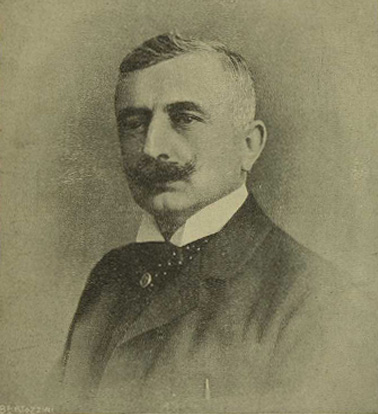
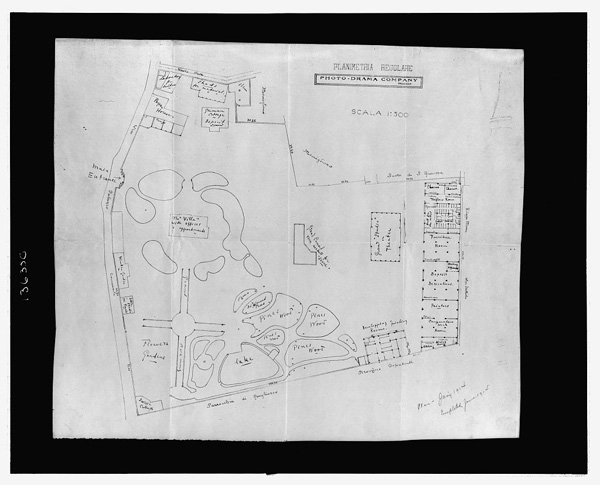
Photo Drama Film Company

Alfredo Gandolfi
Alfredo Gandolfi

Torino, gennaio 1914. Sotto la valente direzione del cav. Alfredo Gandolfi la Photo Drama Film, va iniziandosi a passi giganteschi e nella prossima primavera aprirà i battenti. Quanto di meglio possono fornire le modernità applicabili alla cinematografia sono state introdotte nel nascente Stabilimento non solo dal lato tecnico bensì da quello richiesto dall’arte. Lo stabilimento sorge a pochi chilometri da Torino in quel di Grugliasco, avente un’area di 10 mila mq. di terreno con annessa pineta, villa, bosco, giardini, laghi ecc. Nell’interno vi saranno spaziosi uffici per la parte amministrativa e tecnica, sale elegantissime di ritrovo e di lettura per gli attori. Il cav. Alfredo Gandolfi, coadiuvato dal solerte sig. Cesare Gani, ha già scritturato parecchi buoni elementi dei quali faremo il nome a suo tempo.

Pianta della Photo Drama Film Company a Grugliasco, gennaio 1914 (Library of Congress)

Chicago, March 1914. The memoranda tells me that George Kleine returned to his desk in Chicago, Friday, February 13, which should dispose for all time any notion that Mr. Kleine is superstitious. He isn’t. Friday the 13th has no terrors for him. No trip abroad that he has made in many years has left so many pleasant memories in the wake of his return. I saw him for a few precious minutes across that flat-top desk nearest the door. Mr. Kleine rarely hides behind the larger roll-top that stands further back in his office. And what do you imagine was the most important of the things that concerned him while I was there? A bunch of photographs that he had taken himself!

Mr. Kleine has been engaged for years and years in handling other people’s negatives and now he has taken to his own precious camera and the things that go into it and get in front of it and are taken from it. He found opportunity to push his camera button hundreds of times during his last prolonged visit abroad and it was my privilege to see many of the beautiful photographs. These views took me around with him in his travels. They covered many points of interest in and out of doors, principally in Italy, but none had greater charm for me than those showing glimpses of the magnificent estate which Mr. Kleine purchased up the road from Turin. It lies out from the town nearly five miles and it will be the place where the Photo Drama Producing Company will make films — big productions. One immense building, 330×66 feet is already underway. It will accommodate the actor folk and their wardrobes and properties; shops; the kitchen and dining rooms and serve as a modern utility building for the tremendous studio that will be erected as soon as the plans can be approved. These buildings will differ from other similar institutions in that country. They will include heating and ventilating systems in accordance with the best American practice — something that will be entirely new, because heating and ventilation problems have never entered into Italian studios heretofore. Just why not is a matter of conjecture, because the temperature isn’t always conducive to one’s best effort. Mr. Kleine told me that he had seen the thermometer at twenty degrees and players in films must have suffered due to the extreme cold. All of this will be corrected in the Photo Drama Producing plant.

Signor A. Gandolfi, former business head of the Ambrosio Company, is in charge of the affairs at Turin, and will be director for the big films that will be made at this new plant. The site is admirable, occupying the vantage point in a ten acre plot of land surrounded by a high stone wall. It is Mr. Kleine’s belief that it is the finest location for studio purposes in all Italy. The grounds are nicely wooded and there is a small lake within the enclosure. I hope to show you some views of it within a short time.

Mr. Kleine left America in the latter days of last September and of course this idea of making big films in Italy occupied much of his time and attention. If you will remember, he took some stage celebrities with him and it is reasonable to suppose that he has been overwhelmed with applications of Americans for positions in his foreign stock company. Mr. Kleine is enthusiastic about the possibilities for high-class big productions. He will bend every energy to maintain the standard he has already established and it is reasonable to suppose that with these prospective facilities; a company of his own selection and an organization of famous producers and camera experts, that he will be able to excel those films that have already made for the excellence of his output. Mr. Kleine is one of those men who frowns upon the term “this business is in its infancy.” An industry that has taken fifth place in the rank of the world’s big business can hardly lay claim to the title of infant. He is also practically convinced that a dollar is a low maximum figure for the admission price to the motion picture for the larger attractions. He still believes that he will open his beautiful New York theater with a dollar as the high figure, but he already sees the possibility of this price going higher.

I would like to get into that great pile of photographs that he brought back, but it would be like renewing a glimpse at Baedecker. I am sure that Mr. Kleine found his greatest pleasure at Venice, but points like Florence and Pisa held much for him if we are to judge by the snaps brought back. Mr. Kleine never looked better or seemed to be more fit for a hard day’s grind than he is now. What is more his office door is open!

The Goat Man
(Motography, March 7 1914)

Josette Andriot Parisian Fashion

Josette Andriot
Josette Andriot

New York, January 1914. One would hardly think it possible that, to choose a design, from the Maisons des Mesdames, Paquin, Chéruit, Agnes, or Callot, they would suggest going to the motion pictures, and you would express amazement at the idea if it were suggested to you, yet it is a fact that to-day such is the case. Even writers and some of our American dressmakers are following up this idea, since Paul Poiret gave his
exhibition of models in pictures.

During an exhibition recently of a Parisian Eclair photoplay entitled ”The Green God,” or “The Flower Girl of Montmartre,” which I had the pleasure of viewing, I was thoroughly astounded at the beauty of the French creations displayed in the production, and worn by the renowned star, Mlle. Josette Andriot. The costumes were perfect dreams, and, indeed, my thoughts were so carried away with the idea of being able to enjoy such a treat that the production itself seemed grander and more gorgeous than ever.

One would almost forget the photoplay trying to solve the mysterious secret of these beautiful models, and many a paper and pencil were to be noticed among the audience jotting down the various ideas and suggestions that appealed to them — and they
were many. The next time I go I shall positively be sure to have my little notebook and pencil with me, for it is impossible to remember all the little points of interest which present themselves, so helpful in new ideas as to what Paris is wearing.

The Eclair Film Company, a thoroughly French concern, that made this particular picture, is situated in the heart of Paris. Therefore much is to be expected from them in this respect.

Mlle. Josette Andriot, a dashing brunette, tall and stately, who is their leading actress, knows the fundamentals of smart dressing, and she expresses herself distinctly in three foremost qualities — individuality, personality, and self.

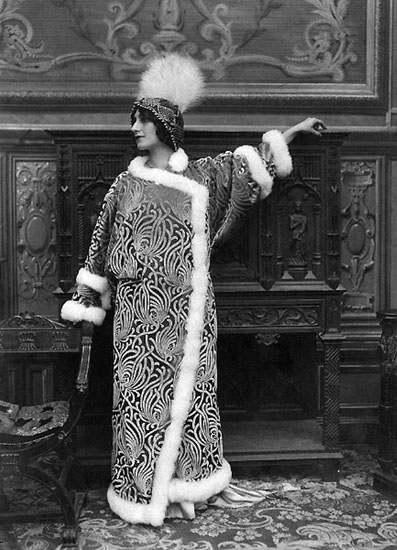
One particular gown worn by this beautiful actress in the production referred to I will describe, in order that you may realize my enthusiasm and join in it. Although extremely simple it was most charming and wellstyled, and, it goes without saying, distinctly French. A soft silver drapery suspended a silver banding, and giving the effect of an overwrap, was a novel feature of this costume. The skirt was of white satin draped high in the front, beneath a wide crossoxer girdle of the same material, and fell in graceful folds, forming a short pointed train. A single flower of velvet dropped from the waist-line. The decoration for her head-dress was a gorgeous bird of paradise.

All the brilliancy, yet glowing softness, of this toilette, was in charming contrast with a costume of dark velvet trimmed with ermine worn by a beautiful blonde in the same scene.

To appreciate beauty in its true form visit one of these delicious French productions, and gather the fruits of their beautiful ideas regarding “smart dressing.” You don’t have to go to Paris now for the advanced styles. They are brought right here to your own doorstep, saving you unlimited expense, time, anxiety, and a long journey.

Don’t throw away your opportunity. Easter is coming, and you know you want that one particular gown to be par excellence, so keep your eyes wide open and don’t miss the joy outstretched to you by the motion pictures. Should you feel doubtful, why not let your dressmaker, or seamstress, or modiste know, or take her with you next time when you see one of these beautiful creations, point it out, and tell her it is just what you want, and if she is a clever woman you will have that very gown yourself.

Agnes Egan Cobb
(Motion Picture News)