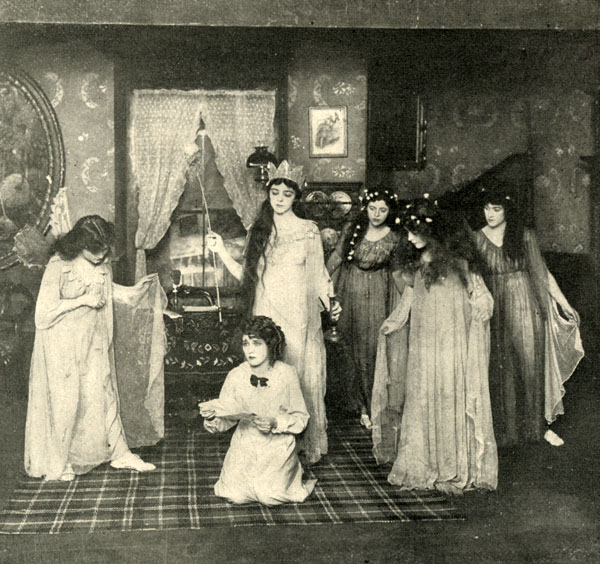
Little Mary among the fairies

Mary Pickford among the fairies
Mary Pickford among the fairies (Lillian Gish second ‘fairy’ from right to left)

David Belasco, in announcing that The Good Little Devil “is a fairy-tale for grown-ups,” disarms the critics who may now judge it neither as a play for children nor as legitimate drama for their own contemporaries. But as either, or as both, it is entertaining and weIl done. The play which Austin Strong has adapted with the prose of our tongue from the French of Mme. Rostand and her son Maurice, developed from the favorite fairy-tale which this mother wove for her son in the twilight nursery hour. It tells the story of Charles MacLance, a Scotch orphan boy, who might have been good had his ogre of an aunt, Mrs. MacMiche, not teased and mauled and starved and beaten him into being bad. But his badness wasn’t very bad badness–it was good badness that only meant mischief, not harm. There was love in his heart, and that is why everybody loved him, from Betsy the maid and Oliver the poet to Juliette, the little blind girl, and the fairies.

Such a plot affords Mr. Belasco all the opportunities he needs for the display of that theatrical art of which he is a master. There is every mood represented, from broad farce in the scenes between the ogre aunt and her confrères, the Old Nicks, to pure, sweet sentiment in the childish love scenes between Charles and his Juliette, and for these every degree of lighting is demanded. There is a starry night, when the fairies are floating from planet to satellite; twilight for lovers’ trysting and broad noonday sun for the frolics of schoolboys and garden friends.

If Mary Pickford, who plays the blind little girl, is a product of “the movies,” then commend us to the photo-play posing as a school for acting. Contrary to expectation, her facial expression was restrained rather than overemphatic and her diction was rarely fine. But both these qualities and her winsome prettiness are as nothing compared with the spirituality, the sweet childish simplicity with which she played her part. Had Ernest Lawford, who played the part of the poet, and Ernest Truex, the boy hero, shared her earnestness, her true feeling for the meaning of tile lines, they would have been more convincing. As it was, they both were in their parts, not of them; they had the semblance but not the soul of the people they represented. And if Ernest Lawford had the art to conceal his identity with his former parts he might also fare better. One who succeeds in doing this capitally is William Norris in whose crotchety, gnarled, maliciously hateful, deliciously comical Mrs. MacMiche one could never recognize the blithely singing hero of “Toyland.” A better old witch woman one couldn’t imagine in or outside of a story book.

Theatre Republic. “A Good Little Devil.” Fairy play in three acts by Rosemonde Gerard and Maurice Rostand, adapted by Austin Strong. Produced on January 8th.
(The Theatre, New York City February, 1913)

Adolph Zukor films a feature version of ‘A Good Little Devil’ for his new Famous Players Company. Mary reprises her role as Julia in her first feature-length film; Zukor shelves it for eleven months and releases it in March 1st 1914. (Mary Pickord Foundation)

David Belasco made his first screen appearance in the prologue of this production.

Notizie varie – dicembre 1913

Isis Film, Genova
Logo Isis Film, Genova

Bilancio della Cinematografia

Hans Gostar nella importante rivista ebdomadaria tedesca Plutus che si occupa di borse e di finanze, pubblica un interessante studio sulla situazione economica della cinematografia nel 1913. Rileviamo a titolo di curiosità qualche cifra:

La totalità dei capitali investiti nel mondo nella industria cinematografica sono calcolati in più di 2 miliardi. Di questa somma 312 milioni, servono ad alimentare l’attività delle fabbriche europee e dell’America del Nord.

Il Gostar dà poi qualche notizia sul costo della produzione: a suo dire il prezzo della pellicola vergine varia tra i 25 ed i 50 centesimi a metro ed il positivo ha un valore materiale medio di 60 à 66 centesimi al metro ed il film colorato da 90 a 95 centesimi. Egli viene alla conclusione che un film ordinario dagli 800 ai 1200 metri costa in media un 25,000fr. Non escludendo che ve ne siano quelli speciali il cui costo superi di molto questa cifra.

Si stampano generalmente di ogni film, cento copie qualche volta 120 raramente di più, che si vendono in ragione di L. 1,25 a metro meno che non siano pellicole rappresentanti speciali soggetti, ceduti in monopolio, nel qual caso il prezzo cresce eccessivamente.

Questo in riassunto scrive il Gostar con un dettaglio di cifre, di induzioni di ragionamenti. Il lavoro è pregevole ed in linea generale esatto ed interessante naturalmente in linea generale, che, nella pratica molte cose variano ed alcune deduzioni e conteggi sono assolutamente imponderabili.

La pellicola cinematografica ininfiammabile

La nitrocellulosa continua ad avere tutta la sua importanza industriale, ma ha trovato un grande concorrente nell’acetato di cellulosa.

L’acetato di cellulosa è un corpo che brucia difficilmente e che si fonde bruciando: è solubile nel cloroformio e nell’acetone. La sua plasticità permette di farne come la celluloide, dei pettini, dei manici per coltello, dei pomi per ombrelli, ecc. Mescolandolo col fosfato trifenilico, si ottengono dei blocchi o dei fogli di materia sensibilmente ininfiammabile e se ne può fare delle vernici per metalli o per ali degli aeroplani.

Ma la principale applicazione del nuovo prodotto è costituita dalle film cinematografiche ininfiammabili, formula che si ricercava per due motivi: la moltiplicazione dei cinematografi in tutti i paesi, le gravi disgrazie cagionate dalle films in celluloide.

Per ottenere films in acetato di celluloide, la soluzione d’acetato in un dissolvente volatile è versata su delle superficie rotative, si lasciano asciugare, e poi si taglia in nastri di 35 millimetri di larghezza. Le più infiammabili, quando sono di buona qualità, hanno una resistenza dinamo-metrica uguale a quella del celluloide. Si allungano meno di queste ultime nei bagni fotografici e si restringono meno sotto l’azione del tempo: la fiamma le fa fondere: fermate davanti all’arco dell’apparecchio di proiezione non prendono fuoco e per conseguenza non sprigionano il gas come fa la celluloide quando brucia. Così il problema delle pellicole cinematografiche ininfiammabili è risolto.

Con atto rogato dal notaio Barletti si è costituita in Genova l’ISIS Società in Accomandita semplice per la produzione e il commercio di films cinematografici; con sede in Genova, Via Garibaldi n. 8. Direttore artistico: Giovanni Riva. Direttore tecnico: Arturo Barr. Amministratori Aurelio Costigliolo, Giuseppe Pitteri. D’imminente programmazione: Jack l’apache o I predatori della Senna.

Una nuova casa fabbricante di films sta per sorgere sulla Riviera di Levante, la quale avrà il nome di Riviera Film. ne saranno proprietari il signor Riccardo Caimmi, noto attore drammatico e capocomico, ed un valente metteur en scène.

Inaugurati a Torino due nuovi cinematografi: Cinema Ambrosio (18 dicembre); Trianon Cinema Teatro di Varietà (20 dicembre). Impresa Giuseppe Barattolo.

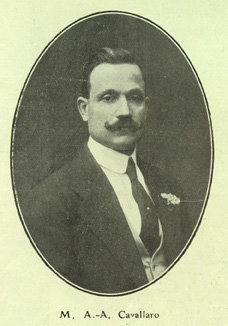
A. A. Cavallaro éditeur propriétaire de La Vita Cinematografica

M. A. A. Cavallaro
M. A. A. Cavallaro

Cette fois-ci, il nous est permis de présenter, à nos fedéles lecteurs, le portrait très ressemblant, de M. A. A. Cavallaro, notre confrère italien, si parfaitement distingué et si sympathique à la fois.

Il nous parait superflu de prononcer l’éloge biographique de M. Cavallaro, tant son nom de vaillant journaliste est connu dans la grande famille cinématographique.

M. A. A. Cavallaro est, en effet, éditeur propriétaire de la Vita Cinematografica, luxueux périodique d’une rare puissance, qui paraît à Turin et qu’il a su, d’une main aussi experte que vigoureuse, lancer sur la voie brillante du succès.

La Vita Cinematografica entre le 1er janvier dans la 5e année d’existence. C’est un modèle du genre, et rien de ce qui constitue l’extrême activité de l’industrie du film ne lui échappe.

La Vita Cinematografica a mené victorieusement des campagnes inoubliables. Elle en a conservé un glorieux souvenir qui restera pour toujours attaché à son nom. Il suffit de se rappeler ses batailles contre les artistes dramatiques, coalisés contre le cinéma et qui s’opposaient à son ascension. Ses réquisitoires contre les auteurs, également déchainés contre le film et ses adeptes, son restés à jamais célèbres. Et la conduite toujours noble et généreuse de A. A. Cavallaro, ses qualités innées d’écrivain et sa connaissance parfaite du Cinéma sont venues à bout des pires difficultés.

La Vita Cinematografica, créée à 20 pages, paraît aujourd’hui sur 200 pages, illustrées des plus riches couleurs. Elle contient dans ses colonnes la matière d’un volume, et ses multiples abonnés y trouvent, en même temps qu’un agréable passe temps, mille et mille renseignements indispensables à l’exercice de leur profession.

A l’heure où paraîtront ces lignes, la Vita Cinematografica sera devenue hebdomadaire. Ceci prouve la place qu’elle a su prendre au premier rang de la presse cinématographique italienne, où toutes ses rubriques, surtout sa critique d’Art, font autorité.

Ses bureaux sont un centre cinématographique. Les artistes, les directeurs et tous les cinématographistes qui visitent Turin s’y arrêtent volontiers. Ils y trouvent toujours le meilleur accueil.

M. A. A. Cavallaro est Calabrais, mais il est surtout journaliste de naissance. D’un caractère joyeux, il est expansif, spirituel causeur. Ses amis sont nombreux, il compte des milliers de sympathies, mais il reste l’homme le plus modeste et le plus bienveillant.

Si on lui vante les mérites de son journal, il en reporte le succès à la valeur des fidèles collaborateurs qui l’ont  soutenu et suivi au cours d’une carrière mouvementée, souvent difficile. De Lui, jamais un mot. Comme la valeur véritable, il sait rester à l’écart et se dérober aux vaines flatteries.

Félicitons sincèrement le confrère, le directeur heureux de la Vita Cinematografica. Il a su donner à la presse professionnelle, par son impulsion ardente, une ampleur extraordinaire qui lui confère le droit d’aspirer à de nouveaux triomphes que le Courrier lui souhaite pour ses étrennes, en lui envoyant l’expression de sa vive sympathie et ses souvenirs parisiens les plus cordiaux.

Nado
(Le Courrier Cinématographique, 27 Décembre 1913)

archivio in penombra on Instagram:  La Vita Cinematografica Numero Speciale, Torino, Dicembre 1913