Photo Drama Film Company

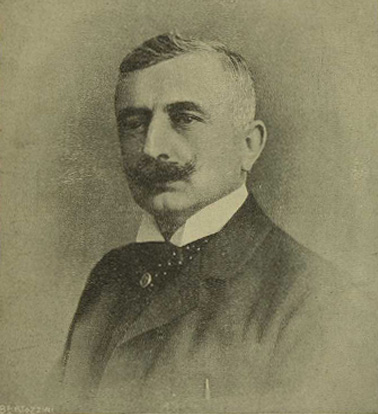
Alfredo Gandolfi
Alfredo Gandolfi

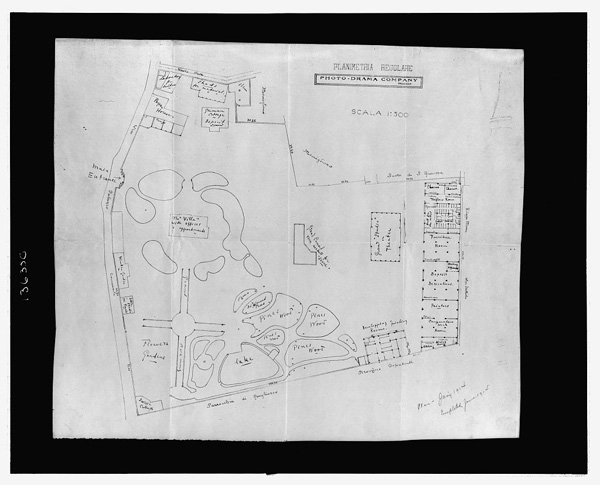
Torino, gennaio 1914. Sotto la valente direzione del cav. Alfredo Gandolfi la Photo Drama Film, va iniziandosi a passi giganteschi e nella prossima primavera aprirà i battenti. Quanto di meglio possono fornire le modernità applicabili alla cinematografia sono state introdotte nel nascente Stabilimento non solo dal lato tecnico bensì da quello richiesto dall’arte. Lo stabilimento sorge a pochi chilometri da Torino in quel di Grugliasco, avente un’area di 10 mila mq. di terreno con annessa pineta, villa, bosco, giardini, laghi ecc. Nell’interno vi saranno spaziosi uffici per la parte amministrativa e tecnica, sale elegantissime di ritrovo e di lettura per gli attori. Il cav. Alfredo Gandolfi, coadiuvato dal solerte sig. Cesare Gani, ha già scritturato parecchi buoni elementi dei quali faremo il nome a suo tempo.

Pianta della Photo Drama Film Company a Grugliasco, gennaio 1914 (Library of Congress)

Chicago, March 1914. The memoranda tells me that George Kleine returned to his desk in Chicago, Friday, February 13, which should dispose for all time any notion that Mr. Kleine is superstitious. He isn’t. Friday the 13th has no terrors for him. No trip abroad that he has made in many years has left so many pleasant memories in the wake of his return. I saw him for a few precious minutes across that flat-top desk nearest the door. Mr. Kleine rarely hides behind the larger roll-top that stands further back in his office. And what do you imagine was the most important of the things that concerned him while I was there? A bunch of photographs that he had taken himself!

Mr. Kleine has been engaged for years and years in handling other people’s negatives and now he has taken to his own precious camera and the things that go into it and get in front of it and are taken from it. He found opportunity to push his camera button hundreds of times during his last prolonged visit abroad and it was my privilege to see many of the beautiful photographs. These views took me around with him in his travels. They covered many points of interest in and out of doors, principally in Italy, but none had greater charm for me than those showing glimpses of the magnificent estate which Mr. Kleine purchased up the road from Turin. It lies out from the town nearly five miles and it will be the place where the Photo Drama Producing Company will make films — big productions. One immense building, 330×66 feet is already underway. It will accommodate the actor folk and their wardrobes and properties; shops; the kitchen and dining rooms and serve as a modern utility building for the tremendous studio that will be erected as soon as the plans can be approved. These buildings will differ from other similar institutions in that country. They will include heating and ventilating systems in accordance with the best American practice — something that will be entirely new, because heating and ventilation problems have never entered into Italian studios heretofore. Just why not is a matter of conjecture, because the temperature isn’t always conducive to one’s best effort. Mr. Kleine told me that he had seen the thermometer at twenty degrees and players in films must have suffered due to the extreme cold. All of this will be corrected in the Photo Drama Producing plant.

Signor A. Gandolfi, former business head of the Ambrosio Company, is in charge of the affairs at Turin, and will be director for the big films that will be made at this new plant. The site is admirable, occupying the vantage point in a ten acre plot of land surrounded by a high stone wall. It is Mr. Kleine’s belief that it is the finest location for studio purposes in all Italy. The grounds are nicely wooded and there is a small lake within the enclosure. I hope to show you some views of it within a short time.

Mr. Kleine left America in the latter days of last September and of course this idea of making big films in Italy occupied much of his time and attention. If you will remember, he took some stage celebrities with him and it is reasonable to suppose that he has been overwhelmed with applications of Americans for positions in his foreign stock company. Mr. Kleine is enthusiastic about the possibilities for high-class big productions. He will bend every energy to maintain the standard he has already established and it is reasonable to suppose that with these prospective facilities; a company of his own selection and an organization of famous producers and camera experts, that he will be able to excel those films that have already made for the excellence of his output. Mr. Kleine is one of those men who frowns upon the term “this business is in its infancy.” An industry that has taken fifth place in the rank of the world’s big business can hardly lay claim to the title of infant. He is also practically convinced that a dollar is a low maximum figure for the admission price to the motion picture for the larger attractions. He still believes that he will open his beautiful New York theater with a dollar as the high figure, but he already sees the possibility of this price going higher.

I would like to get into that great pile of photographs that he brought back, but it would be like renewing a glimpse at Baedecker. I am sure that Mr. Kleine found his greatest pleasure at Venice, but points like Florence and Pisa held much for him if we are to judge by the snaps brought back. Mr. Kleine never looked better or seemed to be more fit for a hard day’s grind than he is now. What is more his office door is open!

The Goat Man
(Motography, March 7 1914)

Édouard Pinto alias Teddy

Édouard Pinto, alias Teddy 1920

Édouard Pinto est né à Lisbonne le 14 janvier 1887, issu d’une famille de banquistes portugais. A huit ans, son frère aîné, Antonio dit Tonito, le fait monter avec lui sur la scène, sous le nom de Pif-Paf, et l’emmène en tournée, une tournée qui dure dix ans et promène dans tous les pays d’Europe, en Afrique et dans les deux Amériques.

La Dinastía, Barcelona 10 janvier 1904

En 1904, alors qu’il se trouvait à Barcelone avec son frère, Teddy fit la connaissance de Segundo de Chomón. Celui-ci commença par filmer en Espagne, une entrée: le clown est assis, lisant son journal, quand survient son compère qui enflamme les pages et finit par mettre le feu au chapeau du premier. Invité par Chomón à venir a travailler à Paris (une fois son service militaire dans l’armée portugaise terminé) dans les scènes à trucs qu’il réalisait alors pour la maison Pathé, il travaille è la fois pour le cinéma le jour et le soir au music-hall ou au cirque.

Après avoir terminé son engagement de dix-huit mois pour la maison Pathé, Teddy tourna pendant une année aux Films Lux, des scènes comiques telles que: Les Amis de M. Gaudillot, Teddy mange des grenouilles “et autres grosses bouffonneries”. En 1912, nous trouvons Teddy tournant por la Société Eclipse deux épisodes de la série Polycarpe: L’enlèvement de Polycarpe et Le cauchemar de Polycarpe. Ensuite Teddy devient son propre metteur en scène et, reprenant la série Teddy, tourne une courte série de films: Teddy a horreur de la fumée, Teddy est mécontent de sa cuisinière, La Guigne de Teddy.

Engagé à l’Eclair, parait dans Protéa II. On allait commencer Protéa III quand la guerre fut déclarée. Teddy s’engagea dans la Légion Etrangère, puis quand le Portugal entre en ligne, fut incorporé dans l’armée portugaise.

Après trois blessures (sans compter l’intoxication par les gaz), Teddy est réformé vers la fin de 1916 et songe à nouveau au cinéma. Revenu à l’Eclair, il tourne, sous la direction de Rémond le rôle du caporal Parisot dans le film tiré des Poilus de la 9e d’Arnould Galopin.

En 1917, c’est la continuation de la série Protéa avec Les Mystères du château de Malmont, où pour la première fois Teddy porte son fameux complet à carreaux. L’engagement de Teddy à l’Eclair est alors terminé.

C’est au Films D. H., sous la direction de Germaine Dulac, que nous trouvons Teddy en 1918:

“On me fait tourner deux films pour l’Amérique: Trois pantins pour une femme, où j’étais un cow-boy hardi, décoré, qui sauve l’héroïne; et le Bonheur des autres, où l’habitude que j’ai des sports m’a beaucoup servi. Le chat appartenant à ma fiancée lui échappe et s’enfuit sur le toit, au-dessus du troisième étage. Elle voudrait que quelqu’un allât le chercher. J’y vais. Je prends une échelle à glissière que j’appuie contre la façade et je grimpe jusqu’à la toiture. A la seconde même où je vais atteindre le but, la partie supérieure de l’échelle, mal attaché, glisse et va rejoindre le sol. J’ai juste le temps de m’agripper à la gouttière, je fais un rétablissement et me voici sur le toit. Je m’empare du fugitif, et, le tenant dans mon bras gauche replié, je m’apprête à descendre. J’y parviens de la façon suivante. Suspendu à la gouttière, j’écarte du mur, avec mes pieds, la persienne d’une fenêtre du troisième que l’on a forcément poussée contre le paroi pou éclairer la pièce. Lorsque la persienne se trouve à angle droit avec le mur, je m’y pose à califourchon, puis j’utilise les lattes comme autant d’échelons et j’arrive à saisir la barre d’appui. Une fois là, je recommence l’opération pour un volet du deuxième, et quand je suis au premier, je lâche la barre d’appui, je saute légèrement dans la rue et cours rapporter Minet à sa maîtresse inquiète.”

Ces deux films terminés, Teddy est à nouveau engagé par l’Eclair pour une durée de sept mois. C’est ainsi que de juillet 1919 à janvier 1920 il tourne, sous la direction de Gérard Bourgeois Le Fils de la Nuit: “La plupart des scènes de ce film ont été tournées en Algérie: à Biskra et dans les ruines de Timgad, à Alger. Mais c’est à San-Remi-de-Provence que l’on tourna une scène du cinquième épisode où Teddy fit une terrible chute. La passerelle qui devait céder sous son poids cède trop tôt. Teddy fit, avec son cheval, une chute de dix mètres et alla s’écraser au fond d’un ravis d’où on le tira en piteux état: épaule gauche ouverte, bras démis, poignet foulé, genou droit déboité. Teddy, après trois mois de soins, se sert encore avec une certain gêne de son bras gauche.”

Après de nouvelles et ultimes prouesses acrobatiques dans La Dette de sang (2 épisodes) de Gérard Bourgeois en 1923, Édouard Pinto n’apparaîtra plus à l’écran. Il se fera professeur de danses modernes…

Enfin une question: Que dites-vous, Édouard Pinto serait le protagoniste de ce film réalisé en 1904 par Segundo de Chomón?

Josette Andriot Parisian Fashion

Josette Andriot
Josette Andriot

New York, January 1914. One would hardly think it possible that, to choose a design, from the Maisons des Mesdames, Paquin, Chéruit, Agnes, or Callot, they would suggest going to the motion pictures, and you would express amazement at the idea if it were suggested to you, yet it is a fact that to-day such is the case. Even writers and some of our American dressmakers are following up this idea, since Paul Poiret gave his
exhibition of models in pictures.

During an exhibition recently of a Parisian Eclair photoplay entitled ”The Green God,” or “The Flower Girl of Montmartre,” which I had the pleasure of viewing, I was thoroughly astounded at the beauty of the French creations displayed in the production, and worn by the renowned star, Mlle. Josette Andriot. The costumes were perfect dreams, and, indeed, my thoughts were so carried away with the idea of being able to enjoy such a treat that the production itself seemed grander and more gorgeous than ever.

One would almost forget the photoplay trying to solve the mysterious secret of these beautiful models, and many a paper and pencil were to be noticed among the audience jotting down the various ideas and suggestions that appealed to them — and they
were many. The next time I go I shall positively be sure to have my little notebook and pencil with me, for it is impossible to remember all the little points of interest which present themselves, so helpful in new ideas as to what Paris is wearing.

The Eclair Film Company, a thoroughly French concern, that made this particular picture, is situated in the heart of Paris. Therefore much is to be expected from them in this respect.

Mlle. Josette Andriot, a dashing brunette, tall and stately, who is their leading actress, knows the fundamentals of smart dressing, and she expresses herself distinctly in three foremost qualities — individuality, personality, and self.

One particular gown worn by this beautiful actress in the production referred to I will describe, in order that you may realize my enthusiasm and join in it. Although extremely simple it was most charming and wellstyled, and, it goes without saying, distinctly French. A soft silver drapery suspended a silver banding, and giving the effect of an overwrap, was a novel feature of this costume. The skirt was of white satin draped high in the front, beneath a wide crossoxer girdle of the same material, and fell in graceful folds, forming a short pointed train. A single flower of velvet dropped from the waist-line. The decoration for her head-dress was a gorgeous bird of paradise.

All the brilliancy, yet glowing softness, of this toilette, was in charming contrast with a costume of dark velvet trimmed with ermine worn by a beautiful blonde in the same scene.

To appreciate beauty in its true form visit one of these delicious French productions, and gather the fruits of their beautiful ideas regarding “smart dressing.” You don’t have to go to Paris now for the advanced styles. They are brought right here to your own doorstep, saving you unlimited expense, time, anxiety, and a long journey.

Don’t throw away your opportunity. Easter is coming, and you know you want that one particular gown to be par excellence, so keep your eyes wide open and don’t miss the joy outstretched to you by the motion pictures. Should you feel doubtful, why not let your dressmaker, or seamstress, or modiste know, or take her with you next time when you see one of these beautiful creations, point it out, and tell her it is just what you want, and if she is a clever woman you will have that very gown yourself.

Agnes Egan Cobb
(Motion Picture News)