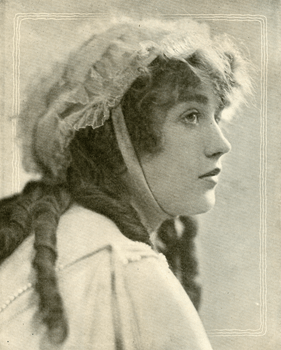
I am a movie fan and have watched with open-eyed astonishment some of the daring feats performed by the frail heroines of the pictures, longing to do some of the stunts myself, but hardly hoping to so literally live the part as I have since one.
From time to time I have written short stories. One of them I rewrote in scenario form and showed it to some of my friends. They thought it was so good that they asked for the privilege of submitting it to one of the producing managers. The result was that the film corporation to whom my scenario was submitted accepted the story and gave me a chance to really be in pictures.
Their offer to have me play the leading part of my own story, “Runaway Romany,” startled me. I had at various times thought it would be great fun to appear in a moving picture play, but when the opportunity came, I had real stage fright or something like it. The film people assuaged my fears; they were very kind and assured me that my story was really good and that they were offering me an exceptionally fine opportunity to be a regular star in the film world.
In the play I am supposed to be rescued from an ocean liner. The director chartered a boat, and we went up the Hudson River, and I was told to jump into the water. I demurred. The river looked so far away. It may have been only 15 feet – it looked 100. The director insisted. Then I jumped. I took, they tell me, a beautiful dive; but can you imagine my feelings upon being told that the camera man had missed it? He had waited so long for me to make up my mind to make the plunge that, when I finally went over the side, his good right arm was suffering from camera cramp. The dive had to be repeated.
One of the most amusing experiences was when we went out into Westchester Country to make my escape from the gypsy camp. The director picked out a nice, quiet railroad station north of Yonkers and prepared to film me escaping on a fast express, while the chief, my gypsy admirer and other members of the cast pursued in vain down the platform. With me were other members of the company, including Joseph Kilgour, Pedro De Cordova, Matt Moore and Ormi Hawley. We gathered on the platform of the Dunwoodie station. Timetables had been consulted and a ticket purchased for the hurried departure of Romany; but bestlaid plans “gang aft agley.” The plotters reckoned without the loyalty to duty of the Westchester constables. With unusual detective ability two minions of the law discovered that I was not a boy, in spite of my trousers. “There is a law against young women’s masquerading in men’s clothing,” they stated with importance. In vain did I protest that we were film folks and that as soon as the scene was taken I was going to leave Westchester County, anyway. It was all of no avail. There was nothing in the index of the constables’ “Guide to Duty” that indicated that an exception might be made in the case of a young girl who was merely playing at being a boy. The train came and went, and not a camera crank was turned.
Again was proved the magic of the pass good for two. Each constable was handed a slip of paper, entitling the bearer to two of the best seats at the opening performance on Broadway. For good measure the constables were permitted to be a part of the pursuing mob when the next train was finally allowed by war schedule to pass the Dunwoodie station.
Tlak about work. Anybody who has the idea that a movie player’s life is a merry one and nothing else is greatly mistaken. In one week I have acted on Long Island, in Connecticut, New Jersey and various parts of New York State from Manhattan to the Adirondacks. I lived in an automobile. My clothes consisted of a gypsy costume, a pair of pajamas and all sorts of things that actors of the speaking stage never wear in public. I celebrate the Fourth of July by doing a state ball in the grand ballroom of one of our best hotels, by filming scenes in the Pennsylvania Station, at Chelsea village rooming house and in a crowded East Sde street.
Playing the star of “Runaway Romany” was supposed to be my vacation, but it was one of the busiest and most exciting vacations I have ever experienced.
Marion Davies (from Film Fun, January 1918)

 sempre in penombra