Hearts of the World, May 1918

Lillian Gish and Robert Harron in a scene from D. W. Griffith's Hearts of the World
Lillian Gish and Robert Harron in a scene from D. W. Griffith’s Hearts of the World

44th Street Theatre – “Hearts of the World,” directed by D. W. Griffith. To quote the programme “Hearts of the World” is the story of a village, scenario by M. Gaston de Tolignac, translated into English by Captain Victor Marier and produced under the personal direction of D. W. Griffith. A great title “Hearts of the World” but hardly a great picture. To my mind, the one salient point lacking is theme. There is nothing about “Hearts of the World particularly worth remembering after leaving the theatre, except the remarkable histrionic ability of the Gish Sisters, Lillian and Dorothy, and the splendid performance of Robert Harron. True, Mr Griffith has portrayed village life in France before  the war, and during the war, with the fine exactitude that characterizes all of his work, but with it all, not forgetting some remarkable battle scenes, the big idea, so essential to a big picture isn’t here. “Hearts of the World” is a charming love story, but one has come to expect more than that from D. W. Griffith’s past performances. However, there is plenty of bang and to go the picture, and , and with the added attraction of an exceptionally capable cast, and flawless direction, the picture is well worth seeing, providing the weaker sex are not squeamish about seeing the truth about the war, depicted faithfully and unadulterated. To quote the programme again, the following synopsis gives a fairly accurate description of “Hearts of the World”:

Two American painters make their homes in France. Marie, the daughter of one painter, and Douglas Hamilton, the oldest son of the other live next door to each other. A natural event is the love between the two.

The Little Disturber, a strolling singer, falls in love with young Douglas also. However, this affair does not develop to any disastrous conclusion.

Marie and her lover are in the midst of great preparations for their coming wedding when the Great War begins. Though an American citizen he gives his life to the service of France.

Marie and her family, left at home in the village, refuse to believe the possibility of danger.

The little French company, a part of the great army of France, however, are beaten back by the great German offensive. Then follows the overwhelming of the French, the bombardment and destrucion of the village. The scenes of the evacuation and of the distress and terror of the villages under the bombardment.

The latter part of the story takes up the village under the German occupation.

In this village Marie and the Little Disturber manage to drag out an existence at the village inn, now in possession of the Huns.

The story relates the suffering, privations and agony of the villagers in their captivity, relating also the preparations for the rescue of the village by the French, the massing of their troops, the intense struggle of the French soldiers to recapture the village and free their loved ones; and the prayers and hopes of the women and children of the village awaiting their deliverance, ascend from cellar and crypt in the stricken district.

Mirilo (Theatre Magazine, May 1918)

Corso Cinema Teatro marzo 1918

La sala interna del Corso Cinema Teatro
La sala del Corso Cinema Teatro ai tempi del cinema muto

Si è inaugurato, con immenso concorso di pubblico, il nuovo Corso Cinema Teatro, dei F.lli Marino. L’interno del locale piace a tutti per la sua costruzione, per le linee e tinte semplici ed eleganti e per la bella distribuzione di luci e colori; ma la facciata è oggetto dei più aspri commenti. Ai più non piace, e la vorrebbero a terra; qualche altro – e sono in pochi – vede che non stona e può piacere.

Il locale si è inaugurato con Carnevalesca, della Cines, interprete la Borelli. Per quanto il film sia bene eseguito, il pubblico lo accolse con ostilità.

Da qualche settimana, il vecchio Corso Cinema Teatro è diventato un negozio di Louis Vuitton, la facciata è rimasta (quasi) intatta.

Dal Christus a Maria di Magdala, intervista con Fausto Salvatori

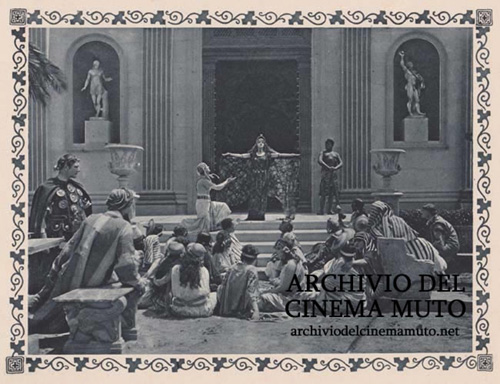
Maria di Magdala (1918)
Maria di Magdala (1919)

Mentre componevo il Christus dissi al barone Alberto Fassini, geniale direttore della Cines, la mia intenzione di compiere altre due rappresentazioni storiche affini, e cioè la Salomé e la Maria di Magdala. Ma, compiuto il Christus e raffigurata la Fabiola, io non pensavo ancora ad affrontare la nuova fatica, allorchè il marchese Capece Minutolo di Bugnano, che alle gravi preoccuazioni della politica unisce le cure più artisticamente illuminate per la direzione della Medusa Film, si rivolse a me, proponendomi il soggetto che io stesso già vagheggiavo. Egli sapeva che questo genere di studi e di rievocazioni era stato tra i miei preferiti, che mi ero ad esso sempre dedicato con l’intento di trasformare la visione biblica ed evangelica in una visione drammatica di sensibilità moderna, pure rispettando sempre i concetti e le forme dei testi; si credette quindi sicuro, il di Bugnano, che io avrei saputo e voluto accogliere la sua proposta.

Mi sono infatti accinto all’opera con vero entusiasmo, evocando le visioni di Egitto e di Palestina; memorie care che mi accompagnarono durante la composizione del Christus. In questa grata rievocazione è balzata dal mio sentimento la nuova visione evangelica ad un tratto; ed ho voluto costruirla come un mistero del ‘400, dove le varie scene erano sentite e rappresentate per mezzo della parola e per mezzo della musica, così qui ho voluto sentire e rappresentare per mezzo del gesto e dei grandi affreschi che improvvisamente sono vissuti nella mia mente, che io ho veduti con glo occhi dell’anima in una chiarezza abbacinante, e che mi propongo di far rivivere sopra lo schermo.

Nessuna storia poteva esser più intensamente umana, fra quelle narrate dagli Evangeli, di quella di Maria di Magdala. E’ la donna che dal peccato risorge verso la purificazione, è il dramma intimo di una vita che si risolve in una magnifica affermazione di sentimento  e di verità. Io intendo di rappresentare la cortigiana in quel periodo della vita sua che corre da quando per la prima volta ha incontrato il Cristo Redentore, fino alla sua morte; e per la sua morte intendo valermi di tutti i fattori che mi possano offrire le leggende medioevali e sopratutto la Leggenda dorata.